Mota-Rojas Daniel, Villanueva-García Dina, Solimano Alfonso, Muns Ramon, Ibarra-Ríos Daniel, Mota-Reyes Andrea
Neurophysiology, Behavior and Animal Welfare Assessment, Universidad Autónoma Metropolitana (UAM), Mexico City 04960, Mexico.
Division of Neonatology, National Institute of Health Hospital Infantil de México Federico Gómez, Mexico City 06720, Mexico.
Biomedicines. 2022 Feb 1;10(2):347. doi: 10.3390/biomedicines10020347.
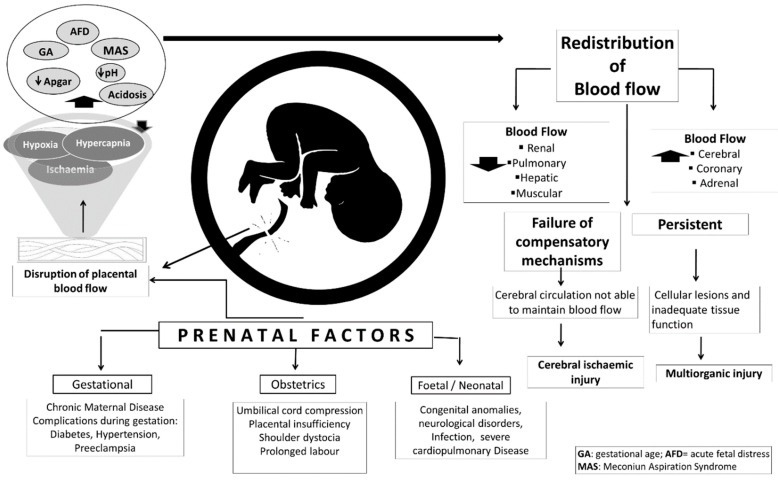
Perinatal asphyxia is caused by lack of oxygen delivery (hypoxia) to end organs due to an hypoxemic or ischemic insult occurring in temporal proximity to labor (peripartum) or delivery (intrapartum). Hypoxic-ischemic encephalopathy is the clinical manifestation of hypoxic injury to the brain and is usually graded as mild, moderate, or severe. The search for useful biomarkers to precisely predict the severity of lesions in perinatal asphyxia and hypoxic-ischemic encephalopathy (HIE) is a field of increasing interest. As pathophysiology is not fully comprehended, the gold standard for treatment remains an active area of research. Hypothermia has proven to be an effective neuroprotective strategy and has been implemented in clinical routine. Current studies are exploring various add-on therapies, including erythropoietin, xenon, topiramate, melatonin, and stem cells. This review aims to perform an updated integration of the pathophysiological processes after perinatal asphyxia in humans and animal models to allow us to answer some questions and provide an interim update on progress in this field.
围产期窒息是由于在临近分娩(围产期)或分娩(产时)时发生的低氧血症或缺血性损伤,导致终末器官氧输送不足(缺氧)所致。缺氧缺血性脑病是脑缺氧损伤的临床表现,通常分为轻度、中度或重度。寻找能够精确预测围产期窒息和缺氧缺血性脑病(HIE)病变严重程度的有用生物标志物是一个越来越受关注的领域。由于病理生理学尚未完全理解,治疗的金标准仍是一个活跃的研究领域。低温已被证明是一种有效的神经保护策略,并已应用于临床实践。目前的研究正在探索各种附加疗法,包括促红细胞生成素、氙气、托吡酯、褪黑素和干细胞。本综述旨在对人类和动物模型中围产期窒息后的病理生理过程进行更新整合,以便我们回答一些问题,并提供该领域进展的中期更新。