Triay Rachel, Buchhanolla Prabandh, Gaudet Alexas, Winter Victoria, Gaudet Alexandra, Faraji Mehdi, Gonzalez-Toledo Eduardo, Siddaiah Harish, Cuellar-Saenz Hugo H, Bailey Steven, Javalkar Vijayakumar, Riel-Romero Rosario Maria S, Kelley Roger E, Gavins Felicity N E, Ansari Junaid
LSU Health Shreveport School of Medicine, Louisiana State University Shreveport, Shreveport, LA 71103, USA.
Department of Neurology, Louisiana State University Health Sciences Center-Shreveport, Shreveport, LA 71103, USA.
Biomedicines. 2022 Feb 13;10(2):435. doi: 10.3390/biomedicines10020435.
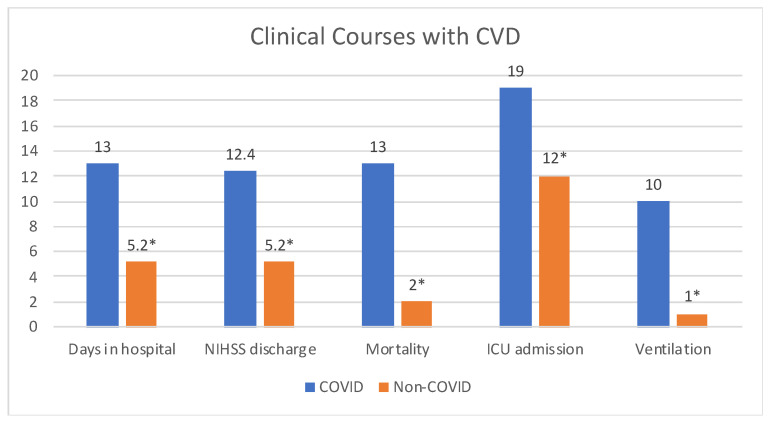
(1) Background: COVID-19 infection is responsible for the ongoing pandemic and acute cerebrovascular disease (CVD) has been observed in COVID-19 patients. (2) Methods: We conducted a retrospective, observational study of hospitalized adult patients admitted to our hospital with SARS-CoV-2 and acute cerebrovascular disease. All clinical data were reviewed including epidemiology, clinical features, laboratory data, neuroradiological findings, hospital management and course from 32 patients hospitalized for COVID-19 management with acute cerebrovascular disease. (3) Results: Acute CVD with COVID-19 was associated with higher NIH stroke scale on discharge compared to non-COVID-19 CVDs. Seizures complicated the hospital course in 16% of COVID-19 patients with CVD. The majority of the acute CVDs were ischemic (81%) in nature followed by hemorrhagic (22%). Acute CVD with COVID-19 resulted in average hospital stays greater than twice that of the control group (13 days in COVID-19, 5 days in control). Acute CVD with COVID-19 patients had worse clinical outcomes with 31% patient deaths and 6% discharged to hospice. In the control group, 6% of patients died. (4) Conclusions: Acute CVD associated with COVID-19 tends to be more complicated with unique and adverse clinical phenotype, longer hospital admissions, and worse clinical outcomes.
(1) 背景:新型冠状病毒肺炎(COVID-19)感染导致了当前的大流行,并且在COVID-19患者中已观察到急性脑血管疾病(CVD)。(2) 方法:我们对我院收治的患有严重急性呼吸综合征冠状病毒2(SARS-CoV-2)和急性脑血管疾病的成年住院患者进行了一项回顾性观察研究。回顾了所有临床数据,包括32例因COVID-19合并急性脑血管疾病住院治疗患者的流行病学、临床特征、实验室数据、神经放射学检查结果、医院管理及病程。(3) 结果:与非COVID-19相关的CVD相比,COVID-19相关的急性CVD出院时美国国立卫生研究院卒中量表评分更高。16%的COVID-19合并CVD患者在住院期间出现癫痫发作。大多数急性CVD本质上是缺血性的(81%),其次是出血性的(22%)。COVID-19相关的急性CVD导致平均住院时间比对照组延长一倍多(COVID-19组为13天,对照组为5天)。COVID-19合并急性CVD患者的临床结局更差,31%的患者死亡,6%的患者出院后进入临终关怀机构。在对照组中,6%的患者死亡。(4) 结论:与COVID-19相关的急性CVD往往更为复杂,具有独特的不良临床表型、更长的住院时间和更差的临床结局。