Acute Lung Injury Center of Excellence, Division of Pulmonary, Allergy, and Critical Care Medicine, Department of Medicine, University of Pittsburgh, Pittsburgh, Pennsylvania, United States of America.
Department of Immunology, University of Pittsburgh School of Medicine, Pittsburgh, Pennsylvania, United States of America.
PLoS Pathog. 2021 Sep 2;17(9):e1009850. doi: 10.1371/journal.ppat.1009850. eCollection 2021 Sep.
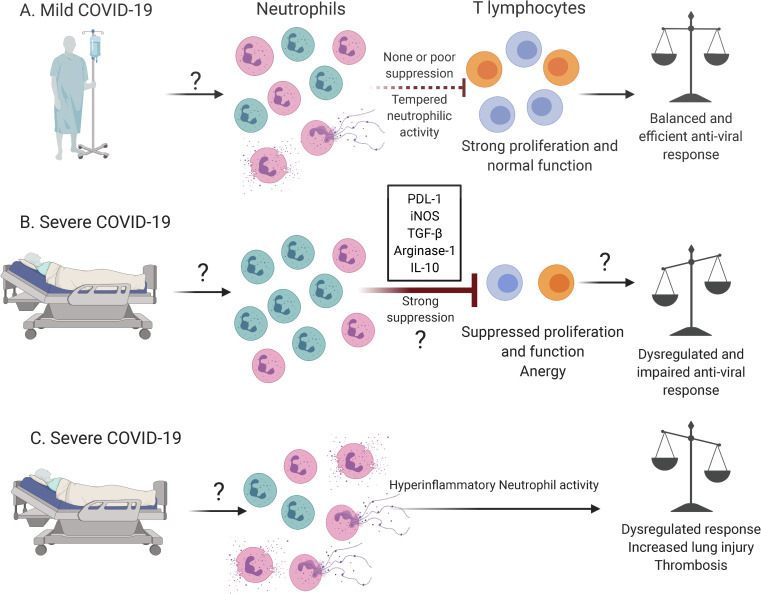
The Coronavirus Disease 2019 (COVID-19) is caused by the betacoronavirus Severe Acute Respiratory Syndrome Coronavirus 2 (SARS-CoV-2) virus that can mediate asymptomatic or fatal infections characterized by pneumonia, acute respiratory distress syndrome (ARDS), and multi-organ failure. Several studies have highlighted the importance of B and T lymphocytes, given that neutralizing antibodies and T cell responses are required for an effective immunity. In addition, other reports have described myeloid cells such as macrophages and monocytes play a major role in the immunity against SARS-CoV-2 as well as dysregulated pro-inflammatory signature that characterizes severe COVID-19. During COVID-19, neutrophils have been defined as a heterogeneous group of cells, functionally linked to severe inflammation and thrombosis triggered by degranulation and NETosis, but also to suppressive phenotypes. The physiological role of suppressive neutrophils during COVID-19 and their implications in severe disease have been poorly studied and is not well understood. Here, we discuss the current evidence regarding the role of neutrophils with suppressive properties such as granulocytic myeloid-derived suppressor cells (G-MDSCs) and their possible role in suppressing CD4+ and CD8+ T lymphocytes expansion and giving rise to lymphopenia in severe COVID-19 infection.
2019 年冠状病毒病(COVID-19)是由贝塔冠状病毒严重急性呼吸综合征冠状病毒 2(SARS-CoV-2)病毒引起的,可引起无症状或致命感染,其特征为肺炎、急性呼吸窘迫综合征(ARDS)和多器官衰竭。多项研究强调了 B 和 T 淋巴细胞的重要性,因为中和抗体和 T 细胞反应是有效免疫所必需的。此外,其他报告还描述了髓样细胞,如巨噬细胞和单核细胞,在对抗 SARS-CoV-2 的免疫以及特征为严重 COVID-19 的失调促炎特征中发挥主要作用。在 COVID-19 期间,中性粒细胞被定义为一组异质细胞,其功能与脱颗粒和 NETosis 引发的严重炎症和血栓形成有关,但也与抑制表型有关。在 COVID-19 期间,具有抑制特性的中性粒细胞的生理作用及其在严重疾病中的影响尚未得到充分研究,也未被很好地理解。在这里,我们讨论了关于具有抑制特性的中性粒细胞(如粒细胞髓样来源的抑制细胞(G-MDSC))的作用的现有证据,以及它们在抑制 CD4+和 CD8+T 淋巴细胞扩增并导致严重 COVID-19 感染中淋巴细胞减少方面的可能作用。