Molecular and Cellular Biology in Renal and Vascular Pathology, IIS-Fundación Jiménez Díaz, Universidad Autónoma Madrid, Av Reyes Católicos 2, 28040 Madrid, Spain.
Red de Investigación Renal (REDinREN), Av. de Monforte de Lemos, 5, 28029 Madrid, Spain.
Biomolecules. 2022 Feb 3;12(2):252. doi: 10.3390/biom12020252.
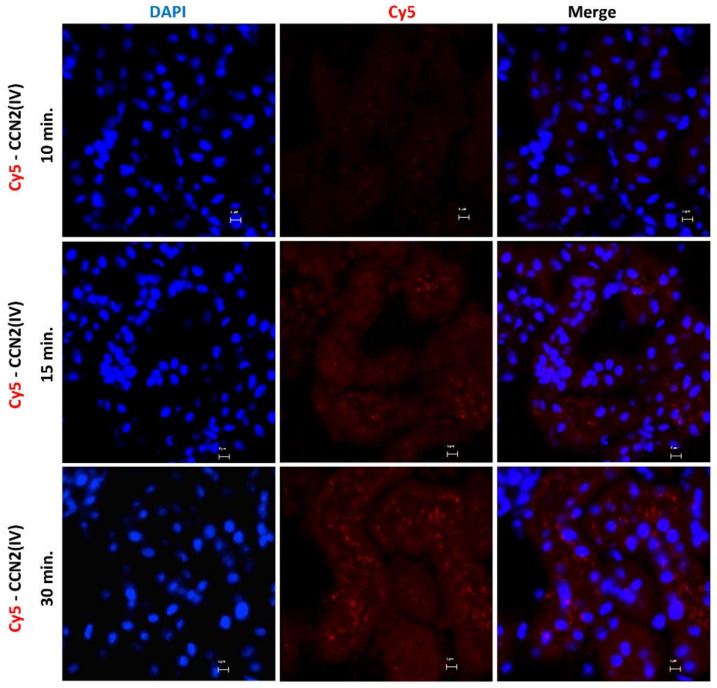
Cellular communication network-2 (CCN2), also called connective tissue growth factor (CTGF), is considered a fibrotic biomarker and has been suggested as a potential therapeutic target for kidney pathologies. CCN2 is a matricellular protein with four distinct structural modules that can exert a dual function as a matricellular protein and as a growth factor. Previous experiments using surface plasmon resonance and cultured renal cells have demonstrated that the C-terminal module of CCN2 (CCN2(IV)) interacts with the epidermal growth factor receptor (EGFR). Moreover, CCN2(IV) activates proinflammatory and profibrotic responses in the mouse kidney. The aim of this paper was to locate the in vivo cellular CCN2/EGFR binding sites in the kidney. To this aim, the C-terminal module CCN2(IV) was labeled with a fluorophore (Cy5), and two different administration routes were employed. Both intraperitoneal and direct intra-renal injection of Cy5-CCN2(IV) in mice demonstrated that CCN2(IV) preferentially binds to the tubular epithelial cells, while no signal was detected in glomeruli. Moreover, co-localization of Cy5-CCN2(IV) binding and activated EGFR was found in tubules. In cultured tubular epithelial cells, live-cell confocal microscopy experiments showed that EGFR gene silencing blocked Cy5-CCN2(IV) binding to tubuloepithelial cells. These data clearly show the existence of CCN2/EGFR binding sites in the kidney, mainly in tubular epithelial cells. In conclusion, these studies show that circulating CCN2(IV) can directly bind and activate tubular cells, supporting the role of CCN2 as a growth factor involved in kidney damage progression.
细胞通讯网络-2 (CCN2),也称为结缔组织生长因子 (CTGF),被认为是一种纤维化生物标志物,并被认为是肾脏病变的潜在治疗靶点。CCN2 是一种基质细胞蛋白,具有四个不同的结构模块,可发挥基质细胞蛋白和生长因子的双重功能。以前使用表面等离子体共振和培养的肾细胞的实验表明,CCN2 的 C 末端模块 (CCN2(IV)) 与表皮生长因子受体 (EGFR) 相互作用。此外,CCN2(IV) 在小鼠肾脏中激活促炎和促纤维化反应。本文的目的是定位体内肾脏中的 CCN2/EGFR 结合位点。为此,用荧光团 (Cy5) 标记 C 末端模块 CCN2(IV),并采用两种不同的给药途径。CCN2(IV) 的 Cy5 标记物经腹腔内和直接肾内注射入小鼠后,均表明 CCN2(IV) 优先与肾小管上皮细胞结合,而在肾小球中未检测到信号。此外,在肾小管中发现 Cy5-CCN2(IV) 结合和激活的 EGFR 共定位。在培养的肾小管上皮细胞中,活细胞共焦显微镜实验表明,EGFR 基因沉默阻断了 Cy5-CCN2(IV)与肾小管上皮细胞的结合。这些数据清楚地表明肾脏中存在 CCN2/EGFR 结合位点,主要位于肾小管上皮细胞中。总之,这些研究表明循环 CCN2(IV) 可以直接与肾小管细胞结合并激活它们,支持 CCN2 作为一种参与肾脏损伤进展的生长因子的作用。