Maté-Muñoz José Luis, Garnacho-Castaño Manuel Vicente, Hernández-Lougedo Juan, Maicas-Pérez Luis, Notario-Alonso Raúl, Da Silva-Grigoletto Marzo Edir, García-Fernández Pablo, Heredia-Elvar Juan Ramón
Department of Radiology, Rehabilitation and Physiotherapy, Complutense University of Madrid, 28040 Madrid, Spain.
Sant Joan de Déu Teaching Campus, 08034 Barcelona, Spain.
Biology (Basel). 2022 Feb 21;11(2):336. doi: 10.3390/biology11020336.
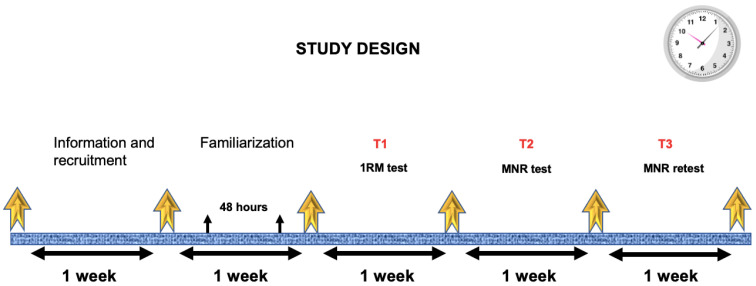
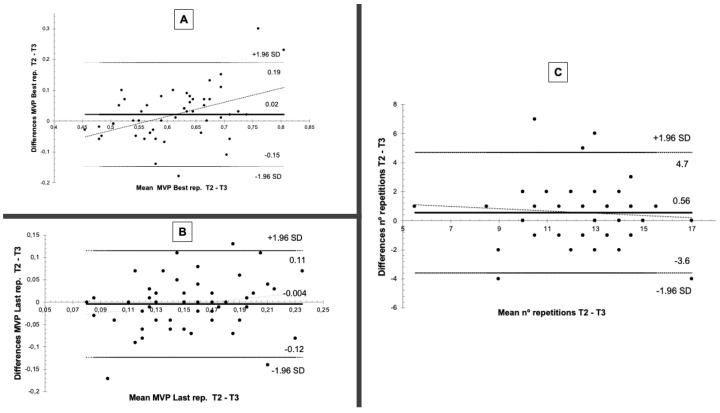
: The aim of the study was to analyze the use of variables such as % of one-repetition maximum (1RM) and number of maximal repetitions (xRM) with execution velocity to define and control the intensity of resistance training in bench press exercise. Hence, exercise professionals will achieve better control of training through a greater understanding of its variables. In this cross-sectional study, fifty male physical education students were divided into four groups according to their relative strength ratio (RSR) and performed a 1RM bench press test (T1). In the second test, participants performed repetitions to exhaustion (T2), using a relative load corresponding to 70% 1RM determined through the mean propulsive velocity (MPV) obtained from the individual load-velocity relationship. This same test was repeated a week later (T3). Tests were monitored according to the MPV of each repetition and blood lactate values (LACT). : Regarding MPV, the best (fastest) repetition of the set (MPVrep Best) values were similar between groups (0.62 m·s-0.64 m·s), with significant differences in relation to the high RSR group ( < 0.001). The average maximum number of repetitions (MNR) was 12.38 ± 2.51, with no significant differences between the RSR groups. Nonetheless, significant variation existed between groups with regards to MNR (CV: 13-29%), with greater variability in the group corresponding to the lowest RSR values (CV: 29%). The loss of velocity in the MNR test in the different groups was similar ( > 0.05). Average LACT values (5.72 mmol·L) showed significant differences between the Medium RSR and Very Low RSR groups. No significant differences were found ( > 0.05) between T2 and T3 with regards to MNR, MPVrep Best, or MPVrep Last, with little variability seen between participants. : The use of variables such as the 1RM, estimated using an absolute load value, or an MNR do not allow an adequate degree of precision to prescribe and control the relative intensity of resistance training. Besides, execution velocity control can offer an adequate alternative to guarantee an accurate prescription of intensity with regard to resistance training.
本研究的目的是分析诸如一次重复最大值百分比(1RM)和最大重复次数(xRM)等变量与执行速度在卧推练习中对定义和控制抗阻训练强度的作用。因此,运动专业人员通过更深入了解这些变量,将能更好地控制训练。在这项横断面研究中,50名男性体育专业学生根据其相对力量比率(RSR)被分为四组,并进行了一次重复最大值卧推测试(T1)。在第二次测试中,参与者以通过个体负荷 - 速度关系获得的平均推进速度(MPV)确定的相当于70% 1RM的相对负荷进行重复至力竭测试(T2)。一周后重复相同测试(T3)。测试根据每次重复的MPV和血乳酸值(LACT)进行监测。关于MPV,各组间每组最佳(最快)重复(MPVrep最佳)值相似(0.62 m·s - 0.64 m·s),与高RSR组相比有显著差异(<0.001)。平均最大重复次数(MNR)为12.38±2.51,RSR组间无显著差异。然而,各组间MNR存在显著差异(变异系数:13 - 29%),对应最低RSR值的组变异更大(变异系数:29%)。不同组在MNR测试中的速度损失相似(>0.05)。平均LACT值(5.72 mmol·L)在中等RSR组和极低RSR组间显示出显著差异。在MNR、MPVrep最佳或MPVrep末次方面,T2和T3之间未发现显著差异(>0.05),参与者间差异很小。使用诸如以绝对负荷值估算的1RM或MNR等变量,无法提供足够精确程度来规定和控制抗阻训练的相对强度。此外,执行速度控制可以提供一种合适的替代方法,以确保在抗阻训练中准确规定强度。