Exercise Research Laboratory, School of Physical Education, Physiotherapy and Dance, Universidade Federal do Rio Grande do Sul, Porto Alegre, RS, BRAZIL.
School of Exercise and Nutrition Sciences, Faculty of Health, Queensland University of Technology (QUT), Brisbane, Queensland, AUSTRALIA.
Med Sci Sports Exerc. 2021 Jun 1;53(6):1206-1216. doi: 10.1249/MSS.0000000000002585.
This study aimed to analyze the effect of resistance training (RT) performed until volitional failure with low, moderate, and high loads on muscle hypertrophy and muscle strength in healthy adults and to assess the possible participant-, design-, and training-related covariates that may affect the adaptations.
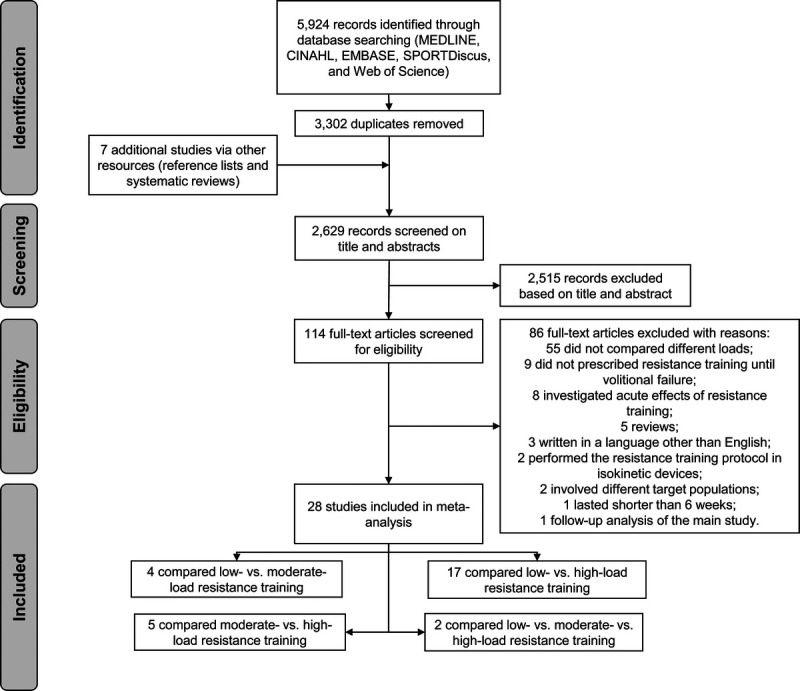
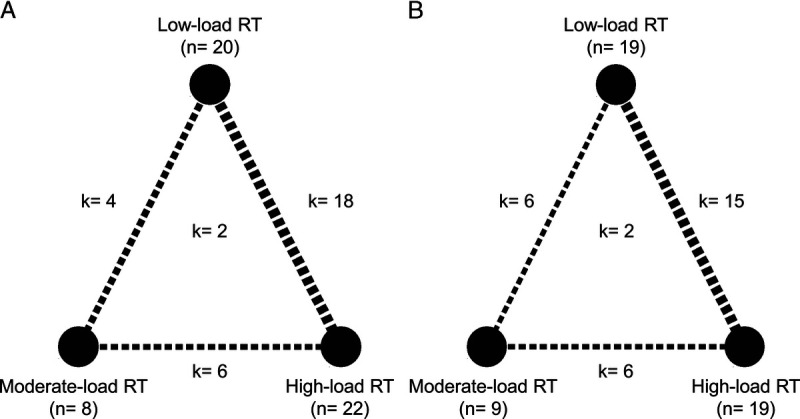
Using Preferred Reporting Items for Systematic Reviews and Meta-Analyses guidelines, MEDLINE, CINAHL, EMBASE, SPORTDiscus, and Web of Science databases were searched. Including only studies that performed sets to volitional failure, the effects of low- (>15 repetitions maximum (RM)), moderate- (9-15 RM), and high-load (≤8 RM) RTs were examined in healthy adults. Network meta-analysis was undertaken to calculate the standardized mean difference (SMD) between RT loads in overall and subgroup analyses involving studies deemed of high quality. Associations between participant-, design-, and training-related covariates with SMD were assessed by univariate and multivariate network meta-regression analyses.
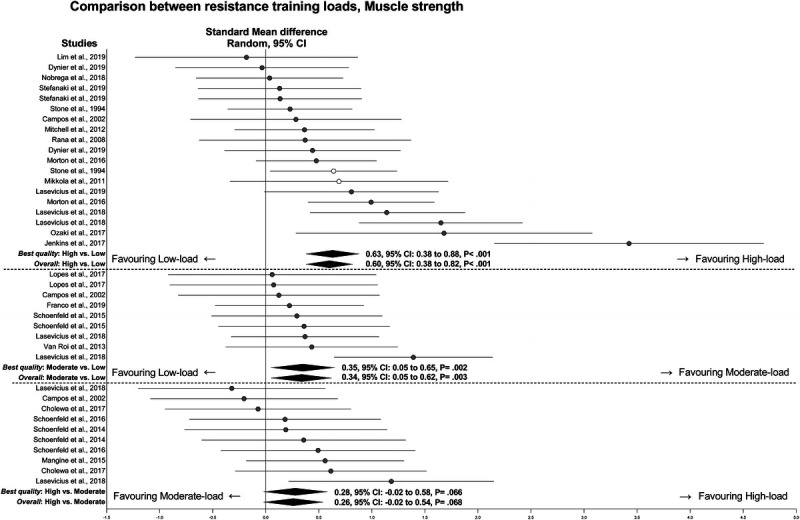
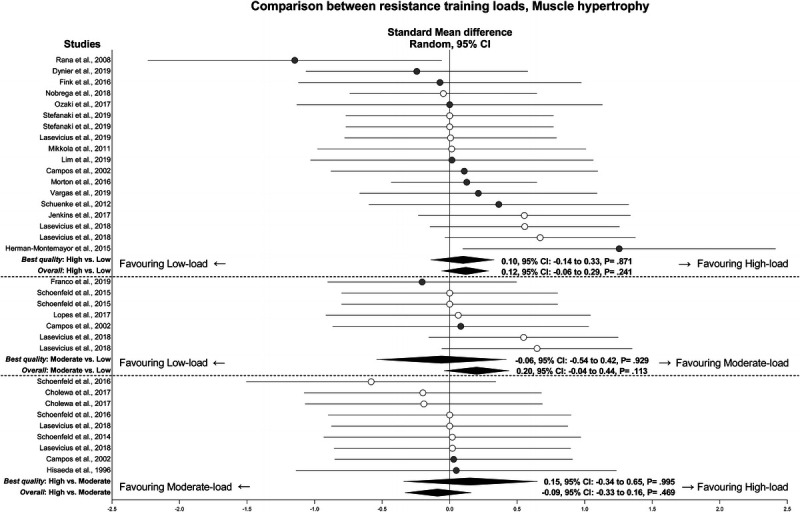
Twenty-eight studies involving 747 healthy adults were included. Although no differences in muscle hypertrophy between RT loads were found in overall (P = 0.113-0.469) or subgroup analysis (P = 0.871-0.995), greater effects were observed in untrained participants (P = 0.033) and participants with some training background who undertook more RT sessions (P = 0.031-0.045). Muscle strength improvement was superior for both high-load and moderate-load compared with low-load RT in overall and subgroup analysis (SMD, 0.60-0.63 and 0.34-0.35, respectively; P < 0.001-0.003), with a nonsignificant but superior effect for high compared with moderate load (SMD, 0.26-0.28, P = 0.068).
Although muscle hypertrophy improvements seem to be load independent, increases in muscle strength are superior in high-load RT programs. Untrained participants exhibit greater muscle hypertrophy, whereas undertaking more RT sessions provides superior gains in those with previous training experience.
本研究旨在分析低、中、高负荷的抗阻训练(RT)直至力竭对健康成年人肌肉肥大和肌肉力量的影响,并评估可能影响适应的参与者、设计和训练相关协变量。
使用系统评价和荟萃分析的首选报告项目指南,检索 MEDLINE、CINAHL、EMBASE、SPORTDiscus 和 Web of Science 数据库。仅纳入完成至力竭的重复次数(RM)的研究,在健康成年人中检查低(>15 RM)、中(9-15 RM)和高负荷(≤8 RM)RT 的效果。进行网络荟萃分析以计算 RT 负荷之间的标准化均数差(SMD),并在认为高质量的研究中进行总体和亚组分析。通过单变量和多变量网络荟萃回归分析评估参与者、设计和训练相关协变量与 SMD 的关联。
纳入了 28 项涉及 747 名健康成年人的研究。尽管在总体分析(P = 0.113-0.469)或亚组分析(P = 0.871-0.995)中,不同 RT 负荷之间的肌肉肥大没有差异,但在未接受训练的参与者(P = 0.033)和具有一定训练背景的参与者中,进行更多 RT 训练的参与者(P = 0.031-0.045)中观察到更大的效果。在总体和亚组分析中,高负荷和中负荷 RT 比低负荷 RT 更能改善肌肉力量(SMD,0.60-0.63 和 0.34-0.35;P < 0.001-0.003),高负荷比中负荷的效果更好(SMD,0.26-0.28,P = 0.068),但差异无统计学意义。
尽管肌肉肥大的改善似乎与负荷无关,但高负荷 RT 方案能更有效地增加肌肉力量。未接受训练的参与者表现出更大的肌肉肥大,而有先前训练经验的参与者进行更多的 RT 训练则能获得更好的收益。