Ben Arfi Kaouther, Schneider Christophe, Bennasroune Amar, Bouland Nicole, Wolak-Thierry Aurore, Collin Guillaume, Le Cuong Cao, Toussaint Kevin, Hachet Cathy, Lehrter Véronique, Dedieu Stéphane, Bouché Olivier, Morjani Hamid, Boulagnon-Rombi Camille, Appert-Collin Aline
Laboratoire de Biopathologie, Centre Hospitalier Universitaire de Reims, 51090 Reims, France.
UMR 7369, Matrice Extracellulaire et Dynamique Cellulaire (MEDyC), Université de Reims Champagne Ardenne (URCA), 51097 Reims, France.
Cancers (Basel). 2022 Feb 13;14(4):928. doi: 10.3390/cancers14040928.
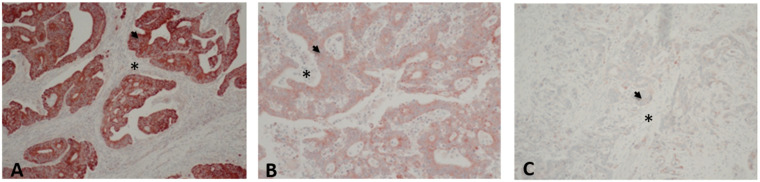
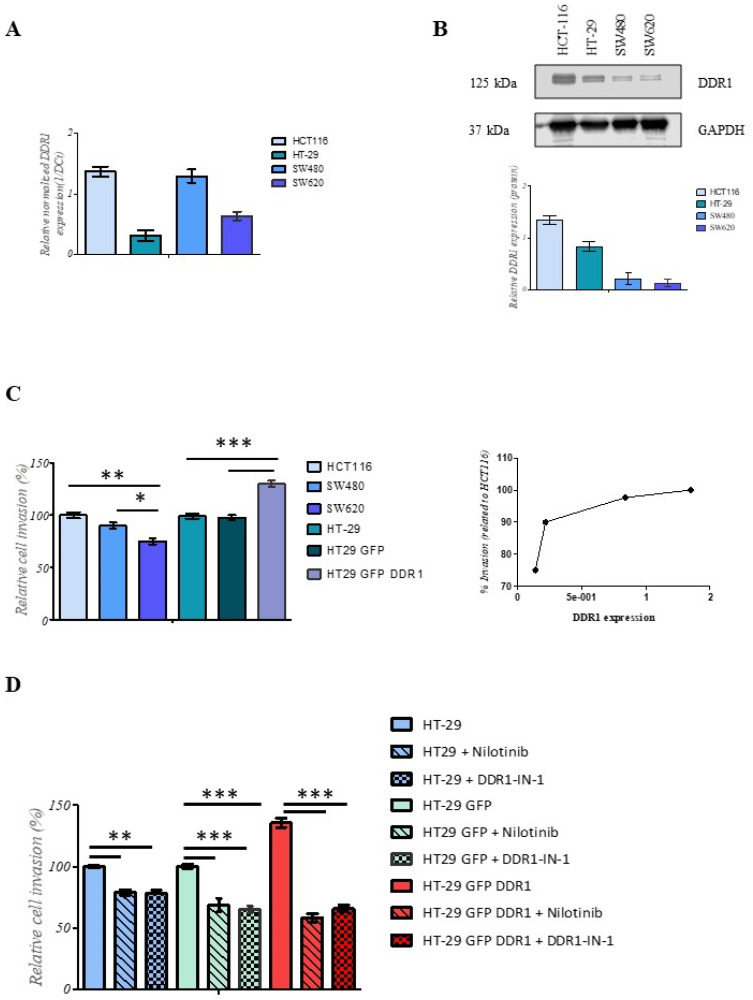
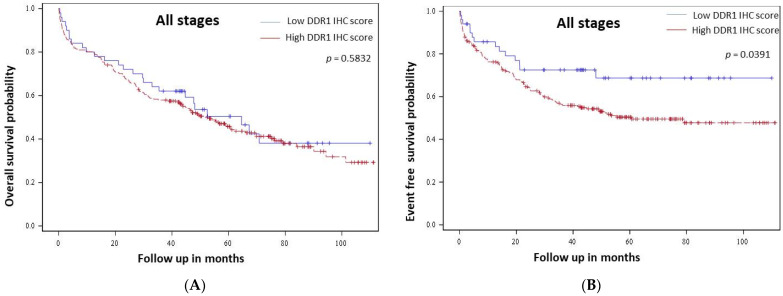
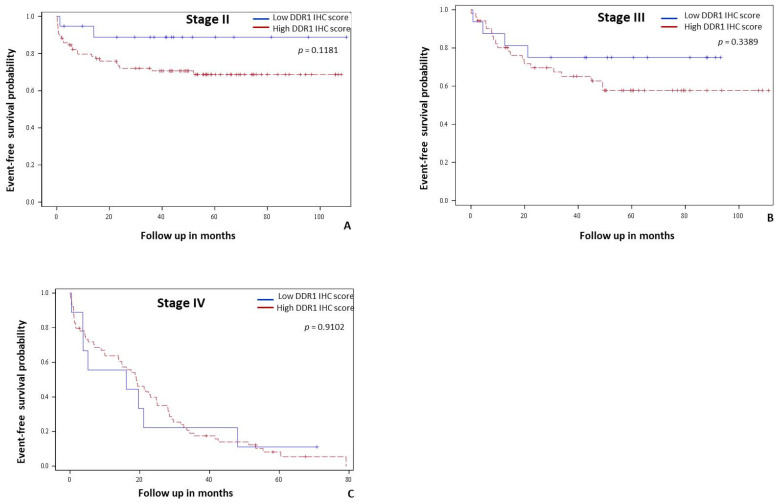
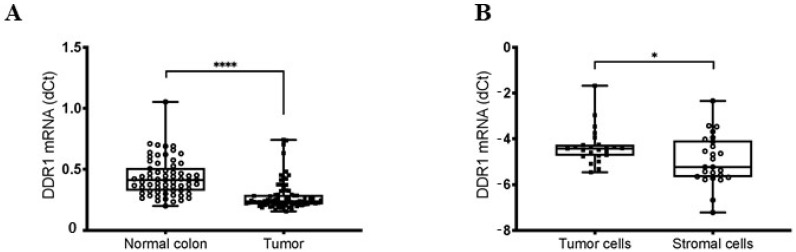
Extracellular matrix components such as collagens are deposited within the tumor microenvironment at primary and metastatic sites and are recognized to be critical during tumor progression and metastasis development. This study aimed to evaluate the clinical and prognostic impact of Discoidin Domain Receptor 1 (DDR1) expression in colon cancers and its association with a particular molecular and/or morphological profile and to evaluate its potential role as a prognosis biomarker. Immunohistochemical expression of DDR1 was evaluated on 292 colonic adenocarcinomas. DDR1 was highly expressed in 240 (82.2%) adenocarcinomas. High DDR1 immunostaining score was significantly associated, on univariate analysis, with male sex, left tumor location, wild type status, mutated status, and Annexin A10 negativity. High DDR1 immunohistochemical expression was associated with shorter event free survival only. Laser capture microdissection analyses revealed that DDR1 mRNA expression was mainly attributable to adenocarcinoma compared to stromal cells. The impact of DDR1 expression on cell invasion was then evaluated by modified Boyden chamber assay using cell types with distinct mutational profiles. The invasion capacity of colon adenocarcinoma is supported by DDR1 expression. Thus, our results showed that DDR1 was highly expressed in most colon adenocarcinomas and appears as an indicator of worse event free survival.
细胞外基质成分如胶原蛋白在原发性和转移部位的肿瘤微环境中沉积,并且在肿瘤进展和转移发生过程中被认为至关重要。本研究旨在评估盘状结构域受体1(DDR1)在结肠癌中的表达对临床和预后的影响及其与特定分子和/或形态学特征的关联,并评估其作为预后生物标志物的潜在作用。对292例结肠腺癌进行了DDR1的免疫组化表达评估。240例(82.2%)腺癌中DDR1呈高表达。单因素分析显示,DDR1免疫染色高分与男性、肿瘤位于左侧、野生型状态、突变状态及膜联蛋白A10阴性显著相关。DDR1高免疫组化表达仅与无事件生存期较短相关。激光捕获显微切割分析显示,与基质细胞相比,DDR1 mRNA表达主要归因于腺癌。然后使用具有不同突变特征的细胞类型,通过改良的Boyden小室试验评估DDR1表达对细胞侵袭的影响。DDR1表达支持结肠腺癌的侵袭能力。因此,我们的结果表明,DDR1在大多数结肠腺癌中高表达,并且似乎是无事件生存期较差的一个指标。