Yoo Jeong-Ju, Cho Eun Ju, Chung Goh Eun, Chang Young, Cho Yuri, Park Sang-Hyun, Jeong Su-Min, Kim Bo-Yeon, Shin Dong Wook, Kim Yun Joon, Yoon Jung-Hwan, Han Kyungdo, Yu Su Jong
Division of Gastroenterology and Hepatology, Department of Internal Medicine, Soonchunhyang University Bucheon Hospital, Bucheon 14584, Korea.
Department of Internal Medicine and Liver Research Institute, Seoul National University College of Medicine, Seoul 03080, Korea.
J Clin Med. 2022 Feb 11;11(4):935. doi: 10.3390/jcm11040935.
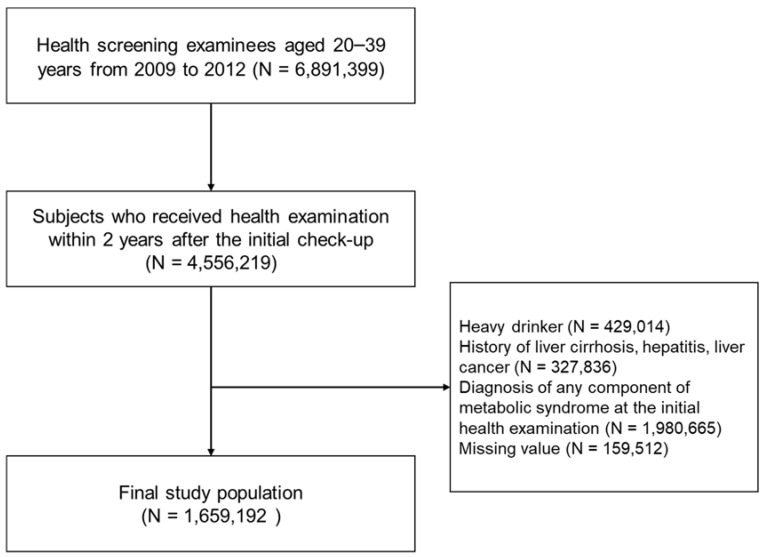
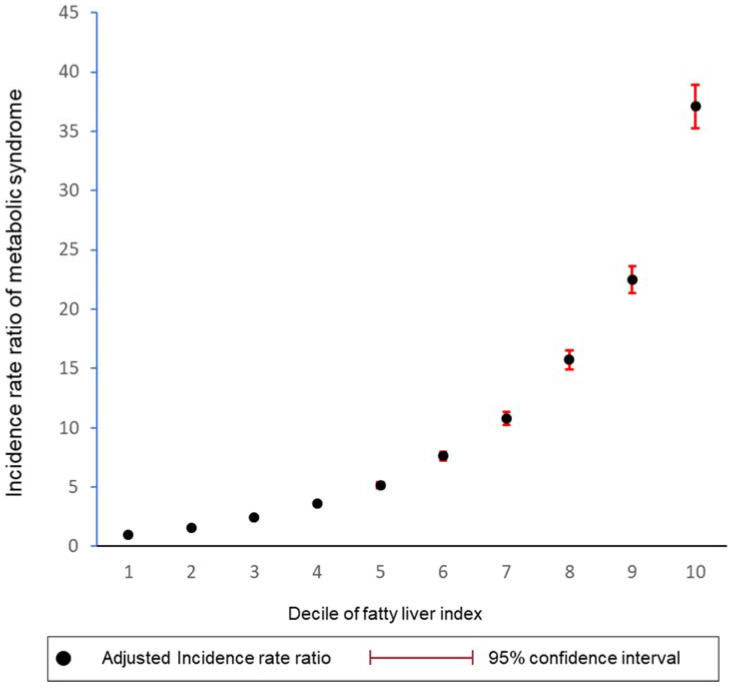
Nonalcoholic fatty liver disease (NAFLD) is associated with metabolic syndrome (MetS). However, the temporal relationship between NAFLD and MetS has yet to be evaluated, especially in young adults. In this study, we investigated whether NAFLD could be a precursor for MetS in metabolically healthy young adults. Using the Korean nationwide health screening database, we analyzed subjects aged 20-39 years who were free from any component of MetS between 2009 and 2012. A total of 1,659,192 subjects without excessive alcohol consumption or concomitant liver disease were categorized into three groups according to the fatty liver index (FLI): (1) NAFLD (FLI ≥ 60); (2) borderline NAFLD (30 ≤ FLI < 60); and (3) control (FLI < 30). During the 6,699,462 person-years of follow-up, 109,239 subjects developed MetS (16.3 per 1000-person-years). The NAFLD group and the borderline NAFLD group were associated with a higher risk of MetS than the control group (incidence rate ratios, 2.9 (95% confidence interval (CI), 2.7-3.1) for the NAFLD group and 2.1 (95% CI, 2.1-2.2) for the borderline NAFLD group, respectively). In addition, all of the metabolic components were positively associated with FLI in a proportional manner. NAFLD is associated with the future onset of MetS in young adults. Therefore, active lifestyle intervention is required for young adults diagnosed with NAFLD to prevent MetS and other metabolic diseases.
非酒精性脂肪性肝病(NAFLD)与代谢综合征(MetS)相关。然而,NAFLD与MetS之间的时间关系尚未得到评估,尤其是在年轻成年人中。在本研究中,我们调查了在代谢健康的年轻成年人中,NAFLD是否可能是MetS的前驱因素。利用韩国全国健康筛查数据库,我们分析了2009年至2012年间无MetS任何组分的20 - 39岁受试者。共有1,659,192名无过量饮酒或合并肝病的受试者根据脂肪肝指数(FLI)分为三组:(1)NAFLD(FLI≥60);(2)临界NAFLD(30≤FLI<60);(3)对照组(FLI<30)。在6,699,462人年的随访期间,109,239名受试者发生了MetS(每1000人年16.3例)。NAFLD组和临界NAFLD组发生MetS的风险高于对照组(发病率比,NAFLD组为2.9(95%置信区间(CI),2.7 - 3.1),临界NAFLD组为2.1(95%CI,2.1 - 2.2))。此外,所有代谢组分均与FLI呈正相关。NAFLD与年轻成年人未来发生MetS相关。因此,对于诊断为NAFLD的年轻成年人,需要积极的生活方式干预以预防MetS和其他代谢性疾病。