Khang Ah Reum, Lee Hye Won, Yi Dongwon, Kang Yang Ho, Son Seok Man
Division of Endocrinology and Metabolism, Department of Internal Medicine, Pusan National University Yangsan Hospital, Pusan National University School of Medicine, Yangsan, Republic of Korea,
Diabetes Metab Syndr Obes. 2019 Jan 24;12:181-190. doi: 10.2147/DMSO.S189544. eCollection 2019.
Nonalcoholic fatty liver disease (NAFLD) is the most common chronic liver disease worldwide, and it is the hepatic manifestation of metabolic syndrome (MetS). We aimed to estimate the prevalence of NAFLD defined by the fatty liver index (FLI), in order to investigate the association between FLI and metabolic disorders and to determine the cutoff value of FLI to screen for MetS.
This study utilized a national representative sample of Korean adults (the Korean National Health and Nutrition Examination Surveys) which was conducted in 2010-2011. A total of 10,107 adults aged 19 years or older were selected. NAFLD was diagnosed on the basis of an increased FLI (≥60) after the exclusion of alcohol or viral liver disease.
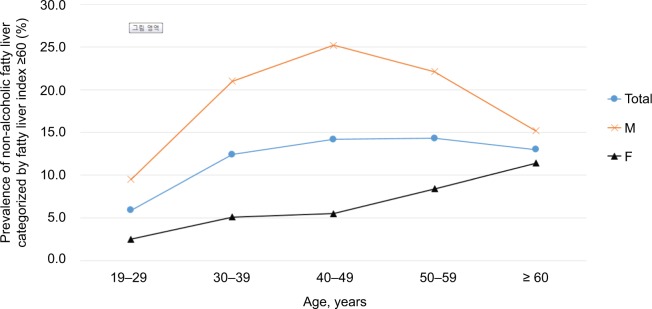
NAFLD was identified in 1,134 subjects (age-standardized prevalence, 10.0%). When subjects were categorized into three groups by FLI (<20, 20-59, and ≥60), the higher FLI group showed a higher prevalence of hypertension (49.7% vs 14.4%), diabetes mellitus (DM; 20.4% vs 3.8%), and MetS (74.9% vs 7.4%). FLI was positively associated with age, body mass index, blood pressure, hemoglobin A1c, and homeostasis model assessment of insulin resistance ( for trend <0.001). In the multivariate analysis, the higher FLI group had a significantly higher risk for hypertension (OR =2.92, 95% CI =2.18-3.90, <0.001), DM (OR =4.38, 95% CI =2.96-6.49, <0.001), and MetS (OR =24.85, 95% CI =17.33-35.64, <0.001). However, no increase was observed for cardiovascular disease after adjustment of other risk factors. The cutoff value of the FLI estimated to predict the presence of MetS was 20 (area under the curve 0.849, sensitivity 0.828, and negative predictive value 91.9%).
NAFLD prevalence using FLI is significantly higher in subjects with metabolic disorder including MetS. FLI might be a useful screening tool to detect subjects who may require early management of MetS and who have a high cardiovascular risk.
非酒精性脂肪性肝病(NAFLD)是全球最常见的慢性肝病,是代谢综合征(MetS)的肝脏表现。我们旨在评估由脂肪肝指数(FLI)定义的NAFLD患病率,以研究FLI与代谢紊乱之间的关联,并确定用于筛查MetS的FLI临界值。
本研究采用2010 - 2011年韩国成年人全国代表性样本(韩国国家健康与营养检查调查)。共选取10107名19岁及以上成年人。在排除酒精性或病毒性肝病后,根据FLI升高(≥60)诊断NAFLD。
1134名受试者被诊断为NAFLD(年龄标准化患病率为10.0%)。当根据FLI将受试者分为三组(<20、20 - 59和≥60)时,FLI越高的组高血压患病率越高(49.7%对14.4%)、糖尿病(DM;20.4%对3.8%)和MetS患病率越高(74.9%对7.4%)。FLI与年龄、体重指数、血压、糖化血红蛋白以及胰岛素抵抗的稳态模型评估呈正相关(趋势P<0.001)。在多变量分析中,FLI越高的组患高血压(OR = 2.92,95%CI = 2.18 - 3.90,P<0.001)、DM(OR = 4.38,95%CI = 2.96 - 6.49,P<0.001)和MetS(OR = 24.85,95%CI = 17.33 - 35.64,P<0.001)的风险显著更高。然而,在调整其他危险因素后,未观察到心血管疾病增加。估计预测MetS存在的FLI临界值为20(曲线下面积0.849,敏感性0.828,阴性预测值91.9%)。
使用FLI评估的NAFLD患病率在包括MetS在内的代谢紊乱受试者中显著更高。FLI可能是一种有用的筛查工具,用于检测可能需要早期管理MetS且心血管风险高的受试者。