Gutierrez Karina, Glanzner Werner G, de Macedo Mariana P, Rissi Vitor B, Dicks Naomi, Bohrer Rodrigo C, Baldassarre Hernan, Agellon Luis B, Bordignon Vilceu
Department of Animal Science, McGill University, Sainte-Anne-de-Bellevue, QC H9X 3V9, Canada.
Department of Agriculture, Biodiversity and Forests, Federal University of Santa Catarina, Curitibanos 89520-000, Brazil.
Life (Basel). 2022 Jan 25;12(2):171. doi: 10.3390/life12020171.
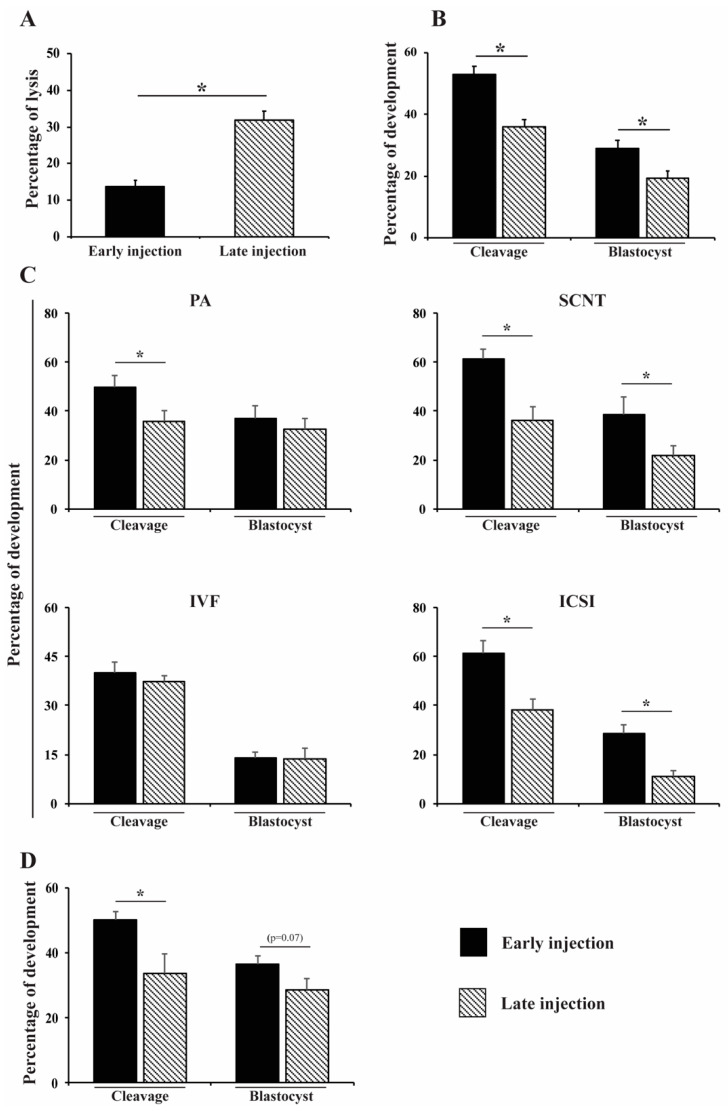
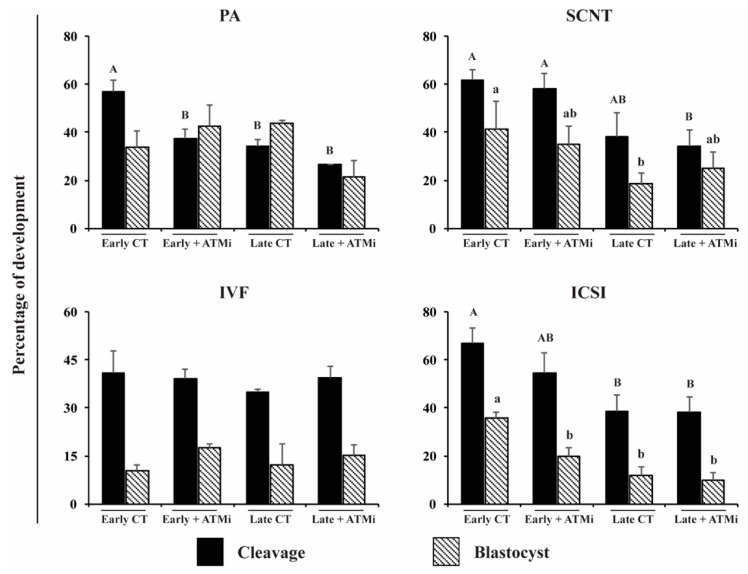
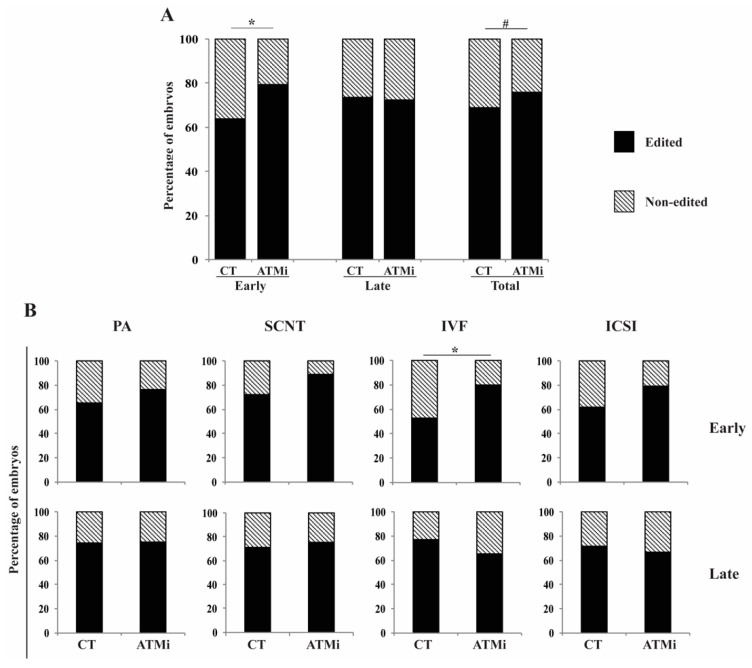
CRISPR/Cas9 technology is a powerful tool used for genome manipulation in different cell types and species. However, as with all new technologies, it still requires improvements. Different factors can affect CRISPR/Cas efficiency in zygotes, which influence the total cost and complexity for creating large-animal models for research. This study evaluated the importance of zygote cell cycle stage between early-injection (within 6 h post activation/fertilization) versus late-injection (14-16 h post activation/fertilization) when the CRISPR/Cas9 components were injected and the inhibition of the homologous recombination (HR) pathway of DNA repair on gene editing, embryo survival and development on embryos produced by fertilization, sperm injection, somatic cell nuclear transfer, and parthenogenetic activation technologies. Injections at the late cell cycle stage decreased embryo survival (measured as the proportion of unlysed embryos) and blastocyst formation (68.2%; 19.3%) compared to early-stage injection (86.3%; 28.8%). However, gene editing was higher in blastocysts from late-(73.8%) vs. early-(63.8%) injected zygotes. Inhibition of the HR repair pathway increased gene editing efficiency by 15.6% in blastocysts from early-injected zygotes without compromising embryo development. Our finding shows that injection at the early cell cycle stage along with HR inhibition improves both zygote viability and gene editing rate in pig blastocysts.
CRISPR/Cas9技术是一种用于在不同细胞类型和物种中进行基因组操作的强大工具。然而,与所有新技术一样,它仍需改进。不同因素会影响CRISPR/Cas在受精卵中的效率,这会影响创建用于研究的大型动物模型的总成本和复杂性。本研究评估了在注射CRISPR/Cas9组件时,早期注射(激活/受精后6小时内)与晚期注射(激活/受精后14 - 16小时)时受精卵细胞周期阶段的重要性,以及DNA修复的同源重组(HR)途径的抑制对受精、精子注射、体细胞核移植和孤雌激活技术产生的胚胎的基因编辑、胚胎存活和发育的影响。与早期注射(86.3%;28.8%)相比,在细胞周期晚期注射会降低胚胎存活率(以未裂解胚胎的比例衡量)和囊胚形成率(68.2%;19.3%)。然而,晚期(73.8%)注射的受精卵形成的囊胚中的基因编辑率高于早期(63.8%)注射的受精卵。抑制HR修复途径可使早期注射的受精卵形成的囊胚中的基因编辑效率提高15.6%,且不影响胚胎发育。我们的研究结果表明,在细胞周期早期注射并抑制HR可提高猪囊胚中受精卵的活力和基因编辑率。