Whitworth Kristin M, Benne Joshua A, Spate Lee D, Murphy Stephanie L, Samuel Melissa S, Murphy Clifton N, Richt Jürgen A, Walters Eric, Prather Randall S, Wells Kevin D
Division of Animal Sciences, University of Missouri, 920 East Campus Dr., E125D ASRC, Columbia, MO, 65211, USA.
National Swine Research and Resource Center, University of Missouri, 920 East Campus Dr., E125D ASRC, Columbia, MO, 65211, USA.
Transgenic Res. 2017 Feb;26(1):97-107. doi: 10.1007/s11248-016-9989-6. Epub 2016 Oct 15.
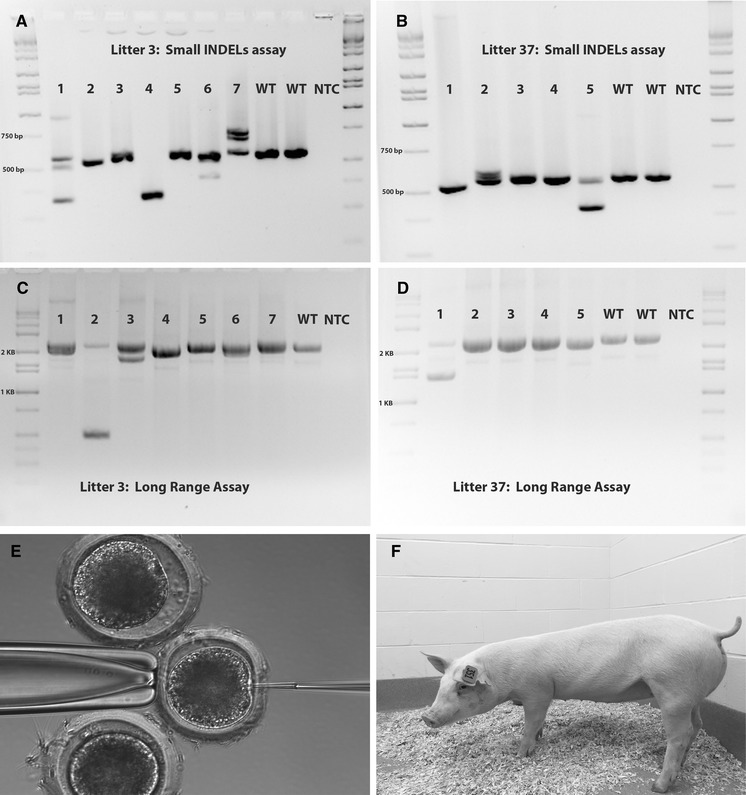
The CRISPR/Cas9 genome editing tool has increased the efficiency of creating genetically modified pigs for use as biomedical or agricultural models. The objectives were to determine if DNA editing resulted in a delay in development to the blastocyst stage or in a skewing of the sex ratio. Six DNA templates (gBlocks) that were designed to express guide RNAs that target the transmembrane protease, serine S1, member 2 (TMPRSS2) gene were in vitro transcribed. Pairs of CRISPR guide RNAs that flanked the start codon and polyadenylated Cas9 were co-injected into the cytoplasm of zygotes and cultured in vitro to the blastocyst stage. Blastocysts were collected as they formed on days 5, 6 or 7. PCR was performed to determine genotype and sex of each embryo. Separately, embryos were surgically transferred into recipient gilts on day 4 of estrus. The rate of blastocyst development was not significantly different between CRISPR injection embryos or the non-injected controls at day 5, 6 or 7 (p = 0.36, 0.09, 0.63, respectively). Injection of three CRISPR sets of guides resulted in a detectable INDEL in 92-100 % of the embryos analyzed. There was not a difference in the number of edits or sex ratio of male to female embryos when compared between days 5, 6 and 7 to the controls (p > 0.22, >0.85). There were 12 resulting piglets and all 12 had biallelic edits of TMRPSS2. Zygote injection with CRISPR/Cas9 continues to be a highly efficient tool to genetically modify pig embryos.
CRISPR/Cas9基因组编辑工具提高了培育用作生物医学或农业模型的转基因猪的效率。目的是确定DNA编辑是否会导致发育延迟到囊胚阶段或导致性别比例偏差。设计了六个DNA模板(gBlocks),用于体外转录靶向跨膜蛋白酶丝氨酸S1成员2(TMPRSS2)基因的引导RNA。将位于起始密码子两侧的CRISPR引导RNA对和聚腺苷酸化的Cas9共同注射到受精卵的细胞质中,并在体外培养至囊胚阶段。在第5、6或7天囊胚形成时收集囊胚。进行PCR以确定每个胚胎的基因型和性别。另外,在发情第4天通过手术将胚胎移植到受体后备母猪体内。在第5、6或7天,CRISPR注射胚胎与未注射的对照之间的囊胚发育率没有显著差异(p分别为0.36、0.09、0.63)。注射三组CRISPR引导序列导致在92%-100%的分析胚胎中检测到插入缺失。与对照组相比,在第5、6和7天之间,编辑数量或雄性与雌性胚胎的性别比例没有差异(p>0.22,>0.85)。共产生了12头仔猪,所有12头仔猪的TMRPSS2均有双等位基因编辑。用CRISPR/Cas9注射受精卵仍然是对猪胚胎进行基因改造的高效工具。