Parreira Pedro, Santos-Costa Paulo, Pardal João, Neves Teresa, Bernardes Rafael A, Serambeque Beatriz, Sousa Liliana B, Graveto João, Silén-Lipponen Marja, Korhonen Ulla, Koponen Leena, Myllymäki Mikko, Yurrebaso Macho Amaia, Mayens Alexander L Ward, Picado Valverde Eva Maria, Guzmán Ordaz Raquel, Juanes Méndez Juan Antonio, Iglesias Jose Luis Pérez, Canelo José Antonio Mirón, Jankowiak-Bernaciak Aleksandra, Patrzała Amelia, Bączyk Grażyna, Basa Anna, do Sacramento Costa Reis Alcinda Maria, Simões Joaquim Augusto, Torres Ana Luísa, do Rosário Pinto Maria, Salgueiro-Oliveira Anabela
The Health Sciences Research Unit: Nursing (UICISA: E), Nursing School of Coimbra (ESEnfC), 3004-011 Coimbra, Portugal.
Coimbra Institute for Clinical and Biomedical Research (iCBR) Area of Environment Genetics and Oncobiology (CIMAGO), University of Coimbra, 3000-548 Coimbra, Portugal.
J Pers Med. 2022 Jan 28;12(2):180. doi: 10.3390/jpm12020180.
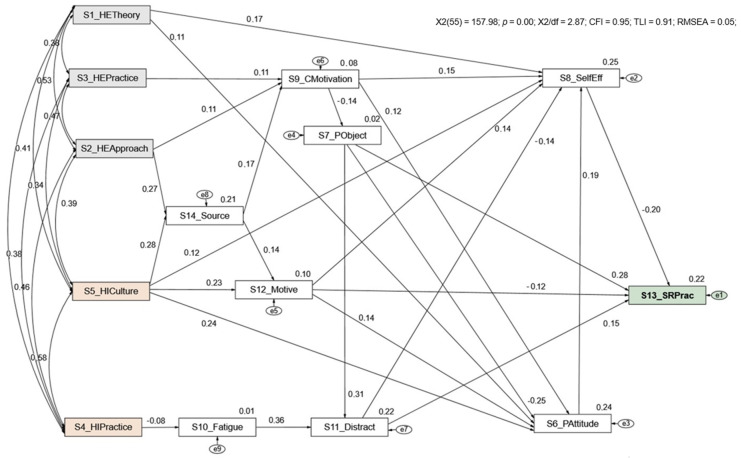
Healthcare-associated infections (HAI) are one of the major concerns worldwide, posing significant challenges to healthcare professionals' education and training. This study intended to measure nursing students' perceptions regarding their learning experiences on HAI prevention and control. In the first phase of the study, a cross-sectional and descriptive study with a convenience sample composed of undergraduate nursing students from Portugal, Spain, Poland, and Finland was conducted to develop the InovSafeCare questionnaire. In the second phase, we applied the InovSafeCare scale in a sample of nursing students from two Portuguese higher education institutions to explore which factors impact nursing students' adherence to HAI prevention and control measures in clinical settings. In phase one, the InovSafeCare questionnaire was applied to 1326 students internationally, with the instrument presenting adequate psychometric qualities with reliability results in 14 dimensions. During phase two, the findings supported that Portuguese nursing students' adherence to HAI prevention and control measures is influenced not only by the curricular offerings and resources available in academic settings, but also by the standards conveyed by nursing tutors during clinical placements. Our findings support the need for a dedicated curricular focus on HAI prevention and control learning, not only through specific classroom modules, innovative resources, and pedagogical approaches, but also through a complementary and coordinated liaison between teachers and tutors in academic and clinical settings.
医疗保健相关感染(HAI)是全球主要关注的问题之一,给医疗保健专业人员的教育和培训带来了重大挑战。本研究旨在衡量护理专业学生对其在HAI预防与控制方面学习经历的看法。在研究的第一阶段,开展了一项横断面描述性研究,采用便利抽样法,样本由来自葡萄牙、西班牙、波兰和芬兰的本科护理专业学生组成,以编制InovSafeCare问卷。在第二阶段,我们将InovSafeCare量表应用于来自葡萄牙两所高等教育机构的护理专业学生样本,以探究哪些因素会影响护理专业学生在临床环境中对HAI预防与控制措施的遵守情况。在第一阶段,InovSafeCare问卷在全球范围内应用于1326名学生,该工具呈现出足够的心理测量学质量,在14个维度上有可靠性结果。在第二阶段,研究结果支持这样的观点,即葡萄牙护理专业学生对HAI预防与控制措施的遵守不仅受到学术环境中的课程设置和可用资源的影响,还受到临床实习期间护理导师所传达标准的影响。我们的研究结果支持需要专门在课程中关注HAI预防与控制学习,不仅要通过特定的课堂模块、创新资源和教学方法,还要通过教师与导师在学术和临床环境中的互补与协调联络。