Moos Martin, Korbelová Jaroslava, Štětina Tomáš, Opekar Stanislav, Šimek Petr, Grgac Robert, Koštál Vladimír
Institute of Entomology, Biology Centre, Czech Academy of Sciences, Branišovská 31, 370 05 České Budějovice, Czech Republic.
Faculty of Science, University of South Bohemia, 370 05 České Budějovice, Czech Republic.
Metabolites. 2022 Feb 9;12(2):163. doi: 10.3390/metabo12020163.
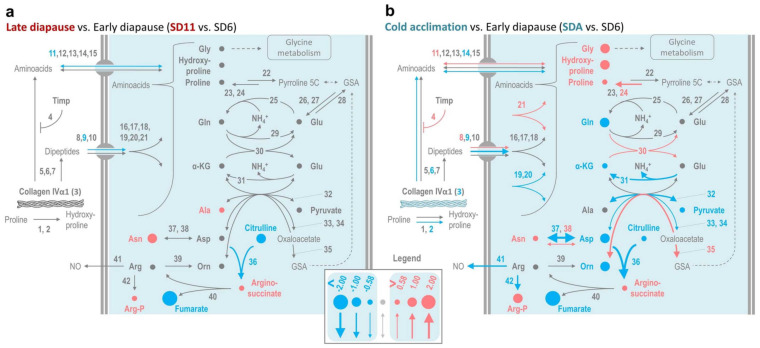
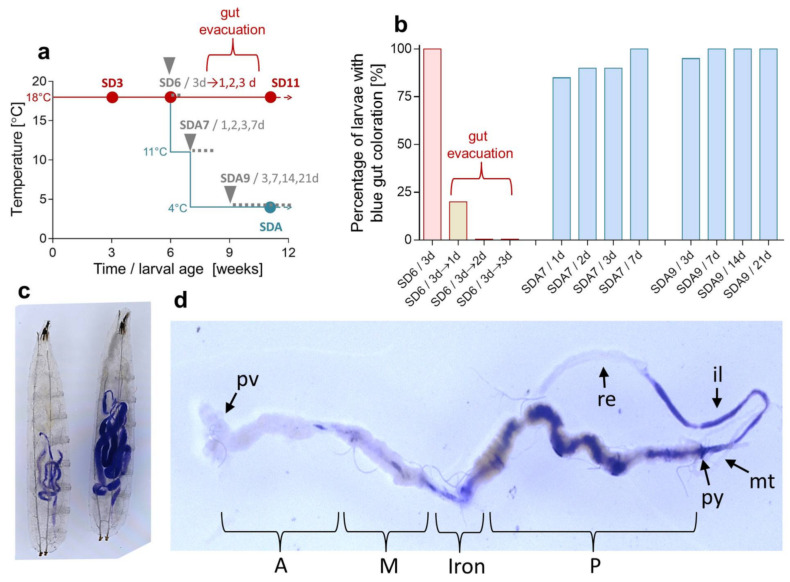
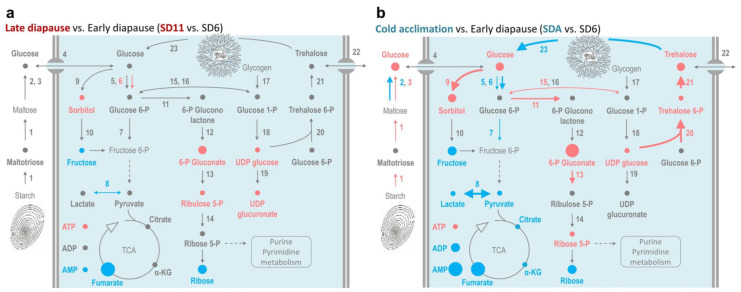
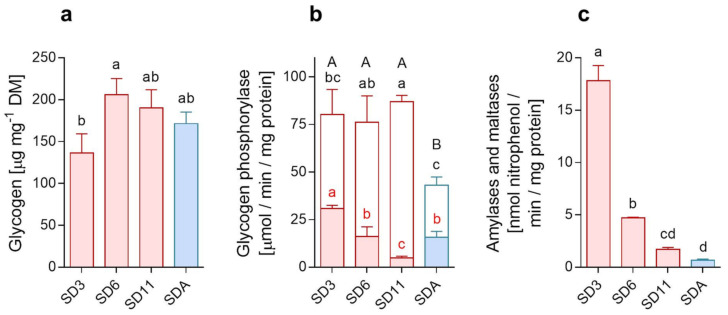
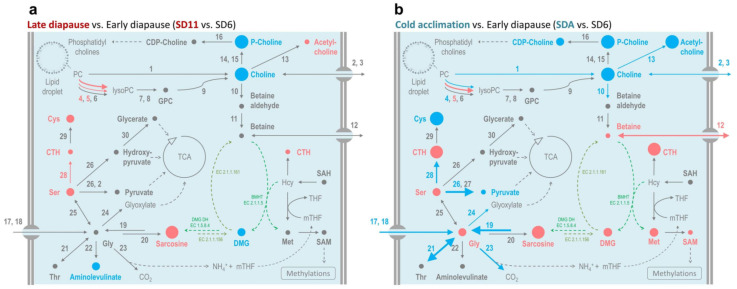
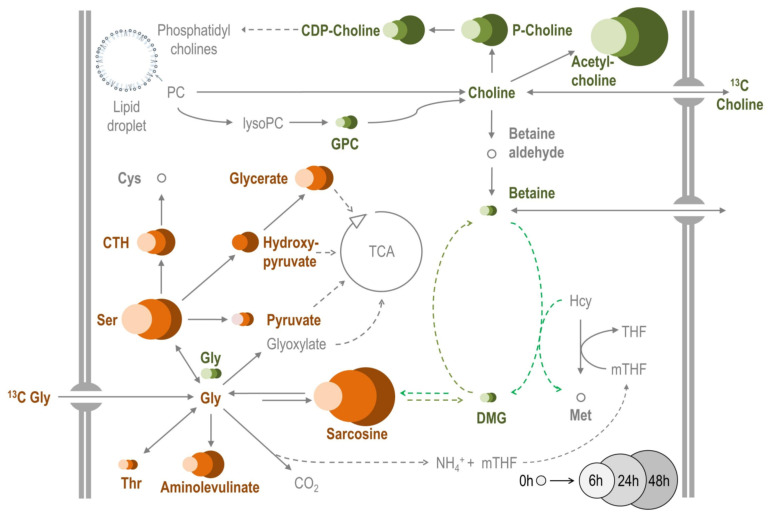
Many cold-acclimated insects accumulate high concentrations of low molecular weight cryoprotectants (CPs) in order to tolerate low subzero temperatures or internal freezing. The sources from which carbon skeletons for CP biosynthesis are driven, and the metabolic reprogramming linked to cold acclimation, are not sufficiently understood. Here we aim to resolve the metabolism of putative CPs by mapping relative changes in concentration of 56 metabolites and expression of 95 relevant genes as larvae of the drosophilid fly, transition from a freeze sensitive to a freeze tolerant phenotype during gradual cold acclimation. We found that larvae may directly assimilate amino acids proline and glutamate from diet to acquire at least half of their large proline stocks (up to 55 µg per average 2 mg larva). Metabolic conversion of internal glutamine reserves that build up in early diapause may explain the second half of proline accumulation, while the metabolic conversion of ornithine and the degradation of larval collagens and other proteins might be two additional minor sources. Next, we confirm that glycogen reserves represent the major source of glucose units for trehalose synthesis and accumulation (up to 27 µg per larva), while the diet may serve as an additional source. Finally, we suggest that interconversions of phospholipids may release accumulated glycero-phosphocholine (GPC) and -ethanolamine (GPE). Choline is a source of accumulated methylamines: glycine-betaine and sarcosine. The sum of methylamines together with GPE and GPC represents approximately 2 µg per larva. In conclusion, we found that food ingestion may be an important source of carbon skeletons for direct assimilation of, and/or metabolic conversions to, CPs in a diapausing and cold-acclimated insect. So far, the cold-acclimation- linked accumulation of CPs in insects was considered to be sourced mainly from internal macromolecular reserves.
许多适应寒冷的昆虫会积累高浓度的低分子量抗冻剂(CPs),以便耐受零下低温或体内结冰。目前对于CP生物合成的碳骨架来源以及与冷驯化相关的代谢重编程尚未有充分了解。在此,我们旨在通过绘制56种代谢物浓度的相对变化以及95个相关基因的表达情况,来解析果蝇幼虫在逐渐冷驯化过程中从对冷冻敏感表型转变为耐冷冻表型时假定CPs的代谢情况。我们发现,幼虫可能直接从食物中吸收氨基酸脯氨酸和谷氨酸,以获取其至少一半的大量脯氨酸储备(平均每2毫克幼虫高达55微克)。滞育早期积累的体内谷氨酰胺储备的代谢转化可能解释了脯氨酸积累的另一半,而鸟氨酸的代谢转化以及幼虫胶原蛋白和其他蛋白质的降解可能是另外两个次要来源。接下来,我们证实糖原储备是海藻糖合成和积累的主要葡萄糖单位来源(每只幼虫高达27微克),而食物也可作为额外来源。最后,我们认为磷脂的相互转化可能会释放积累的甘油磷酸胆碱(GPC)和甘油磷酸乙醇胺(GPE)。胆碱是积累的甲胺类物质(甘氨酸甜菜碱和肌氨酸)的来源。甲胺类物质与GPE和GPC的总量约为每只幼虫2微克。总之,我们发现食物摄入可能是滞育和冷驯化昆虫中CPs直接同化和/或代谢转化的碳骨架的重要来源。到目前为止,昆虫中与冷驯化相关的CPs积累被认为主要来自内部大分子储备。