Department of Neurobiology, Care Sciences and Society, Division of Neurogeriatrics, Center for Alzheimer Research, Karolinska Institutet, Stockholm, Sweden.
Biodonostia Health Research Institute, Neuroscience Area, 20014, Donostia-San Sebastián, Gipuzkoa, Spain.
Alzheimers Res Ther. 2022 Feb 24;14(1):37. doi: 10.1186/s13195-022-00979-9.
Thioredoxin-80 (Trx80) is a cleavage product from the redox-active protein Thioredoxin-1 and has been previously described as a pro-inflammatory cytokine secreted by immune cells. Previous studies in our group reported that Trx80 levels are depleted in Alzheimer's disease (AD) brains. However, no studies so far have investigated peripheral Trx80 levels in the context of AD pathology and whether could be associated with the main known AD risk factors and biomarkers.
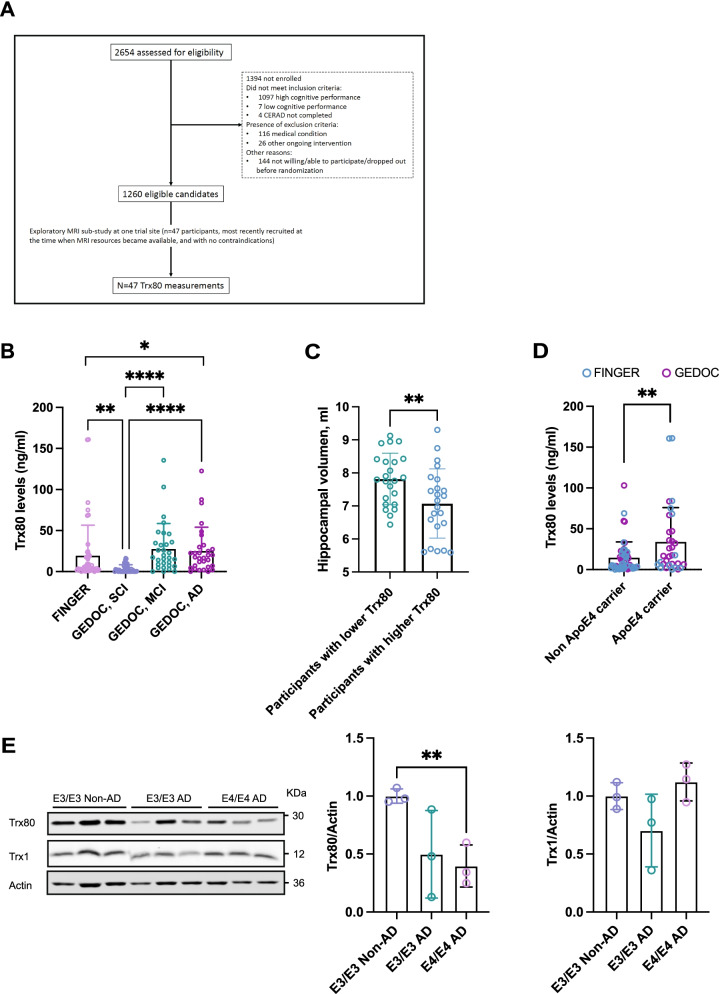
Trx80 was measured in serum samples from participants from two different cohorts: the observational memory clinic biobank (GEDOC) (N = 99) with AD CSF biomarker data was available and the population-based lifestyle multidomain intervention trial Finnish Geriatric Intervention Study to Prevent Cognitive Impairment and Disability (FINGER) (N = 47), with neuroimaging data and blood markers of inflammation available. The GEDOC cohort consists of participants diagnosed with subjective cognitive impairment (SCI), mild cognitive impairment (MCI), and AD, whereas the FINGER participants are older adults at-risk of dementia, but without substantial cognitive impairment. One-way ANOVA and multiple comparison tests were used to assess the levels of Trx80 between groups. Linear regression models were used to explore associations of Trx80 with cognition, AD CSF biomarkers (Aβ42, t-tau, p-tau and p-tau/t-tau ratio), inflammatory cytokines, and neuroimaging markers.
In the GEDOC cohort, Trx80 was associated to p-tau/t-tau ratio in the MCI group. In the FINGER cohort, serum Trx80 levels correlated with lower hippocampal volume and higher pro-inflammatory cytokine levels. In both GEDOC and FINGER cohorts, ApoE4 carriers had significantly higher serum Trx80 levels compared to non-ApoE4 carriers. However, Trx80 levels in the brain were further decreased in AD patients with ApoE4 genotype.
We report that serum Trx80 levels are associated to AD disease stage as well as to several risk factors for AD such as age and ApoE4 genotype, which suggests that Trx80 could have potential as serum AD biomarker. Increased serum Trx80 and decreased brain Trx80 levels was particularly seen in ApoE4 carriers. Whether this could contribute to the mechanism by which ApoE4 show increased vulnerability to develop AD would need to be further investigated.
ClinicalTrials.gov NCT01041989 . Registered on 4 January 2010-retrospectively registered.
硫氧还蛋白-80(Trx80)是一种来自氧化还原活性蛋白硫氧还蛋白-1 的裂解产物,先前被描述为免疫细胞分泌的促炎细胞因子。我们小组的先前研究报告称,阿尔茨海默病(AD)大脑中 Trx80 水平耗竭。然而,迄今为止,尚无研究调查 AD 病理学中周围 Trx80 水平,以及是否与主要已知的 AD 风险因素和生物标志物相关。
从两个不同队列的参与者的血清样本中测量了 Trx80:有 AD 脑脊液生物标志物数据的观察性记忆诊所生物库(GEDOC)(N=99)和基于人群的生活方式多领域干预试验芬兰老年干预研究以预防认知障碍和残疾(FINGER)(N=47),具有神经影像学数据和炎症标志物。GEDOC 队列包括被诊断为主观认知障碍(SCI),轻度认知障碍(MCI)和 AD 的参与者,而 FINGER 参与者是有痴呆风险的老年人,但没有明显的认知障碍。使用单向方差分析和多重比较检验来评估各组之间 Trx80 的水平。线性回归模型用于探索 Trx80 与认知,AD 脑脊液生物标志物(Aβ42,t-tau,p-tau 和 p-tau/t-tau 比值),炎症细胞因子和神经影像学标志物的关联。
在 GEDOC 队列中,MCI 组中 Trx80 与 p-tau/t-tau 比值相关。在 FINGER 队列中,血清 Trx80 水平与海马体积较小和促炎细胞因子水平较高相关。在 GEDOC 和 FINGER 队列中,ApoE4 携带者的血清 Trx80 水平明显高于非 ApoE4 携带者。但是,具有 ApoE4 基因型的 AD 患者的脑内 Trx80 水平进一步降低。
我们报告说,血清 Trx80 水平与 AD 疾病阶段以及 AD 的几个风险因素(如年龄和 ApoE4 基因型)相关,这表明 Trx80 可能作为血清 AD 生物标志物具有潜力。在 ApoE4 携带者中尤其可以看到血清 Trx80 水平升高和脑内 Trx80 水平降低。这是否有助于解释 ApoE4 如何增加易患 AD 的机制,还需要进一步研究。
ClinicalTrials.gov NCT01041989。于 2010 年 1 月 4 日注册-回顾性注册。