Laboratoire de la Barrière Hémato-Encéphalique (LBHE), UR 2465, Université d'Artois, F-62300 Lens, France.
Endocrinology, Diabetes and Nutrition Unit, Institute of Experimental and Clinical Research, Medical Sector, Université Catholique de Louvain, 1200 Brussels, Belgium.
Int J Mol Sci. 2022 Sep 6;23(18):10235. doi: 10.3390/ijms231810235.
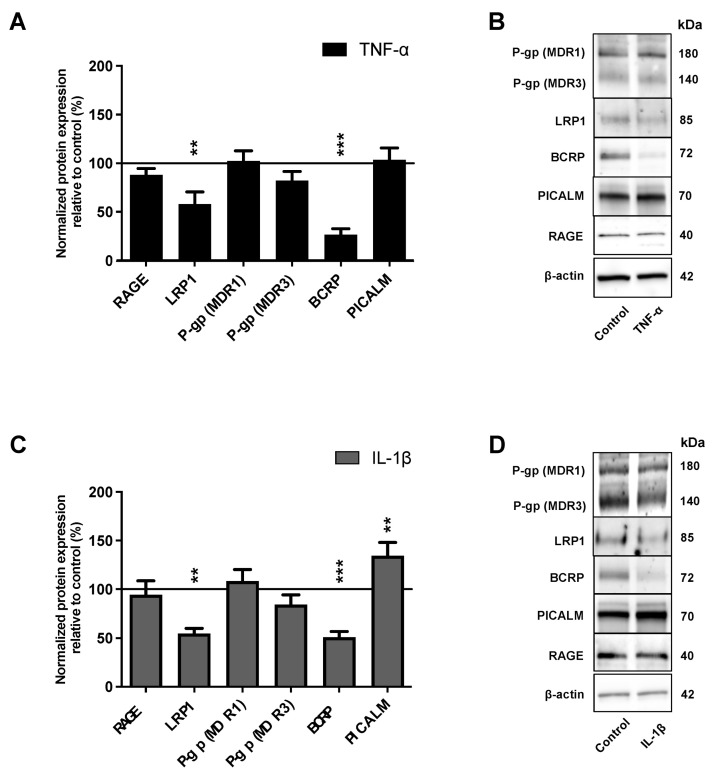
The blood-brain barrier (BBB) is a selective barrier and a functional gatekeeper for the central nervous system (CNS), essential for maintaining brain homeostasis. The BBB is composed of specialized brain endothelial cells (BECs) lining the brain capillaries. The tight junctions formed by BECs regulate paracellular transport, whereas transcellular transport is regulated by specialized transporters, pumps and receptors. Cytokine-induced neuroinflammation, such as the tumor necrosis factor-α (TNF-α) and interleukin-1β (IL-1β), appear to play a role in BBB dysfunction and contribute to the progression of Alzheimer's disease (AD) by contributing to amyloid-β (Aβ) peptide accumulation. Here, we investigated whether TNF-α and IL-1β modulate the permeability of the BBB and alter Aβ peptide transport across BECs. We used a human BBB in vitro model based on the use of brain-like endothelial cells (BLECs) obtained from endothelial cells derived from CD34+ stem cells cocultivated with brain pericytes. We demonstrated that TNF-α and IL-1β differentially induced changes in BLECs' permeability by inducing alterations in the organization of junctional complexes as well as in transcelluar trafficking. Further, TNF-α and IL-1β act directly on BLECs by decreasing LRP1 and BCRP protein expression as well as the specific efflux of Aβ peptide. These results provide mechanisms by which CNS inflammation might modulate BBB permeability and promote Aβ peptide accumulation. A future therapeutic intervention targeting vascular inflammation at the BBB may have the therapeutic potential to slow down the progression of AD.
血脑屏障(BBB)是中枢神经系统(CNS)的选择性屏障和功能性守门员,对于维持脑内环境稳态至关重要。BBB 由排列在脑毛细血管内的脑内皮细胞(BEC)组成。BEC 形成的紧密连接调节细胞旁转运,而跨细胞转运则由专门的转运体、泵和受体调节。细胞因子诱导的神经炎症,如肿瘤坏死因子-α(TNF-α)和白细胞介素-1β(IL-1β),似乎在 BBB 功能障碍中起作用,并通过促进淀粉样β(Aβ)肽积累促进阿尔茨海默病(AD)的进展。在这里,我们研究了 TNF-α 和 IL-1β 是否调节 BBB 的通透性并改变 Aβ 肽在 BEC 中的转运。我们使用了一种基于源自 CD34+干细胞的脑样内皮细胞(BLEC)的体外 BBB 模型,这些内皮细胞与脑周细胞共培养。我们证明,TNF-α 和 IL-1β 通过诱导连接复合体的组织改变以及跨细胞转运来差异诱导 BLEC 通透性的变化。此外,TNF-α 和 IL-1β 通过降低 LRP1 和 BCRP 蛋白表达以及 Aβ 肽的特异性外排直接作用于 BLEC。这些结果提供了中枢神经系统炎症可能调节 BBB 通透性并促进 Aβ 肽积累的机制。针对 BBB 血管炎症的未来治疗干预可能具有减缓 AD 进展的治疗潜力。