Department of Population, Family and Reproductive Health, Johns Hopkins University Bloomberg School of Public Health, Baltimore, Maryland, USA
Bill and Melinda Gates Institute for Population and Reproductive Health, Johns Hopkins University, Baltimore, Maryland, USA.
BMJ Glob Health. 2022 Feb;7(2). doi: 10.1136/bmjgh-2021-007807.
Adolescent girls and young women (AGYW) disproportionately experience gender-based violence (GBV), which can increase during emergencies like the COVID-19 pandemic.
A cohort of youth ages 15-24 in Nairobi, Kenya was surveyed at three time points over an 18-month period prior to and during the COVID-19 pandemic: June-August 2019 (prepandemic), August-October 2020 (12-month follow-up) and May 2021 (18-month follow-up). We characterise (1) prevalence, relative timing and help-seeking for leading forms of GBV, (2) GBV trajectories over 18 months and (3) associations of individual, dyad and COVID-related factors on GBV trajectories among AGYW (n=612) in Nairobi, Kenya. Virtual focus group discussions (n=12) and interviews (n=40) contextualise quantitative results.
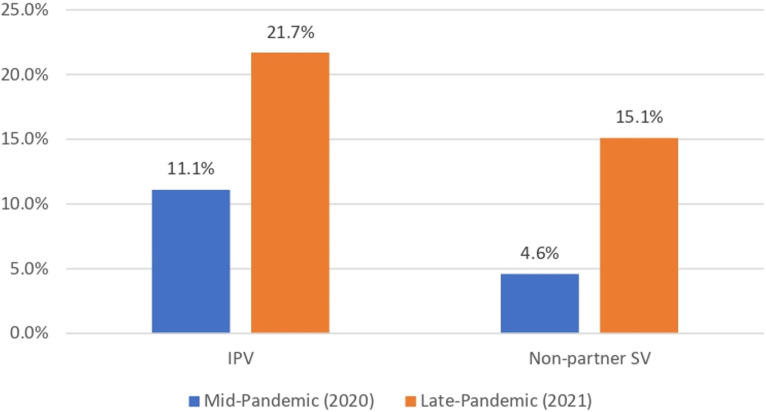
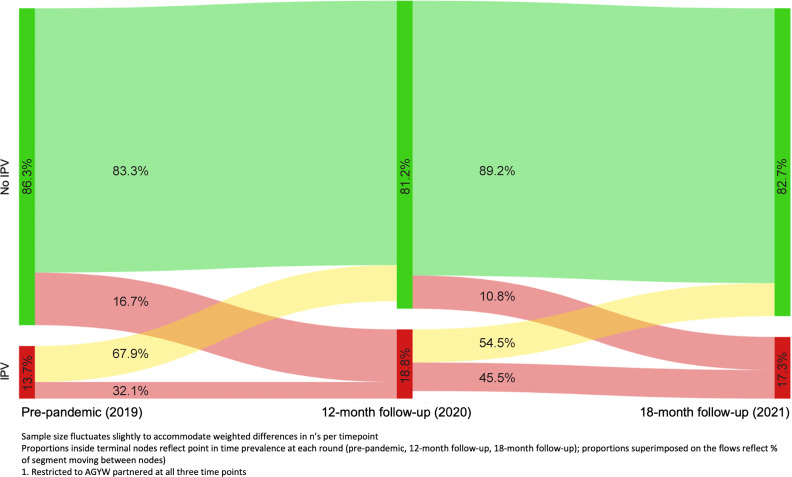
Intimate partner violence (IPV) prevalence hovered at 17% across time points (ever at pre-pandemic; past 12 months at 12-month follow-up (2020); past 6 months at 18-month follow-up (2021)); non-partner sexual violence (SV) was 3% at 12-month and 18-month follow-up. Overall, 27.6% of AGYW experienced IPV during the pandemic. IPV during the pandemic was associated with work as the primary pre-COVID activity, low social support and partner age difference >4 years. Among AGYW partnered at all three time points, 66.2% stayed IPV-free (no IPV), 9.2% saw IPV resolve by 18-month follow-up, while 11.1% had IPV start and 13.6% experienced intermittent IPV. Help-seeking for IPV and SV in 2020 (11.1% and 4.6%, respectively) increased to 21.7% and 15.1%, respectively, by 2021. Qualitative results speak to impacts of curfews, and pandemic-related financial stress in prompting conflict and threatening traditional gender roles, and underlying conditions that enable IPV.
The persistence of IPV against AGYW in Nairobi prior to and during the COVID-19 pandemic reflects endemic conditions and pandemic-specific stressors. Youth, including unmarried youth, remain a priority population for GBV prevention and survivor-centred response.
少女和年轻女性(AGYW)不成比例地经历基于性别的暴力(GBV),这种暴力在 COVID-19 大流行等紧急情况下可能会增加。
在 COVID-19 大流行之前和期间,在内罗毕对年龄在 15-24 岁的青年进行了三次时间点的调查:2019 年 6-8 月(大流行前)、2020 年 8-10 月(12 个月随访)和 2021 年 5 月(18 个月随访)。我们描述了(1)主要形式的 GBV 的流行程度、相对时间和寻求帮助的情况,(2)18 个月内的 GBV 轨迹,以及(3)个体、对偶和与 COVID 相关的因素对 AGYW(n=612)在肯尼亚内罗毕的 GBV 轨迹的关联。虚拟焦点小组讨论(n=12)和访谈(n=40)为定量结果提供了背景。
亲密伴侣暴力(IPV)的流行率在整个时间点都徘徊在 17%(大流行前曾有过;12 个月随访时为过去 12 个月(2020 年);18 个月随访时为过去 6 个月(2021 年));非伴侣性暴力(SV)为 12 个月和 18 个月随访时的 3%。总的来说,27.6%的 AGYW 在大流行期间经历了 IPV。大流行期间的 IPV 与工作是 COVID 前的主要活动、低社会支持和伴侣年龄差>4 岁有关。在所有三个时间点都有伴侣的 AGYW 中,66.2%保持 IPV 无(无 IPV),9.2%的人在 18 个月随访时看到 IPV 得到解决,而 11.1%的人出现 IPV 开始,13.6%的人经历间歇性 IPV。2020 年(分别为 11.1%和 4.6%)寻求 IPV 和 SV 的帮助增加到 2021 年的 21.7%和 15.1%。定性结果表明,宵禁和与大流行相关的经济压力会引发冲突,威胁到传统的性别角色,并为 IPV 提供了潜在条件。
在 COVID-19 大流行之前和期间,内罗毕少女和年轻女性持续遭受 IPV,这反映了地方性条件和大流行特定的压力源。青年,包括未婚青年,仍然是预防基于性别的暴力和以幸存者为中心的应对的重点人群。