Department of Computer Science and Technology, University of Cambridge, Cambridge, UK.
Norwich Medical School, 2.04 Bob Champion Research and Education Building, University of East Anglia, Norwich, NR4 7TJ, UK.
Sci Rep. 2022 Feb 24;12(1):3160. doi: 10.1038/s41598-022-06899-w.
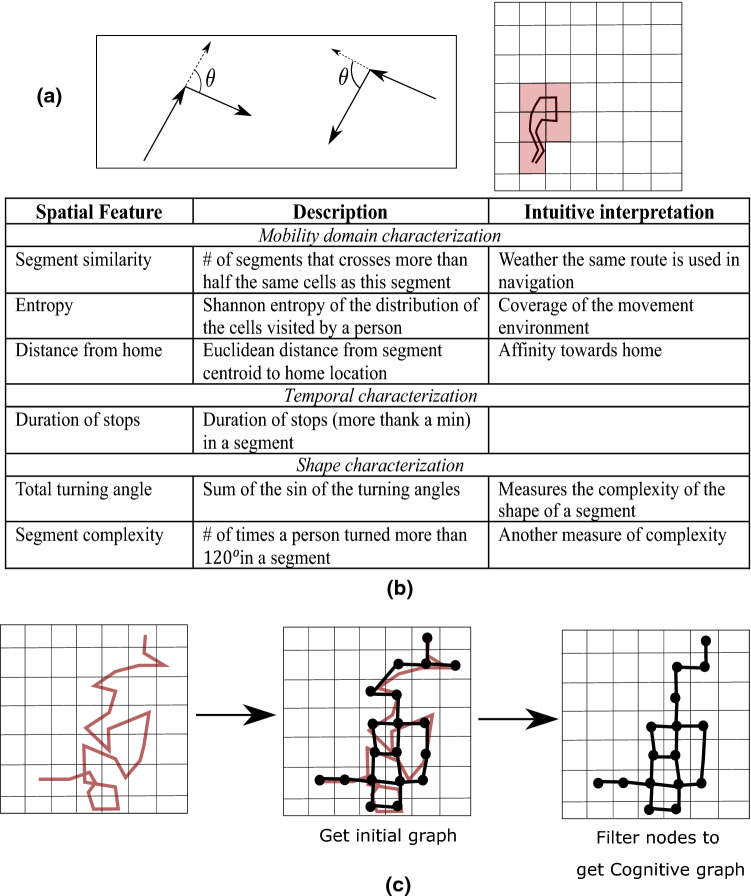
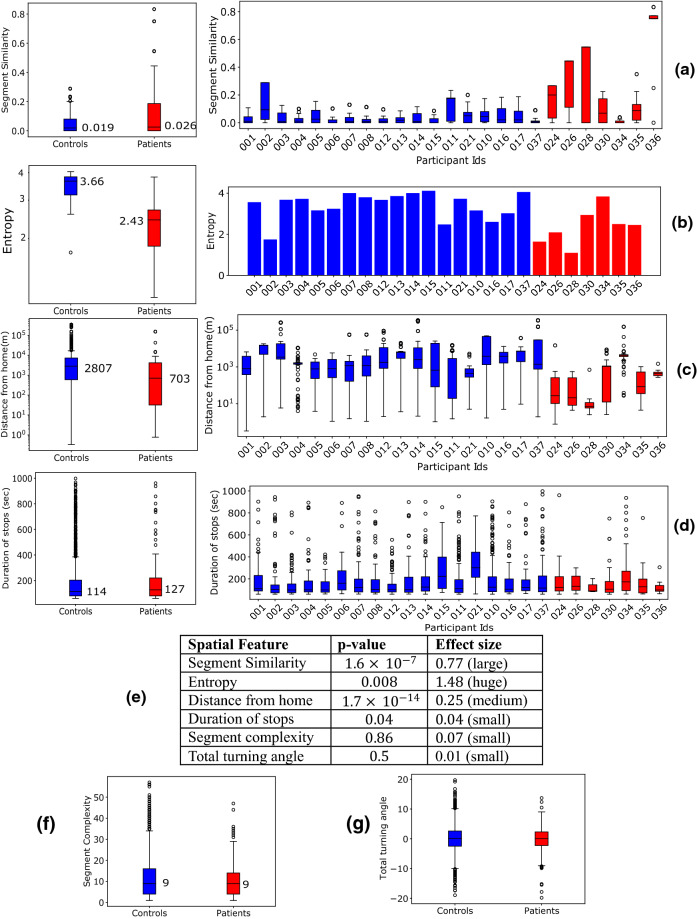
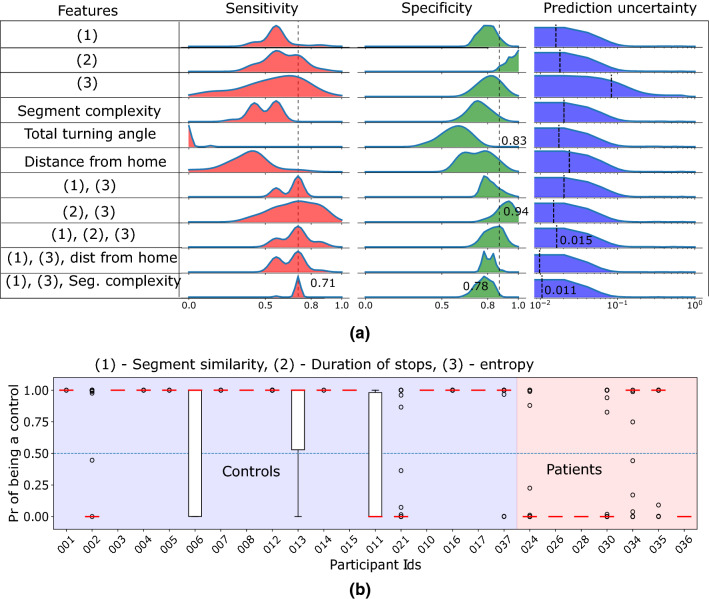
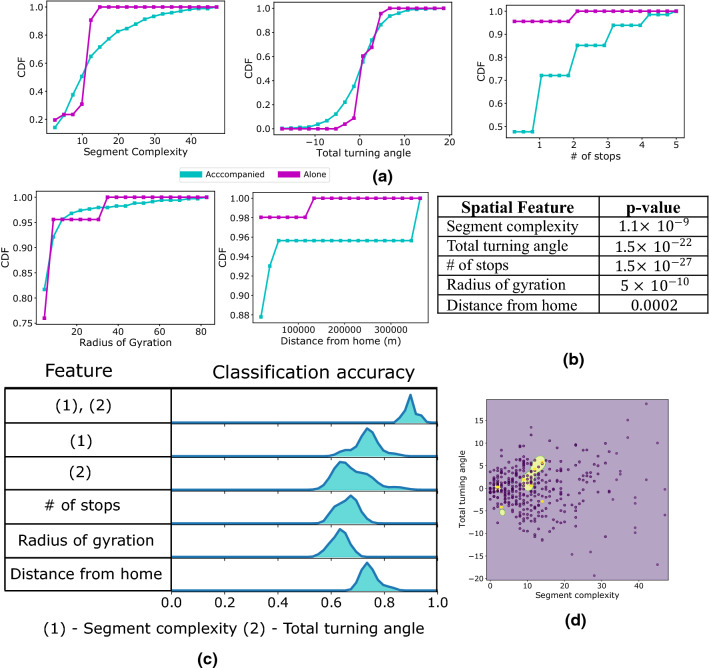
Impairment of navigation is one of the earliest symptoms of Alzheimer's disease (AD), but to date studies have involved proxy tests of navigation rather than studies of real life behaviour. Here we use GPS tracking to measure ecological outdoor behaviour in AD. The aim was to use data-driven machine learning approaches to explore spatial metrics within real life navigational traces that discriminate AD patients from controls. 15 AD patients and 18 controls underwent tracking of their outdoor navigation over two weeks. Three kinds of spatiotemporal features of segments were extracted, characterising the mobility domain (entropy, segment similarity, distance from home), spatial shape (total turning angle, segment complexity), and temporal characteristics (stop duration). Patients significantly differed from controls on entropy (p-value 0.008), segment similarity (p-value [Formula: see text]), and distance from home (p-value [Formula: see text]). Graph-based analyses yielded preliminary data indicating that topological features assessing the connectivity of visited locations may also differentiate patients from controls. In conclusion, our results show that specific outdoor navigation features discriminate AD patients from controls, which has significant implication for future AD diagnostics, outcome measures and interventions. Furthermore, this work illustrates how wearables-based sensing of everyday behaviour may be used to deliver ecologically-valid digital biomarkers of AD pathophysiology.
导航障碍是阿尔茨海默病(AD)的最早症状之一,但迄今为止的研究涉及到对导航的代理测试,而不是对真实生活行为的研究。在这里,我们使用 GPS 跟踪来测量 AD 患者的真实户外行为。目的是使用数据驱动的机器学习方法来探索真实生活轨迹中的空间指标,以区分 AD 患者和对照组。15 名 AD 患者和 18 名对照组在两周内接受了户外导航的跟踪。提取了三种时空特征,分别描述了移动域(熵、片段相似度、离家距离)、空间形状(总转角、片段复杂度)和时间特征(停留持续时间)。患者在熵(p 值[Formula: see text])、片段相似度(p 值[Formula: see text])和离家距离(p 值[Formula: see text])方面与对照组有显著差异。基于图的分析初步表明,评估访问地点连通性的拓扑特征也可以区分患者和对照组。总之,我们的研究结果表明,特定的户外导航特征可以区分 AD 患者和对照组,这对未来的 AD 诊断、结果测量和干预具有重要意义。此外,这项工作说明了如何使用基于可穿戴设备的日常行为感知来提供 AD 病理生理学的生态有效数字生物标志物。