Puthusseryppady Vaisakh, Morrissey Sol, Aung Min Hane, Coughlan Gillian, Patel Martyn, Hornberger Michael
Norwich Medical School, University of East Anglia, Norwich, United Kingdom.
Department of Neurobiology and Behavior, University of California Irvine, Irvine, CA, United States.
JMIR Aging. 2022 Apr 21;5(2):e28222. doi: 10.2196/28222.
Spatial disorientation is one of the earliest and most distressing symptoms seen in patients with Alzheimer disease (AD) and can lead to them getting lost in the community. Although it is a prevalent problem worldwide and is associated with various negative consequences, very little is known about the extent to which outdoor navigation patterns of patients with AD explain why spatial disorientation occurs for them even in familiar surroundings.
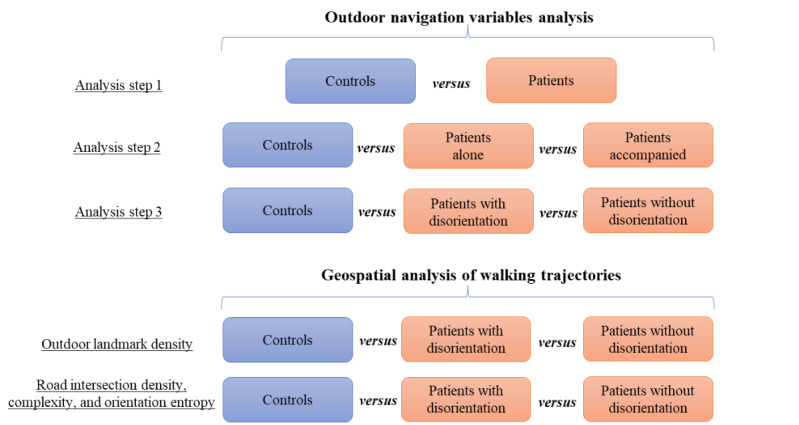
This study aims to understand the outdoor navigation patterns of patients with AD in different conditions (alone vs accompanied; disoriented vs not disoriented during the study) and investigate whether patients with AD experienced spatial disorientation when navigating through environments with a high outdoor landmark density and complex road network structure (road intersection density, intersection complexity, and orientation entropy).
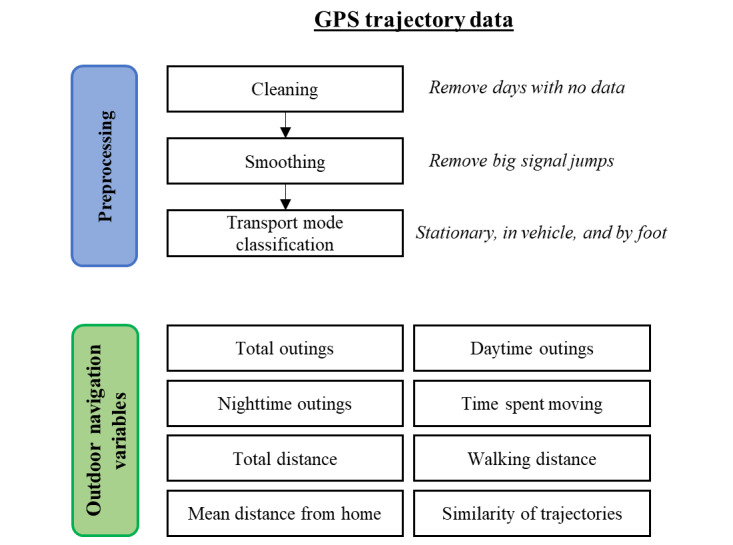
We investigated the outdoor navigation patterns of community-dwelling patients with AD (n=15) and age-matched healthy controls (n=18) over a 2-week period using GPS tracking and trajectory mining analytical techniques. Here, for the patients, the occurrence of any spatial disorientation behavior during this tracking period was recorded. We also used a spatial buffer methodology to capture the outdoor landmark density and features of the road network in the environments that the participants visited during the tracking period.
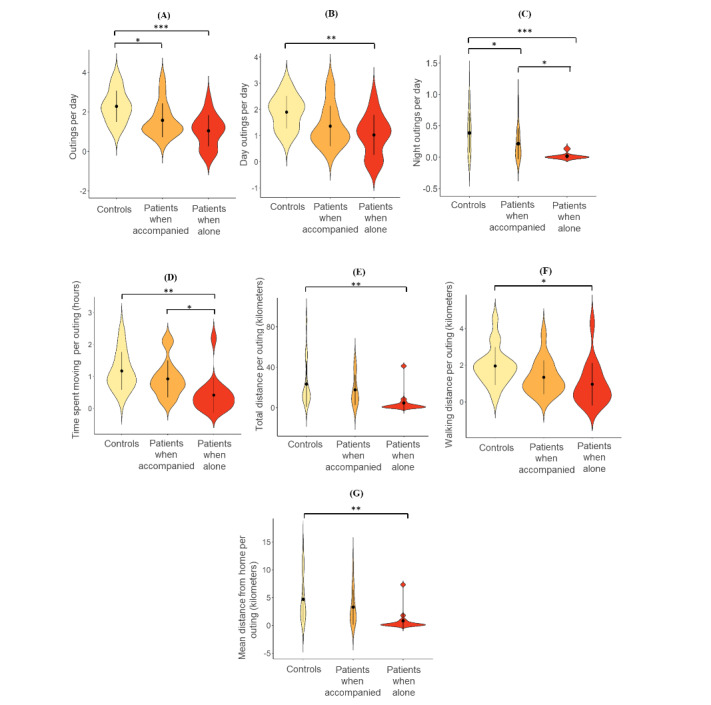
The patients with AD had outdoor navigation patterns similar to those of the controls when they were accompanied; however, when they were alone, they had significantly fewer outings per day (total outings: P<.001; day outings: P=.003; night outings: P<.001), lower time spent moving per outing (P=.001), lower total distance covered per outing (P=.009), lower walking distance per outing (P=.02), and lower mean distance from home per outing (P=.004). Our results did not identify any mobility risk factors for spatial disorientation. We also found that the environments visited by patients who experienced disorientation versus those who maintained their orientation during the tracking period did not significantly differ in outdoor landmark density (P=.60) or road network structure (road intersection density: P=.43; intersection complexity: P=.45; orientation entropy: P=.89).
Our findings suggest that when alone, patients with AD restrict the spatial and temporal extent of their outdoor navigation in the community to successfully reduce their perceived risk of spatial disorientation. Implications of this work highlight the importance for future research to identify which of these individuals may be at an actual high risk for spatial disorientation as well as to explore the implementation of health care measures to help maintain a balance between patients' right to safety and autonomy when making outings alone in the community.
空间定向障碍是阿尔茨海默病(AD)患者最早出现且最令人苦恼的症状之一,可能导致他们在社区中走失。尽管这是一个在全球范围内普遍存在的问题,并伴有各种负面后果,但对于AD患者的户外导航模式在多大程度上能够解释为何他们即使在熟悉的环境中也会出现空间定向障碍,我们知之甚少。
本研究旨在了解AD患者在不同条件下(独自与有人陪同;研究期间定向障碍与无定向障碍)的户外导航模式,并调查AD患者在穿越具有高户外地标密度和复杂道路网络结构(道路交叉点密度、交叉点复杂性和方向熵)的环境时是否会经历空间定向障碍。
我们使用GPS跟踪和轨迹挖掘分析技术,对15名社区居住的AD患者和18名年龄匹配的健康对照者进行了为期2周的户外导航模式调查。在此期间,记录了患者是否出现任何空间定向障碍行为。我们还使用空间缓冲区方法来获取参与者在跟踪期间访问的环境中的户外地标密度和道路网络特征。
AD患者在有人陪同的情况下,其户外导航模式与对照组相似;然而,当他们独自出行时,每天的外出次数显著减少(总外出次数:P<0.001;日间外出次数:P=0.003;夜间外出次数:P<0.001),每次外出的移动时间缩短(P=0.001),每次外出的总路程缩短(P=0.009),每次外出的步行距离缩短(P=0.02),每次外出离家的平均距离缩短(P=0.004)。我们的研究结果未发现任何导致空间定向障碍的行动风险因素。我们还发现,在跟踪期间经历定向障碍的患者与保持定向的患者所访问的环境在户外地标密度(P=0.60)或道路网络结构(道路交叉点密度:P=0.43;交叉点复杂性:P=0.45;方向熵:P=0.89)方面没有显著差异。
我们的研究结果表明,AD患者独自出行时会限制其在社区中的户外导航的空间和时间范围,以成功降低他们感知到的空间定向障碍风险。这项工作的意义在于强调未来研究识别哪些个体可能实际面临高空间定向障碍风险的重要性,以及探索实施医疗保健措施,以帮助在患者独自在社区外出时,在其安全权和自主权之间保持平衡。