Dalaqua Mariana, do Nascimento Felipe Barjud Pereira, Miura Larissa Kaori, Garcia Marcio Ricardo Taveira, Barbosa Junior Alcino Alves, Reis Fabiano
Hôpitaux Universitaires de Genève, Service de Radiologie, Genève, Switzerland.
Imaging Department, Hospital Israelita Albert Einstein, São Paulo, SP, Brazil.
Radiol Bras. 2022 Jan-Feb;55(1):38-46. doi: 10.1590/0100-3984.2021.0042.
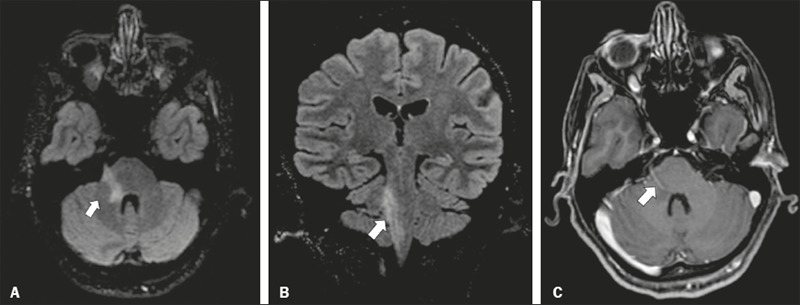
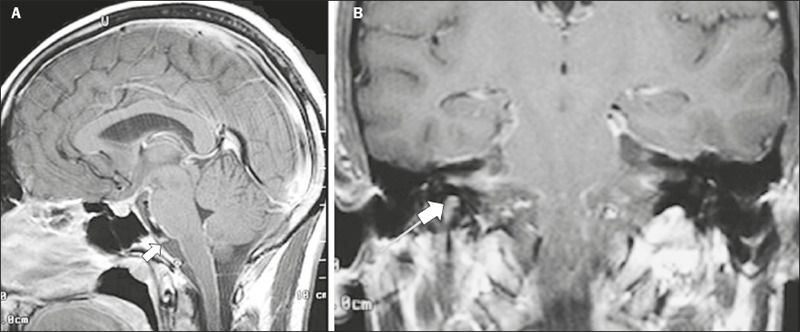
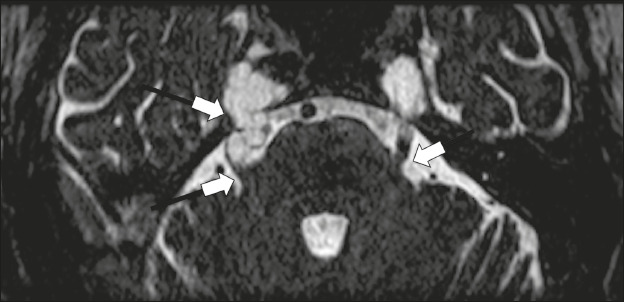
The cranial nerves, which represent extensions of the functional structures of the brain, traverse the head and neck. They are connected to various cranial structures and are associated with several diseases. An in-depth understanding of their complex anatomy and normal imaging appearance allows the examiner to identify and characterize abnormalities with greater precision. One important tool for evaluating the cranial nerves is contrast-enhanced magnetic resonance imaging, especially that employing three-dimensional steady-state free precession sequences, which provide high soft-tissue and spatial resolution, despite the slen-derness of the nerves. In most cases of cranial nerve abnormalities, the imaging findings are nonspecific. Therefore, to narrow the differential diagnosis, it is necessary to take a full patient history, perform a focused physical examination, and order laboratory tests. In this pictorial essay, we review, illustrate, and discuss, from a pathophysiological perspective, infectious, neoplastic, and demyelinating disorders, as well as other inflammatory disorders, affecting the cranial nerves, the aim being to provide a practical, tangible reference for radiologists to use in daily practice.
颅神经是脑功能结构的延伸,贯穿头部和颈部。它们与各种颅部结构相连,并与多种疾病相关。深入了解其复杂的解剖结构和正常影像学表现,有助于检查者更精确地识别和描述异常情况。评估颅神经的一项重要工具是对比增强磁共振成像,尤其是采用三维稳态自由进动序列的成像,尽管神经纤细,但该序列能提供高软组织分辨率和空间分辨率。在大多数颅神经异常病例中,影像学表现是非特异性的。因此,为了缩小鉴别诊断范围,有必要全面了解患者病史、进行针对性体格检查并安排实验室检查。在这篇图文并茂的文章中,我们从病理生理学角度回顾、展示并讨论影响颅神经的感染性、肿瘤性、脱髓鞘性疾病以及其他炎性疾病,目的是为放射科医生在日常实践中提供实用、切实的参考。