Masuya Jiro, Ichiki Masahiko, Morishita Chihiro, Higashiyama Motoki, Ono Miki, Honyashiki Mina, Iwata Yoshio, Tanabe Hajime, Inoue Takeshi
Department of Psychiatry, Tokyo Medical University, Shinjuku-ku, Tokyo, 160-0023, Japan.
Faculty of Humanities and Social Sciences, Shizuoka University, Suruga-ku, Shizuoka, 422-8529, Japan.
Neuropsychiatr Dis Treat. 2022 Feb 15;18:253-263. doi: 10.2147/NDT.S337922. eCollection 2022.
When assessing patients with depressive and anxiety disorders in psychiatric clinical practice, it is common to encounter children and adolescents who have experienced abuse and victimization. To date, it has been clarified that experiences of "childhood abuse" and "childhood victimization" lead to "neuroticism", and that neuroticism leads to "adult depressive symptoms". In this study, we analyzed how these four factors are interrelated.
The following self-administered questionnaire surveys were conducted in 576 adult volunteers: Patient Health Questionnaire-9, Eysenck Personality Questionnaire-revised shortened version, Child Abuse and Trauma Scale, and Childhood Victimization Rating Scale. For statistical analysis, Pearson correlation coefficient analysis, -test, multiple regression analysis, and covariance structure analysis (path analysis) were performed.
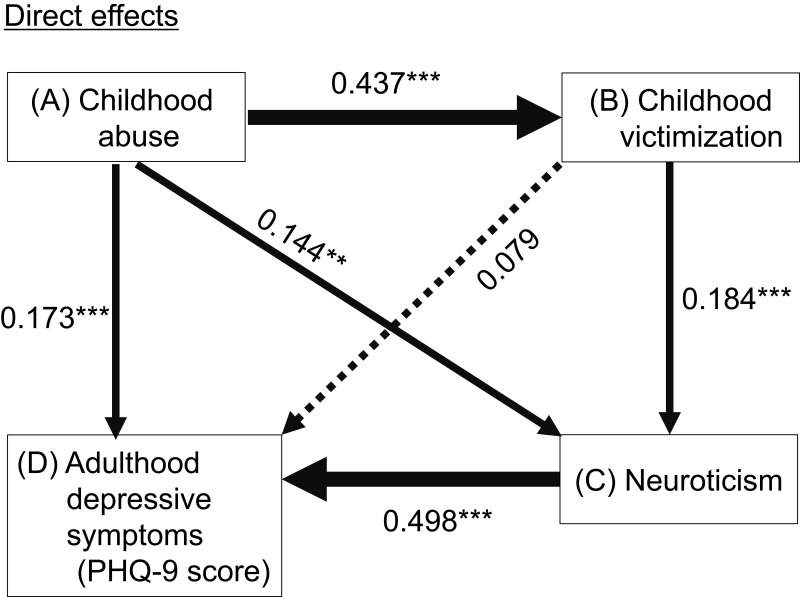
Path analysis showed that the indirect effects of childhood abuse and childhood victimization on depressive symptoms through neuroticism were statistically significant. In addition, the indirect effects of childhood abuse on neuroticism through childhood victimization were statistically significant. Finally, the indirect effects of childhood abuse on depressive symptoms through the combined paths of childhood victimization and neuroticism were statistically significant.
Our results suggest that "childhood abuse (A)" induces changes in the personality trait of "neuroticism (C)" with "childhood victimization (B)" as a mediator, and that these adversities affect the expression of "depressive symptoms in adulthood (D)" through "neuroticism (C)" as a mediator. In other words, to our knowledge, this is the first study to clarify that these four factors are not only individually associated with each other but also cause a chain reaction of A to B to C to D.
在精神科临床实践中评估患有抑郁和焦虑症的患者时,经常会遇到曾遭受虐待和侵害的儿童及青少年。迄今为止,已经明确“童年期虐待”和“童年期受害”经历会导致“神经质”,而神经质会导致“成人抑郁症状”。在本研究中,我们分析了这四个因素是如何相互关联的。
对576名成年志愿者进行了以下自填式问卷调查:患者健康问卷-9、艾森克人格问卷修订简版、儿童虐待与创伤量表以及童年期受害评定量表。进行了Pearson相关系数分析、t检验、多元回归分析和协方差结构分析(路径分析)以进行统计分析。
路径分析表明,童年期虐待和童年期受害通过神经质对抑郁症状产生的间接效应具有统计学意义。此外,童年期虐待通过童年期受害对神经质产生的间接效应具有统计学意义。最后,童年期虐待通过童年期受害和神经质的联合路径对抑郁症状产生的间接效应具有统计学意义。
我们的结果表明,“童年期虐待(A)”以“童年期受害(B)”为中介诱发“神经质(C)”这一人格特质的变化,并且这些逆境通过“神经质(C)”为中介影响“成年期抑郁症状(D)”的表现。换句话说,据我们所知,这是第一项阐明这四个因素不仅相互独立相关,而且会引发从A到B再到C最后到D的连锁反应的研究。