Brouwers Kaj, Thijssen Max F, Kruit Anne Sophie, van Midden Dominique, Koers Erik J, Zegers Her J H, Hummelink Stefan, Ulrich Dietmar J O
Department of Plastic and Reconstructive Surgery, Radboudumc, Nijmegen, the Netherlands.
Department of Pathology, Radboudumc, Nijmegen, the Netherlands.
Plast Reconstr Surg Glob Open. 2022 Feb 21;10(2):e4123. doi: 10.1097/GOX.0000000000004123. eCollection 2022 Feb.
Static cold storage is the gold standard of preservation in vascularized composite allotransplantation and allows a preservation time of 4-6 hours. Machine preservation is a promising technique for prolonged preservation; however, studies on extended preservation that compare different preservatives are scarce. This study aims to assess the feasibility of 24-hour acellular perfusion and compares different preservation solutions in a porcine myocutaneous flap replantation model.
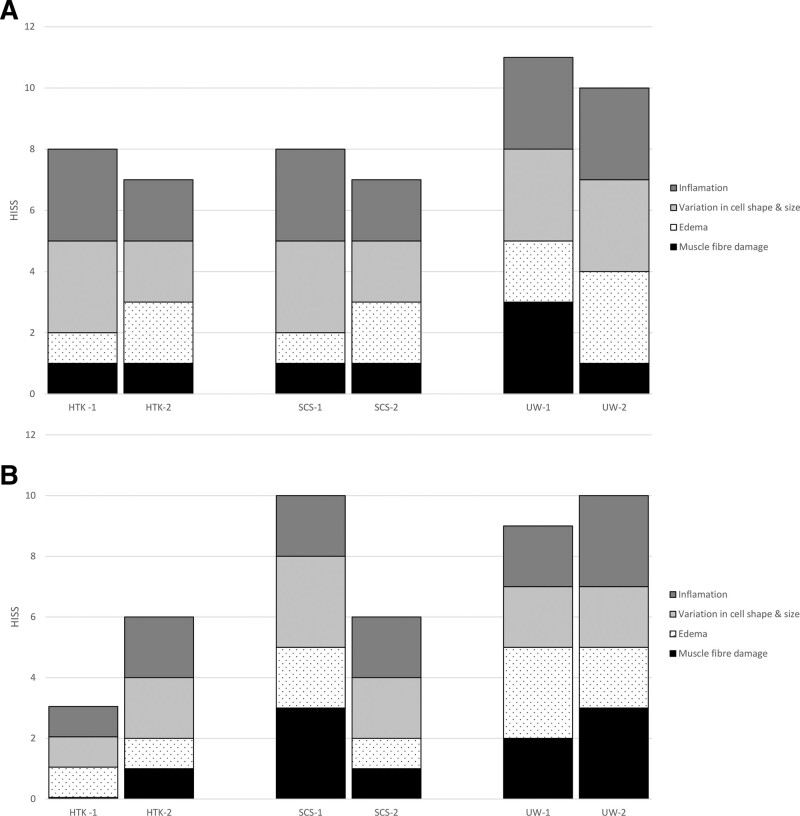
Six harvested bilateral myocutaneous flaps of three Dutch Landrace pigs were perfused hypothermically for 24 hours with University of Wisconsin machine perfusion solution (UW-MPS; n = 2) or histidine-tryptophan-ketoglutarate solution (HTK; n = 2) or preserved on ice for 4 hours (n = 2) before orthotopic replantation. Animals were observed for 7 days after replantation. Skeletal muscle injury was assessed by biochemical markers during perfusion, and muscle biopsies were analyzed for ischemia reperfusion injury directly after preservation and at 1, 3, and 7 days after replantation.
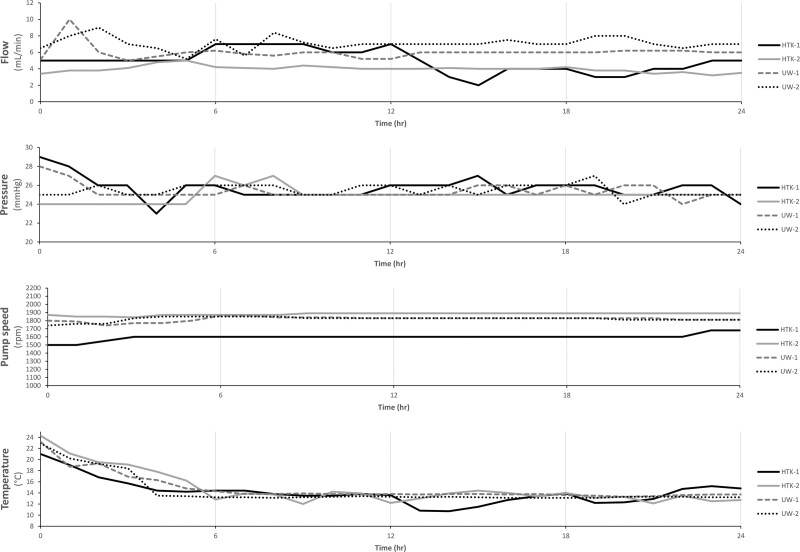
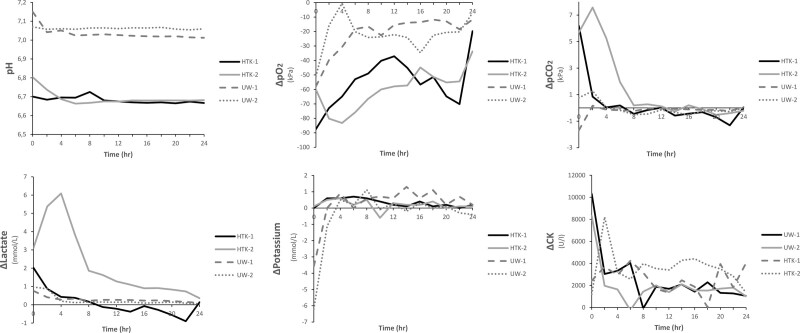
Markers of muscle damage varied during perfusion, but decreased overall in both perfusion groups. Flap weight increased 60% and 97% in the HTK-perfused flaps, compared with -6% and -7% in the UW-MPS-perfused flaps after 24 hours. Histopathologic evaluation demonstrated decreased muscle damage in flaps perfused with HTK compared with the UW-MPS-perfused flaps at 1 week after replantation.
Machine perfusion of myocutaneous flaps for 24 hours with subsequent replantation is feasible, but warrants further research. Perfusion with HTK solution seemed to result in better histological outcomes 7 days after reperfusion compared with UW-MPS.
静态冷藏是血管化复合组织异体移植保存的金标准,可实现4至6小时的保存时间。机器保存是一种有前景的延长保存技术;然而,比较不同防腐剂的延长保存研究较少。本研究旨在评估24小时无细胞灌注的可行性,并在猪肌皮瓣再植模型中比较不同的保存溶液。
从三只荷兰长白猪身上获取六对双侧肌皮瓣,在原位再植前,用威斯康星大学机器灌注液(UW-MPS;n = 2)或组氨酸-色氨酸-酮戊二酸溶液(HTK;n = 2)进行低温灌注24小时,或在冰上保存4小时(n = 2)。再植后观察动物7天。在灌注期间通过生化标志物评估骨骼肌损伤,并在保存后以及再植后1、3和7天对肌肉活检组织进行缺血再灌注损伤分析。
灌注期间肌肉损伤标志物有所变化,但两个灌注组总体上均有所下降。24小时后,HTK灌注组的皮瓣重量增加了60%和97%,而UW-MPS灌注组的皮瓣重量分别下降了6%和7%。组织病理学评估显示,再植1周后,与UW-MPS灌注组相比,HTK灌注组的皮瓣肌肉损伤减少。
肌皮瓣机器灌注24小时后再植是可行的,但值得进一步研究。与UW-MPS相比,HTK溶液灌注似乎在再灌注7天后产生了更好的组织学结果。