Kruit Anne Sophie, van Midden Dominique, Schreinemachers Marie-Claire, Koers Erik, Zegers Her, Kusters Benno, Hummelink Stefan, Ulrich Dietmar J O
Department of Plastic and Reconstructive Surgery, Radboud University Medical Center, 6525 GA Nijmegen, The Netherlands.
Department of Pathology, Radboud University Medical Center, 6525 GA Nijmegen, The Netherlands.
J Clin Med. 2021 Aug 27;10(17):3858. doi: 10.3390/jcm10173858.
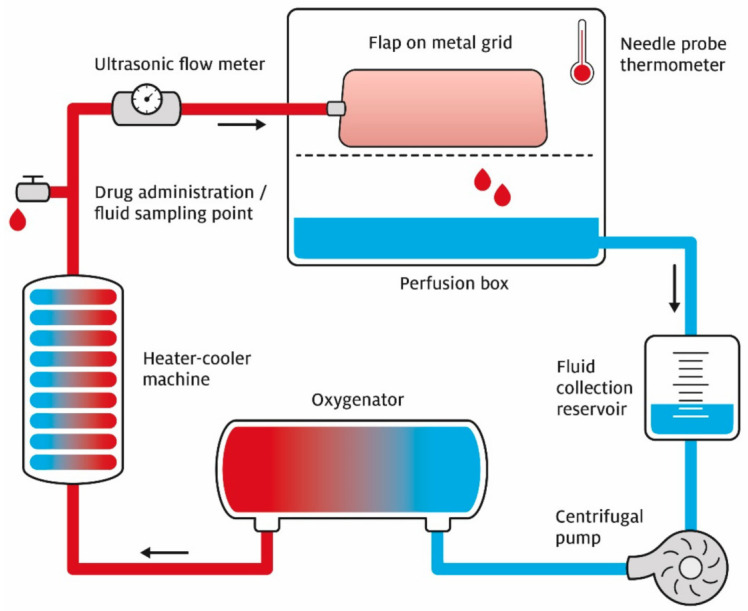
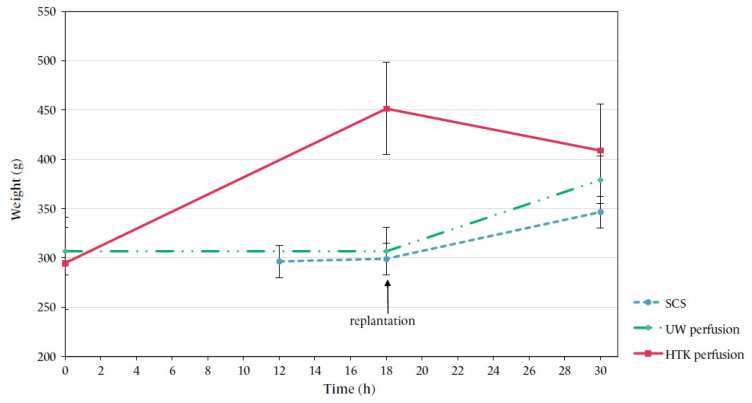
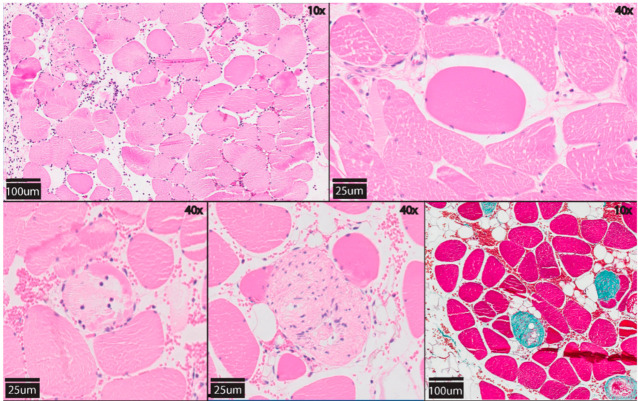
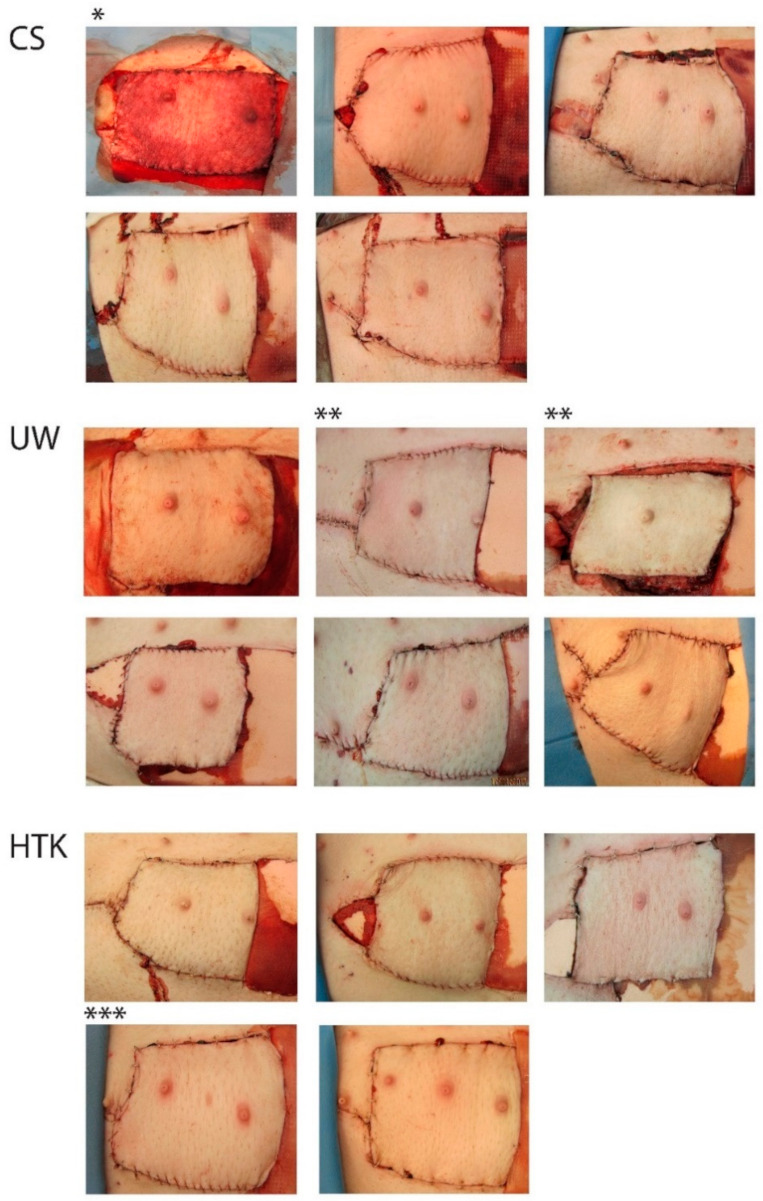
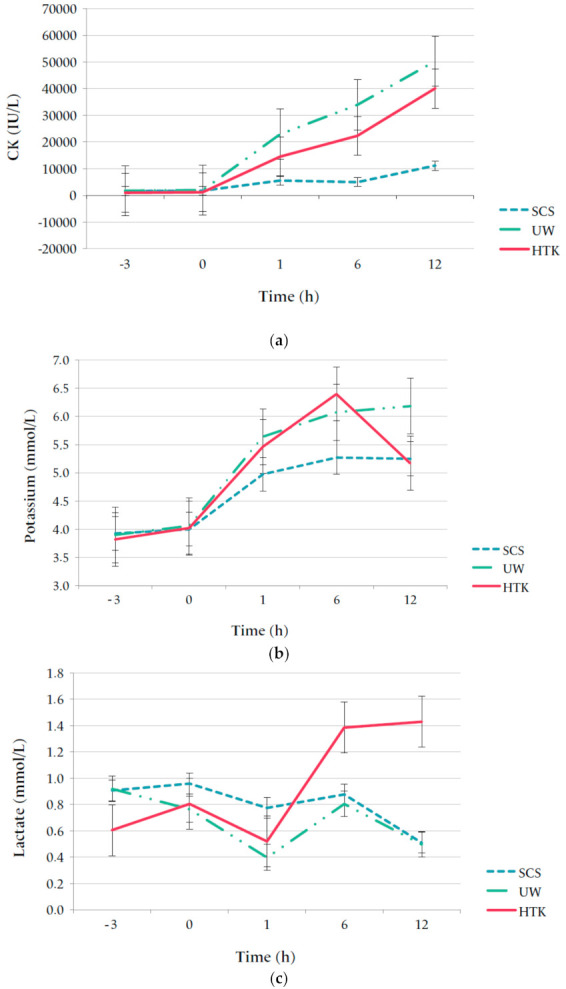
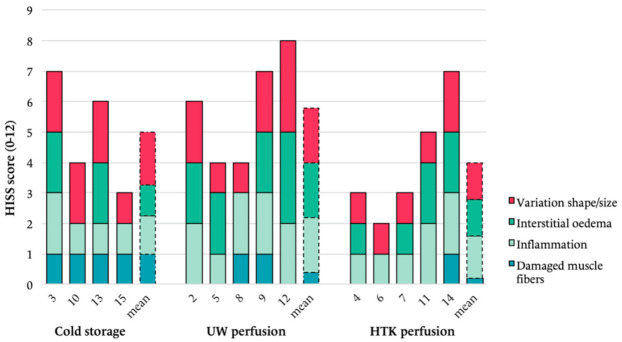
Cold storage remains the clinical standard for composite tissue preservation but is time-limited. A long ischemia time during surgery will adversely affect postoperative outcomes due to ischemia-reperfusion injury. Extracorporeal perfusion (ECP) seems to be a promising alternative for prolonged preservation, but more evidence is needed to support its use and to identify optimal perfusion fluids. This article assessed musculocutaneous flap vitality after prolonged ECP and compared outcomes after replantation to short static cold storage (SCS). Unilateral musculocutaneous rectus abdominis flaps were raised from 15 pigs and preserved by 4 h SCS ( = 5), 18 h mid-thermic ECP with Histidine-Tryptophan-Ketoglutarate (HTK, = 5) or University of Wisconsin solution (UW, = 5). Flaps were replanted and observed for 12 h. Skeletal muscle histology was assessed (score 0-12; high scores equal more damage), blood and perfusate samples were collected and weight was recorded as a marker for oedema. Mean histological scores were 4.0 after HTK preservation, 5.6 after UW perfusion and 5.0 after SCS ( = 0.366). Creatinine kinase (CK) was higher after ECP compared to SCS ( < 0.001). No weight increase was observed during UW perfusion, but increased 56% during HTK perfusion. Following 12 h reperfusion, mean weight gain reduced 39% in the HTK group and increased 24% in the UW group and 17% in the SCS group. To conclude, skeletal muscle seemed well preserved after 18 h ECP with HTK or UW perfusion, with comparable histological results to 4 h SCS upon short reperfusion. The high oedema rate during HTK perfusion remains a challenge that needs to be further addressed.
冷藏仍然是复合组织保存的临床标准,但存在时间限制。手术过程中较长的缺血时间会因缺血再灌注损伤而对术后结果产生不利影响。体外灌注(ECP)似乎是延长保存时间的一种有前景的替代方法,但需要更多证据来支持其使用并确定最佳灌注液。本文评估了长时间ECP后肌皮瓣的活力,并将再植后的结果与短时间静态冷藏(SCS)进行了比较。从15头猪身上取下单侧腹直肌肌皮瓣,分别通过4小时SCS(n = 5)、含组氨酸 - 色氨酸 - 酮戊二酸(HTK,n = 5)或威斯康星大学溶液(UW,n = 5)的18小时中温ECP进行保存。将皮瓣再植并观察12小时。评估骨骼肌组织学(评分0 - 12;高分表示损伤更严重),采集血液和灌注液样本,并记录重量作为水肿的指标。HTK保存后平均组织学评分为4.0,UW灌注后为5.6,SCS后为5.0(P = 0.366)。与SCS相比,ECP后肌酸激酶(CK)更高(P < 0.001)。UW灌注期间未观察到重量增加,但HTK灌注期间增加了56%。再灌注12小时后,HTK组平均体重增加减少了39%,UW组增加了24%,SCS组增加了17%。总之,经HTK或UW灌注18小时ECP后,骨骼肌似乎保存良好,短时间再灌注后的组织学结果与4小时SCS相当。HTK灌注期间的高水肿率仍然是一个需要进一步解决的挑战。