Campione Elena, Mazzilli Sara, Di Prete Monia, Dattola Annunziata, Cosio Terenzio, Lettieri Barbato Daniele, Costanza Gaetana, Lanna Caterina, Manfreda Valeria, Gaeta Schumak Ruslana, Prignano Francesca, Coniglione Filadelfo, Ciprani Fabrizio, Aquilano Katia, Bianchi Luca
Dermatology Unit, University of Rome Tor Vergata, Rome, Italy.
Italy State Police Health Service Department, Ministry of Interior, Rome, Italy.
Front Med (Lausanne). 2022 Feb 8;9:760852. doi: 10.3389/fmed.2022.760852. eCollection 2022.
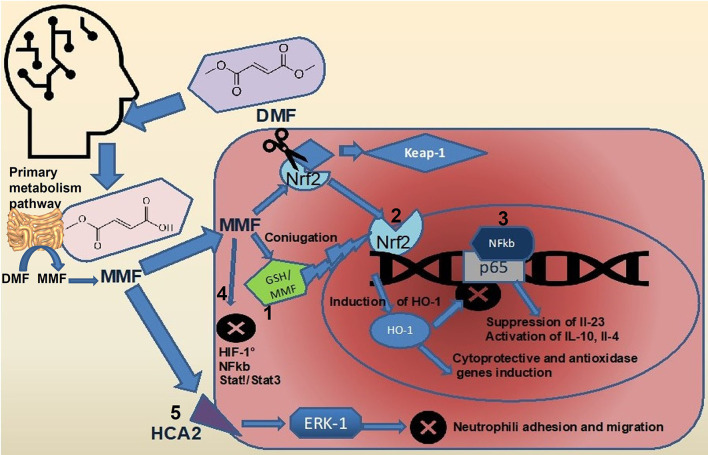
Psoriasis vulgaris is a chronic inflammatory skin disease characterized by well-demarcated scaly plaques. Oxidative stress plays a crucial role in the psoriasis pathogenesis and is associated with the disease severity. Dimethyl fumarate modulates the activity of the pro-inflammatory transcription factors. This is responsible for the downregulation of inflammatory cytokines and an overall shift from a pro-inflammatory to an anti-inflammatory/regulatory response. Both steps are necessary for the amelioration of psoriatic inflammation, although additional mechanisms have been proposed. Several studies reported a long-term effectiveness and safety of dimethyl fumarate monotherapy in patients with moderate-to-severe psoriasis. Furthermore, psoriasis is a chronic disease often associated to metabolic comorbidities, as obesity, diabetes, and cardiovascular diseases, in which glutathione-S transferase deregulation is present. Glutathione-S transferase is involved in the antioxidant system. An increase of its activity in psoriatic epidermis in comparison with the uninvolved and normal epidermal biopsies has been reported. Dimethyl fumarate depletes glutathione-S transferase by formation of covalently linked conjugates. This review investigates the anti-inflammatory role of dimethyl fumarate in oxidative stress and its effect by reducing oxidative stress. The glutathione-S transferase regulation is helpful in treating psoriasis, with an anti-inflammatory effect on the keratinocytes hyperproliferation, and in modulation of metabolic comorbidities.
寻常型银屑病是一种慢性炎症性皮肤病,其特征为边界清晰的鳞屑斑块。氧化应激在银屑病发病机制中起关键作用,且与疾病严重程度相关。富马酸二甲酯可调节促炎转录因子的活性。这导致炎症细胞因子下调,并使整体反应从促炎转变为抗炎/调节反应。尽管还提出了其他机制,但这两个步骤对于改善银屑病炎症都是必要的。多项研究报道了富马酸二甲酯单药治疗中重度银屑病患者的长期有效性和安全性。此外,银屑病是一种常与代谢合并症相关的慢性病,如肥胖、糖尿病和心血管疾病,其中存在谷胱甘肽 - S转移酶失调。谷胱甘肽 - S转移酶参与抗氧化系统。与未受累及的正常表皮活检相比,已报道银屑病表皮中其活性增加。富马酸二甲酯通过形成共价连接的共轭物使谷胱甘肽 - S转移酶耗竭。本综述研究了富马酸二甲酯在氧化应激中的抗炎作用及其通过降低氧化应激产生的效果。谷胱甘肽 - S转移酶调节有助于治疗银屑病,对角质形成细胞过度增殖具有抗炎作用,并可调节代谢合并症。