Ramos-Cejudo Jaime, Genfi Afia, Abu-Amara Duna, Debure Ludovic, Qian Meng, Laska Eugene, Siegel Carole, Milton Nicholas, Newman Jennifer, Blessing Esther, Li Meng, Etkin Amit, Marmar Charles R, Fossati Silvia
Center for Alcohol Use Disorder and PTSD, Department of Psychiatry, New York University Grossman School of Medicine, NY, USA.
Steven and Alexandra Cohen Veterans Center for the Study of PTSD and TBI, Department of Psychiatry, New York University Grossman School of Medicine, NY, USA.
Psychiatr Res Clin Pract. 2021 Winter;3(4):153-162. doi: 10.1176/appi.prcp.20210017. Epub 2021 Jun 1.
Posttraumatic stress disorder (PTSD) is a serious and frequently debilitating psychiatric condition that can occur in people who have experienced traumatic stessors, such as war, violence, sexual assault and other life-threatening events. Treatment of PTSD and traumatic brain injury (TBI) in veterans is challenged by diagnostic complexity, partially due to PTSD and TBI symptom overlap and to the fact that subjective self-report assessments may be influenced by a patient's willingness to share their traumatic experiences and resulting symptoms. Corticotropin-releasing factor (CRF) is one of the main mediators of hypothalamic pituitary adrenal (HPA)-axis responses in stress and anxiety.
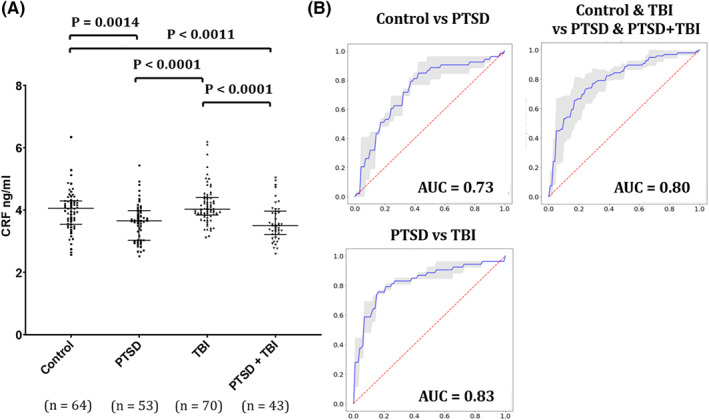
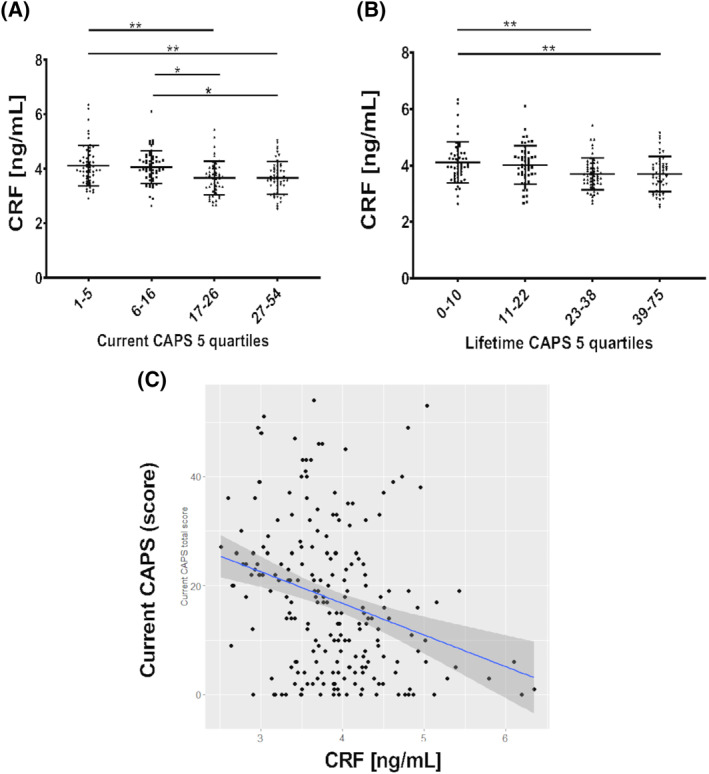
We analyzed serum CRF levels in 230 participants including heathy controls (64), and individuals with PTSD (53), TBI (70) or PTSD+TBI (43) by enzyme immunoassay (EIA). Significantly lower CRF levels were found in both the PTSD and PTSD+TBI groups compared to healthy control (PTSD vs Controls: P=0.0014, PTSD + TBI vs Controls: P=0.0011) and chronic TBI participants (PTSD vs TBI: P<0.0001PTSD + TBI vs TBI: P<0.0001) , suggesting a PTSD-related mechanism independent from TBI and associated with CRF reduction. CRF levels negatively correlated with PTSD severity on the CAPS-5 scale in the whole study group.
Hyperactivation of the HPA axis has been classically identified in acute stress. However, the recognized enhanced feedback inhibition of the HPA axis in chronic stress supports our findings of lower CRF in PTSD patients. This study suggests that reduced serum CRF in PTSD should be further investigated. Future validation studies will establish if CRF is a possible blood biomarker for PTSD and/or for differentiating PTSD and chronic TBI symptomatology.
创伤后应激障碍(PTSD)是一种严重且常使人衰弱的精神疾病,可发生于经历过创伤性应激源的人群,如战争、暴力、性侵犯及其他危及生命的事件。退伍军人创伤后应激障碍(PTSD)和创伤性脑损伤(TBI)的治疗面临诊断复杂性的挑战,部分原因是PTSD和TBI症状重叠,以及主观自我报告评估可能受患者分享创伤经历及由此产生症状意愿的影响。促肾上腺皮质激素释放因子(CRF)是应激和焦虑时下丘脑-垂体-肾上腺(HPA)轴反应的主要介质之一。
我们采用酶免疫分析法(EIA)分析了230名参与者的血清CRF水平,其中包括健康对照者(64名)、PTSD患者(53名)、TBI患者(70名)或PTSD+TBI患者(43名)。与健康对照者相比,PTSD组和PTSD+TBI组的CRF水平均显著降低(PTSD组与对照组比较:P=0.0014;PTSD+TBI组与对照组比较:P=0.0011),与慢性TBI参与者相比也显著降低(PTSD组与TBI组比较:P<0.0001;PTSD+TBI组与TBI组比较:P<0.0001),提示存在一种独立于TBI且与CRF降低相关的PTSD相关机制。在整个研究组中,CRF水平与CAPS-5量表上的PTSD严重程度呈负相关。
HPA轴的过度激活在急性应激中已得到经典确认。然而,在慢性应激中公认的HPA轴反馈抑制增强支持了我们关于PTSD患者CRF水平较低的研究结果。本研究表明,PTSD患者血清CRF降低的情况应进一步研究。未来的验证研究将确定CRF是否可能是PTSD的血液生物标志物和/或用于区分PTSD和慢性TBI症状。