Saif Omar, Keane Aidan, Staddon Sam
School of GeoSciences, University of Edinburgh, Institute of Geography Drummond Street, Edinburgh, EH8 9XP, UK.
School of GeoSciences, University of Edinburgh, Crew Building, Alexander Crum Brown Road, Edinburgh, EH10 3FF, UK.
Conserv Biol. 2022 Feb 24;36(4). doi: 10.1111/cobi.13903.
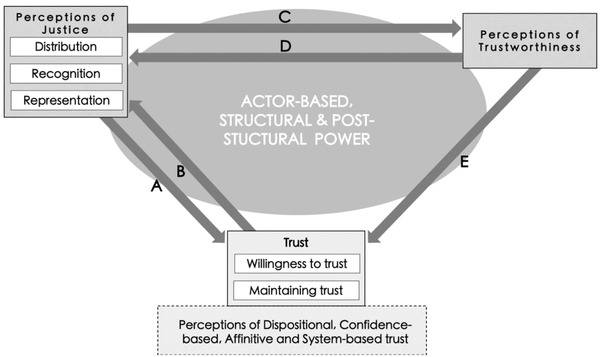
In conservation, trust and justice are increasingly recognized as both intrinsically valuable and critical for successful socio-ecological outcomes. However, the interdependence between these concepts has not been explored. In reviewing the conservation trust scholarship, we find efforts to build trust between conservation and local actors, yet this is often conceived to incentivize local cooperation within dominant paradigms. We argue that trust-building which does not actively plan to address power asymmetries in conservation practice may inadvertently re-embed inequities, and therefore offer a justice-trust model to provide a critical analysis of conservation partnerships. We draw on environmental justice theory to better calibrate trust literature for the historical-political settings of conservation, especially in the Global South. We demonstrate that justice and trust share strong theoretical links with important practical implications for understanding relationships. We apply our justice-trust framework to multiple case-studies, exploring i) how perceptions of (in)justice can shape willingness to trust, and ii) the ways in which nature-dependent communities and marginalized conservation workers are trusted, or the conditions they give trust under, can lead to partnerships being perceived as (un)just. We argue that focusing on trust in tandem with justice can help identify power dynamics so they can be more readily addressed. This article is protected by copyright. All rights reserved.
在保护领域,信任和正义日益被视为既具有内在价值,又对实现成功的社会生态成果至关重要。然而,这些概念之间的相互依存关系尚未得到探讨。在回顾保护信任方面的学术研究时,我们发现有努力在保护部门与当地行为体之间建立信任,但这通常被认为是为了在主流范式内激励地方合作。我们认为,在保护实践中,若不积极规划解决权力不对称问题的信任建设可能会无意中重新嵌入不平等现象,因此我们提供一种正义 - 信任模型,以对保护伙伴关系进行批判性分析。我们借鉴环境正义理论,以便根据保护工作的历史政治背景,尤其是全球南方的背景,更好地校准信任方面的文献。我们证明,正义和信任在理论上有着紧密联系,对理解各种关系具有重要的实际意义。我们将正义 - 信任框架应用于多个案例研究,探讨:其一,对(非)正义的认知如何影响信任意愿;其二,依赖自然的社区和边缘化的保护工作者被信任的方式,或者他们给予信任的条件,如何导致伙伴关系被视为(不)公正。我们认为,将信任与正义结合起来关注有助于识别权力动态,从而使其更易于得到解决。本文受版权保护。保留所有权利。