• 文献检索
  • 文档翻译
  • 深度研究
  • 学术资讯
  • Suppr Zotero 插件Zotero 插件
  • 邀请有礼
  • 套餐&价格
  • 历史记录
应用&插件
Suppr Zotero 插件Zotero 插件浏览器插件Mac 客户端Windows 客户端微信小程序
定价
高级版会员购买积分包购买API积分包
服务
文献检索文档翻译深度研究API 文档MCP 服务
关于我们
关于 Suppr公司介绍联系我们用户协议隐私条款
关注我们

Suppr 超能文献

核心技术专利:CN118964589B侵权必究
粤ICP备2023148730 号-1Suppr @ 2026

文献检索

告别复杂PubMed语法,用中文像聊天一样搜索,搜遍4000万医学文献。AI智能推荐,让科研检索更轻松。

立即免费搜索

文件翻译

保留排版,准确专业,支持PDF/Word/PPT等文件格式,支持 12+语言互译。

免费翻译文档

深度研究

AI帮你快速写综述,25分钟生成高质量综述,智能提取关键信息,辅助科研写作。

立即免费体验

描述交叉健康结局:数据分析方法的评估。

Describing Intersectional Health Outcomes: An Evaluation of Data Analysis Methods.

机构信息

From the Department of Epidemiology and Biostatistics, Schulich School of Medicine & Dentistry, Western University, London, ON, Canada.

Department of Computer Science, Faculty of Science, Western University, London, ON, Canada.

出版信息

Epidemiology. 2022 May 1;33(3):395-405. doi: 10.1097/EDE.0000000000001466.

DOI:10.1097/EDE.0000000000001466
PMID:35213512
原文链接:https://pmc.ncbi.nlm.nih.gov/articles/PMC8983950/
Abstract

BACKGROUND

Intersectionality theoretical frameworks have been increasingly incorporated into quantitative research. A range of methods have been applied to describing outcomes and disparities across large numbers of intersections of social identities or positions, with limited evaluation.

METHODS

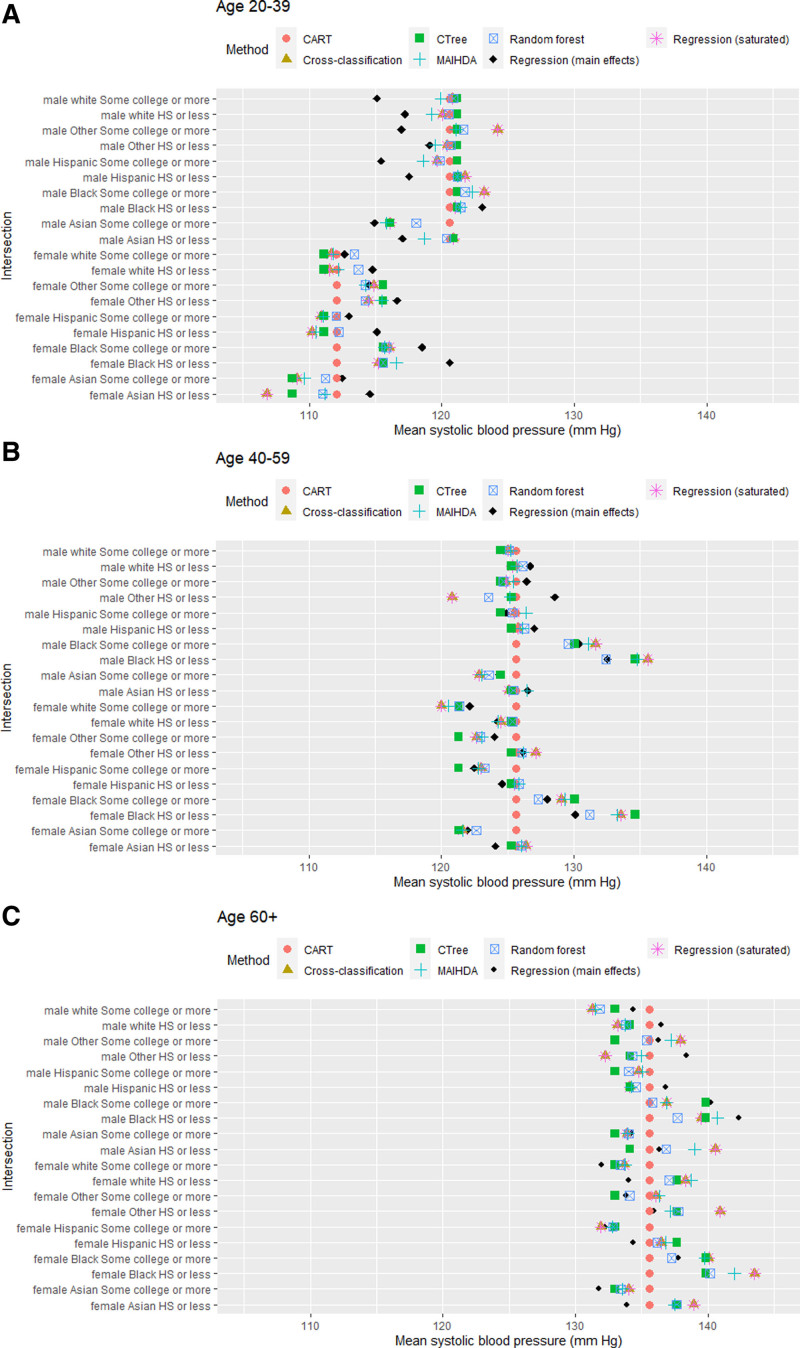
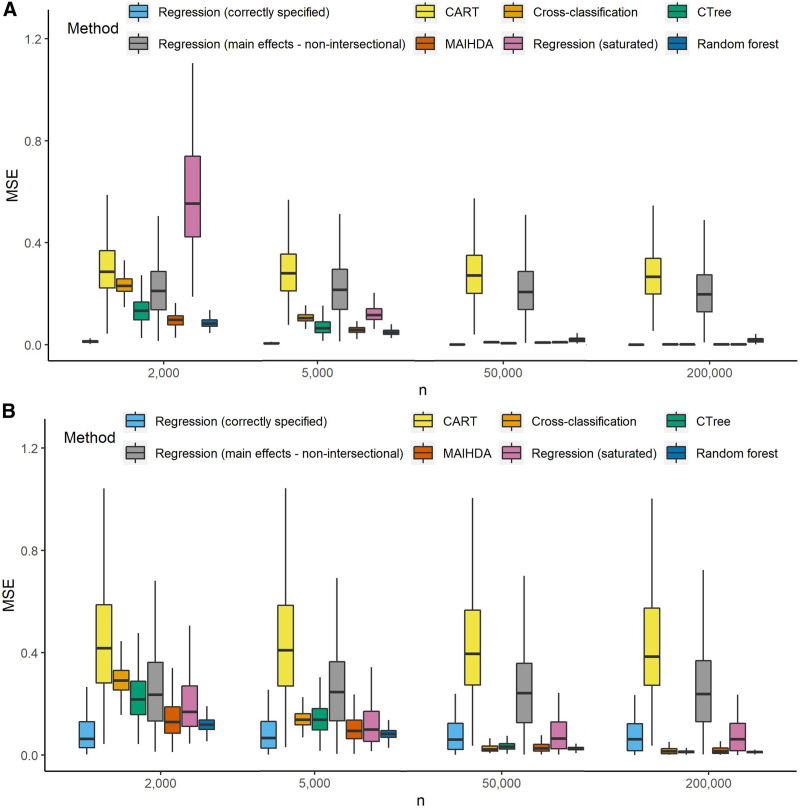
Using data simulated to reflect plausible epidemiologic data scenarios, we evaluated methods for intercategorical intersectional analysis of continuous outcomes, including cross-classification, regression with interactions, multilevel analysis of individual heterogeneity (MAIHDA), and decision-tree methods (classification and regression trees [CART], conditional inference trees [CTree], random forest). The primary outcome was estimation accuracy of intersection-specific means. We applied each method to an illustrative example using National Health and Nutrition Examination Study (NHANES) systolic blood pressure data.

RESULTS

When studying high-dimensional intersections at smaller sample sizes, MAIHDA, CTree, and random forest produced more accurate estimates. In large samples, all methods performed similarly except CART, which produced less accurate estimates. For variable selection, CART performed poorly across sample sizes, although random forest performed best. The NHANES example demonstrated that different methods resulted in meaningful differences in systolic blood pressure estimates, highlighting the importance of selecting appropriate methods.

CONCLUSIONS

This study evaluates some of a growing toolbox of methods for describing intersectional health outcomes and disparities. We identified more accurate methods for estimating outcomes for high-dimensional intersections across different sample sizes. As estimation is rarely the only objective for epidemiologists, we highlight different outputs each method creates, and suggest the sequential pairing of methods as a strategy for overcoming certain technical challenges.

摘要

背景

交叉性理论框架已越来越多地被纳入定量研究中。已经应用了多种方法来描述大量社会身份或地位交叉点的连续结果和差异,但是评估的范围有限。

方法

我们使用模拟数据来反映合理的流行病学数据情况,评估了用于连续结果的交叉分类分析的方法,包括交叉分类、具有交互作用的回归、个体异质性的多层次分析(MAIHDA)和决策树方法(分类和回归树[CART]、条件推断树[CTree]、随机森林)。主要结果是交叉特定平均值的估计准确性。我们使用国家健康和营养检查调查(NHANES)收缩压数据的示例来应用每种方法。

结果

当在较小的样本量下研究高维交叉时,MAIHDA、CTree 和随机森林产生了更准确的估计。在大样本中,除了 CART 外,所有方法的性能都相似,CART 产生的估计值不太准确。对于变量选择,CART 在所有样本量下的性能都很差,尽管随机森林的性能最好。NHANES 示例表明,不同的方法导致收缩压估计值有明显差异,强调了选择适当方法的重要性。

结论

本研究评估了一些用于描述交叉健康结果和差异的不断增长的工具包中的方法。我们确定了用于在不同样本量下估计高维交叉结果的更准确的方法。由于估计很少是流行病学家的唯一目标,因此我们突出了每种方法创建的不同输出,并建议将方法依次配对作为克服某些技术挑战的策略。
https://cdn.ncbi.nlm.nih.gov/pmc/blobs/e793/8983950/bfc0c60ca575/ede-33-395-g002.jpg
https://cdn.ncbi.nlm.nih.gov/pmc/blobs/e793/8983950/d3dfab9bc989/ede-33-395-g001.jpg
https://cdn.ncbi.nlm.nih.gov/pmc/blobs/e793/8983950/bfc0c60ca575/ede-33-395-g002.jpg
https://cdn.ncbi.nlm.nih.gov/pmc/blobs/e793/8983950/d3dfab9bc989/ede-33-395-g001.jpg
https://cdn.ncbi.nlm.nih.gov/pmc/blobs/e793/8983950/bfc0c60ca575/ede-33-395-g002.jpg

相似文献

1
Describing Intersectional Health Outcomes: An Evaluation of Data Analysis Methods.描述交叉健康结局:数据分析方法的评估。
Epidemiology. 2022 May 1;33(3):395-405. doi: 10.1097/EDE.0000000000001466.
2
Quantitative methods for descriptive intersectional analysis with binary health outcomes.用于二元健康结局描述性交叉分析的定量方法。
SSM Popul Health. 2022 Jan 22;17:101032. doi: 10.1016/j.ssmph.2022.101032. eCollection 2022 Mar.
3
Math versus meaning in MAIHDA: A commentary on multilevel statistical models for quantitative intersectionality.MAIHDA 中的数学与意义:对定量交叉性的多层次统计模型的评论。
Soc Sci Med. 2020 Jan;245:112500. doi: 10.1016/j.socscimed.2019.112500. Epub 2019 Aug 24.
4
Multilevel versus single-level regression for the analysis of multilevel information: The case of quantitative intersectional analysis.多层次与单层次回归在多层次信息分析中的应用:定量交叉分析案例。
Soc Sci Med. 2020 Jan;245:112499. doi: 10.1016/j.socscimed.2019.112499. Epub 2019 Aug 24.
5
Folic acid supplementation and malaria susceptibility and severity among people taking antifolate antimalarial drugs in endemic areas.在流行地区,服用抗叶酸抗疟药物的人群中,叶酸补充剂与疟疾易感性和严重程度的关系。
Cochrane Database Syst Rev. 2022 Feb 1;2(2022):CD014217. doi: 10.1002/14651858.CD014217.
6
A tutorial for conducting intersectional multilevel analysis of individual heterogeneity and discriminatory accuracy (MAIHDA).个体异质性与判别准确性的交叉多层次分析(MAIHDA)操作指南
SSM Popul Health. 2024 Mar 26;26:101664. doi: 10.1016/j.ssmph.2024.101664. eCollection 2024 Jun.
7
Methods for analytic intercategorical intersectionality in quantitative research: Discrimination as a mediator of health inequalities.定量研究中分析类别交叉性的方法:歧视作为健康不平等的中介
Soc Sci Med. 2019 Apr;226:236-245. doi: 10.1016/j.socscimed.2018.12.015. Epub 2019 Jan 21.
8
Multilevel analysis of individual heterogeneity and discriminatory accuracy (MAIHDA) within an intersectional framework.基于交叉框架的个体异质性和判别准确性的多层次分析(MAIHDA)。
Soc Sci Med. 2018 Apr;203:74-80. doi: 10.1016/j.socscimed.2017.12.026. Epub 2017 Dec 26.
9
The intersections of socioeconomic position, gender, race/ethnicity and nationality in relation to oral conditions among American adults.美国成年人的社会经济地位、性别、种族/民族和国籍在口腔状况方面的交叉。
Community Dent Oral Epidemiol. 2023 Aug;51(4):644-652. doi: 10.1111/cdoe.12845. Epub 2023 Feb 14.
10
Overcoming combination fatigue: Addressing high-dimensional effect measure modification and interaction in clinical, biomedical, and epidemiologic research using multilevel analysis of individual heterogeneity and discriminatory accuracy (MAIHDA).克服组合疲劳:利用个体异质性和判别准确性的多层次分析(MAIHDA)解决临床、生物医学和流行病学研究中的高维效应测量修正和相互作用问题。
Soc Sci Med. 2024 Jan;340:116493. doi: 10.1016/j.socscimed.2023.116493. Epub 2023 Dec 8.

引用本文的文献

1
The Unheeded Layers of Health Inequity: Visible Minority and Intersectionality.被忽视的健康不平等层面:少数族裔与交叉性
Int J Environ Res Public Health. 2025 Jun 26;22(7):1007. doi: 10.3390/ijerph22071007.
2
Study protocol for the Rainbow Austrian Longitudinal Family (RALF) study: a longitudinal, multi-method, multi-rater investigation of risk and resilience factors in Austrian LGBTQ+ parent families.奥地利彩虹纵向家庭(RALF)研究的研究方案:一项对奥地利 LGBTQ+ 父母家庭中的风险和复原力因素进行纵向、多方法、多评估者的调查。
BMC Psychol. 2025 May 26;13(1):560. doi: 10.1186/s40359-025-02828-4.
3
What can we learn from an intersectionality-informed description of study participants? Results from the German National Cohort.
从对研究参与者的交叉性描述中我们能学到什么?德国国家队列研究的结果。
Int J Equity Health. 2025 May 26;24(1):151. doi: 10.1186/s12939-025-02521-3.
4
Examining variation within Hispanic ethnicity: An intersectional multilevel analysis of individual heterogeneity and discriminatory accuracy (MAIHDA) of birthweight inequities in New York City, 2012-2019.审视西班牙裔内部的差异:2012 - 2019年纽约市出生体重不平等的个体异质性与歧视准确性的交叉多层次分析(MAIHDA)
SSM Popul Health. 2025 Jan 23;29:101759. doi: 10.1016/j.ssmph.2025.101759. eCollection 2025 Mar.
5
Operationalising routinely collected patient data in research to further the pursuit of social justice and health equity: a team-based scoping review.将常规收集的患者数据用于研究以促进社会正义和健康公平的实施:一项基于团队的范围综述。
BMC Med Res Methodol. 2025 Jan 21;25(1):14. doi: 10.1186/s12874-025-02466-9.
6
Methodologies for the collection of parameters to estimate dust/soil ingestion for young children.用于估算幼儿灰尘/土壤摄入的参数收集方法。
Front Public Health. 2024 Jun 26;12:1357346. doi: 10.3389/fpubh.2024.1357346. eCollection 2024.
7
Estimating substance use disparities across intersectional social positions using machine learning: An application of group-lasso interaction network.使用机器学习评估交叉社会地位间的物质使用差异:组套索交互网络的应用
Psychol Addict Behav. 2025 Mar;39(2):113-126. doi: 10.1037/adb0001020. Epub 2024 Jun 27.
8
Methods for structural sexism and population health research: Introducing a novel analytic framework to capture life-course and intersectional effects.结构性别主义与人口健康研究方法:引入一种新的分析框架,以捕捉生命历程和交叉影响。
Soc Sci Med. 2024 Jun;351(Suppl 1):116804. doi: 10.1016/j.socscimed.2024.116804. Epub 2024 May 31.
9
A tutorial for conducting intersectional multilevel analysis of individual heterogeneity and discriminatory accuracy (MAIHDA).个体异质性与判别准确性的交叉多层次分析(MAIHDA)操作指南
SSM Popul Health. 2024 Mar 26;26:101664. doi: 10.1016/j.ssmph.2024.101664. eCollection 2024 Jun.
10
Methodological insights into multilevel analysis of individual heterogeneity and discriminatory accuracy: An empirical examination of the effects of strata configurations on between-stratum variance and of fixed effects across hierarchical levels.多层次分析个体异质性和判别准确性的方法学见解:对层配置对层间方差的影响以及跨层次固定效应的实证检验。
PLoS One. 2024 Mar 18;19(3):e0297561. doi: 10.1371/journal.pone.0297561. eCollection 2024.