• 文献检索
  • 文档翻译
  • 深度研究
  • 学术资讯
  • Suppr Zotero 插件Zotero 插件
  • 邀请有礼
  • 套餐&价格
  • 历史记录
应用&插件
Suppr Zotero 插件Zotero 插件浏览器插件Mac 客户端Windows 客户端微信小程序
定价
高级版会员购买积分包购买API积分包
服务
文献检索文档翻译深度研究API 文档MCP 服务
关于我们
关于 Suppr公司介绍联系我们用户协议隐私条款
关注我们

Suppr 超能文献

核心技术专利:CN118964589B侵权必究
粤ICP备2023148730 号-1Suppr @ 2026

文献检索

告别复杂PubMed语法,用中文像聊天一样搜索,搜遍4000万医学文献。AI智能推荐,让科研检索更轻松。

立即免费搜索

文件翻译

保留排版,准确专业,支持PDF/Word/PPT等文件格式,支持 12+语言互译。

免费翻译文档

深度研究

AI帮你快速写综述,25分钟生成高质量综述,智能提取关键信息,辅助科研写作。

立即免费体验

尼日利亚城市贫民窟的医疗服务使用情况的语境探索。

A contextual exploration of healthcare service use in urban slums in Nigeria.

机构信息

Department of Sociology, University of Ibadan, Ibadan, Nigeria.

Warwick Medical School, University of Warwick, Warwick, United Kingdom.

出版信息

PLoS One. 2022 Feb 25;17(2):e0264725. doi: 10.1371/journal.pone.0264725. eCollection 2022.

DOI:10.1371/journal.pone.0264725
PMID:35213671
原文链接:https://pmc.ncbi.nlm.nih.gov/articles/PMC8880927/
Abstract

INTRODUCTION

Many urban residents in low- and middle-income countries live in unfavorable conditions with few healthcare facilities, calling to question the long-held view of urban advantage in health, healthcare access and utilization. We explore the patterns of healthcare utilization in these deprived neighborhoods by studying three such settlements in Nigeria.

METHODS

The study was conducted in three slums in Southwestern Nigeria, categorized as migrant, indigenous or cosmopolitan, based on their characteristics. Using observational data of those who needed healthcare and used in-patient or out-patient services in the 12 months preceding the survey, frequencies, percentages and odds-ratios were used to show the study participants' environmental and population characteristics, relative to their patterns of healthcare use.

RESULTS

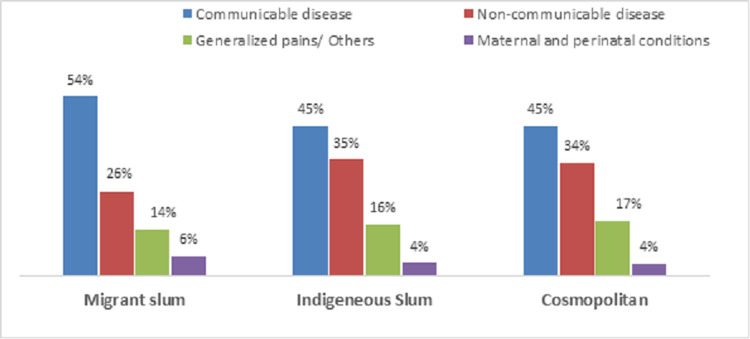
A total of 1,634 residents from the three slums participated, distributed as 763 (migrant), 459 (indigenous) and 412 (cosmopolitan). Residents from the migrant (OR = 0.70, 95%CI: 0.51 to 0.97) and indigenous (OR = 0.65, 95%CI: 0.45 to 0.93) slums were less likely to have used formal healthcare facilities than those from the cosmopolitan slum. Slum residents were more likely to use formal healthcare facilities for maternal and perinatal conditions, and generalized pains, than for communicable (OR = 0.50, 95%CI: 0.34 to 0.72) and non-communicable diseases (OR = 0.61, 95%CI: 0.41 to 0.91). The unemployed had higher odds (OR = 1.45, 95%CI: 1.08 to 1.93) of using formal healthcare facilities than those currently employed.

CONCLUSION

The cosmopolitan slum, situated in a major financial center and national economic hub, had a higher proportion of formal healthcare facility usage than the migrant and indigenous slums where about half of families were classified as poor. The urban advantage premise and Anderson behavioral model remain a practical explanatory framework, although they may not explain healthcare use in all possible slum types in Africa. A context-within-context approach is important for addressing healthcare utilization challenges in slums in sub-Saharan Africa.

摘要

简介

许多中低收入国家的城市居民生活在条件不利的环境中,医疗设施匮乏,这对城市在健康、医疗保健可及性和利用方面具有优势的长期观点提出了质疑。我们通过研究尼日利亚的三个这样的定居点来探索这些贫困社区的医疗保健利用模式。

方法

该研究在尼日利亚西南部的三个贫民窟进行,根据其特点将其分为移民、本土或国际化。使用调查前 12 个月需要医疗保健并使用门诊或住院服务的人的观察数据,使用频率、百分比和优势比来显示研究参与者的环境和人口特征,相对于他们的医疗保健使用模式。

结果

共有来自三个贫民窟的 1634 名居民参与,其中 763 名(移民)、459 名(本土)和 412 名(国际化)。与国际化贫民窟的居民相比,移民(OR=0.70,95%CI:0.51 至 0.97)和本土(OR=0.65,95%CI:0.45 至 0.93)贫民窟的居民使用正规医疗设施的可能性较小。贫民窟居民更有可能因产妇和围产期疾病以及一般性疼痛而使用正规医疗设施,而不是因传染病(OR=0.50,95%CI:0.34 至 0.72)和非传染病(OR=0.61,95%CI:0.41 至 0.91)而使用正规医疗设施。失业者比目前就业者使用正规医疗设施的可能性更高(OR=1.45,95%CI:1.08 至 1.93)。

结论

位于主要金融中心和国家经济中心的国际化贫民窟使用正规医疗设施的比例高于移民和本土贫民窟,其中约一半家庭被归类为贫困家庭。尽管城市优势前提和安德森行为模型可能无法解释非洲所有可能的贫民窟类型中的医疗保健使用情况,但它们仍然是一个实用的解释框架。在撒哈拉以南非洲的贫民窟中,需要采用情境内情境方法来解决医疗保健利用方面的挑战。
https://cdn.ncbi.nlm.nih.gov/pmc/blobs/2491/8880927/040795e984df/pone.0264725.g001.jpg

相似文献

1
A contextual exploration of healthcare service use in urban slums in Nigeria.尼日利亚城市贫民窟的医疗服务使用情况的语境探索。
PLoS One. 2022 Feb 25;17(2):e0264725. doi: 10.1371/journal.pone.0264725. eCollection 2022.
2
The economics of healthcare access: a scoping review on the economic impact of healthcare access for vulnerable urban populations in low- and middle-income countries.医疗保健可及性的经济学:关于医疗保健可及性对中低收入国家弱势城市人口的经济影响的范围综述。
Int J Equity Health. 2022 Dec 31;21(1):191. doi: 10.1186/s12939-022-01804-3.
3
Morbidity Pattern and Choice of Care in an Urban Slum of a Metropolitan State, Southwestern Nigeria.尼日利亚西南部一个大都市州城市贫民窟的发病模式与医疗选择
West Afr J Med. 2020 Jul-Aug;37(3):268-274.
4
Reproductive health service access and utilisation among migrant women in Dhaka's urban slums: a qualitative study.达卡城市贫民窟移民妇女的生殖健康服务获取和利用情况:一项定性研究。
Cult Health Sex. 2024 Sep;26(9):1134-1148. doi: 10.1080/13691058.2024.2302052. Epub 2024 Jan 27.
5
Barriers to formal emergency obstetric care services' utilization.利用正规紧急产科护理服务的障碍。
J Urban Health. 2011 Jun;88 Suppl 2(Suppl 2):S356-69. doi: 10.1007/s11524-010-9481-1.
6
Maternal and newborn healthcare utilization in Kampala urban slums: perspectives of women, their spouses, and healthcare providers.坎帕拉市区贫民窟孕产妇和新生儿保健服务的利用:妇女及其配偶和保健提供者的观点。
BMC Pregnancy Childbirth. 2023 May 5;23(1):321. doi: 10.1186/s12884-023-05643-0.
7
Unmasking inequalities: Sub-national maternal and child mortality data from two urban slums in Lagos, Nigeria tells the story.揭示不平等现象:来自尼日利亚拉各斯两个城市贫民窟的地方层面母婴死亡率数据说明了一切。
PLoS One. 2017 May 10;12(5):e0177190. doi: 10.1371/journal.pone.0177190. eCollection 2017.
8
Prevalence and factors associated with knowledge and access to delivery services at primary health care facilities amongst indigenous women in Khagrachhari district Bangladesh - A cross-sectional study.孟加拉国科格拉恰里县原住民妇女在初级卫生保健设施获得和了解分娩服务的现况及其影响因素:一项横断面研究。
Midwifery. 2020 Nov;90:102798. doi: 10.1016/j.midw.2020.102798. Epub 2020 Jul 18.
9
Birth preparedness and determinants of birth place among migrants living in slums and slum-like pockets in Delhi, India.印度德里贫民窟及类似贫民窟地区移民的生育准备情况和分娩地点的决定因素。
Sex Reprod Healthc. 2018 Jun;16:160-166. doi: 10.1016/j.srhc.2018.04.004. Epub 2018 Apr 9.
10
Reducing Inequity in Urban Health: Have the Intra-urban Differentials in Reproductive Health Service Utilization and Child Nutritional Outcome Narrowed in Bangladesh?减少城市健康不平等:孟加拉国城市内部生殖健康服务利用和儿童营养结果的差异是否缩小了?
J Urban Health. 2019 Apr;96(2):193-207. doi: 10.1007/s11524-018-0307-x.

引用本文的文献

1
Climate, health, and living condition crises in the expanding informal settlements and slums of South-West Nigeria: a case report of Ogun and Oyo states.尼日利亚西南部不断扩张的非正式定居点和贫民窟中的气候、健康与生活条件危机:奥贡州和奥约州的案例报告
J Glob Health. 2025 Jun 27;15:03031. doi: 10.7189/jogh.15.03031.
2
Referral experiences of healthcare consumers: results from a cross-sectional study in urban slums in southeast Nigeria.医疗消费者的转诊经历:尼日利亚东南部城市贫民窟横断面研究的结果
Front Public Health. 2025 May 27;13:1561158. doi: 10.3389/fpubh.2025.1561158. eCollection 2025.
3
Community leaders' perspectives on linking formal and informal health providers in Nigerian urban slums: a qualitative study.

本文引用的文献

1
Pharmacies in informal settlements: a retrospective, cross-sectional household and health facility survey in four countries.非正式住区的药房:四个国家的回顾性、横断面家庭和卫生机构调查。
BMC Health Serv Res. 2021 Sep 9;21(1):945. doi: 10.1186/s12913-021-06937-9.
2
Slum decay in Sub-Saharan Africa: Context, environmental pollution challenges, and impact on dweller's health.撒哈拉以南非洲的贫民窟衰败:背景、环境污染挑战及其对居民健康的影响。
Environ Epidemiol. 2021 May 20;5(3):e158. doi: 10.1097/EE9.0000000000000158. eCollection 2021 Jun.
3
Impact of the societal response to COVID-19 on access to healthcare for non-COVID-19 health issues in slum communities of Bangladesh, Kenya, Nigeria and Pakistan: results of pre-COVID and COVID-19 lockdown stakeholder engagements.
尼日利亚城市贫民窟社区领袖对正规与非正规医疗服务提供者建立联系的看法:一项定性研究。
Discov Soc Sci Health. 2025;5(1):61. doi: 10.1007/s44155-025-00205-5. Epub 2025 May 1.
4
Institutionalizing linkages between informal healthcare providers and the formal health system in Nigeria: what are the facilitating and constraining contextual influences?在尼日利亚将非正式医疗服务提供者与正规卫生系统之间的联系制度化:促进和制约的背景影响因素有哪些?
Health Policy Plan. 2025 Apr 9;40(4):471-482. doi: 10.1093/heapol/czaf009.
5
Co-creation and application of a framework for the de-prioritization of urban communities during insecticide-treated bed net mass campaigns for malaria prevention and control in Kwara State, Nigeria.在尼日利亚夸拉州开展的用于疟疾预防和控制的经杀虫剂处理蚊帐大规模运动期间,城市社区去优先排序框架的共同创建与应用。
BMC Glob Public Health. 2025 Feb 6;3(1):11. doi: 10.1186/s44263-025-00126-0.
6
Diagnosis, treatment, and management of Mpox in urban Informal Settlements in Southwestern Nigeria: an ethnographic approach.尼日利亚西南部城市非正式定居点猴痘的诊断、治疗与管理:一种人种志方法
BMC Public Health. 2025 Jan 9;25(1):115. doi: 10.1186/s12889-024-21267-1.
7
To What Extent Are Informal Healthcare Providers in Slums Linked to the Formal Health System in Providing Services in Sub-Sahara Africa? A 12-Year Scoping Review.在撒哈拉以南非洲地区,贫民窟的非正规医疗服务提供者在提供服务方面与正规卫生系统的联系程度如何?一项为期12年的范围审查。
J Urban Health. 2024 Dec;101(6):1248-1258. doi: 10.1007/s11524-024-00885-5. Epub 2024 Jun 14.
8
Strengthening care for emergencies: what is the level of awareness and utilization of Emergency Medical Services (EMS) in FCT, Nigeria?加强急诊护理:尼日利亚联邦首都区(FCT)民众对紧急医疗服务(EMS)的认知和利用程度如何?
BMC Emerg Med. 2024 Apr 29;24(1):73. doi: 10.1186/s12873-024-00991-2.
9
Health seeking behaviours and private sector delivery of care for non-communicable diseases in low- and middle-income countries: a systematic review.健康寻求行为和中低收入国家非传染性疾病的私营部门医疗服务提供:系统评价。
BMC Health Serv Res. 2024 Jan 23;24(1):127. doi: 10.1186/s12913-023-10464-0.
10
Healthcare utilization among informal caregivers of older adults in the Ashanti region of Ghana: a study based on the health belief model.加纳阿散蒂地区老年人非正式照料者的医疗保健利用情况:一项基于健康信念模型的研究。
Arch Public Health. 2023 Oct 23;81(1):187. doi: 10.1186/s13690-023-01200-5.
新冠疫情下孟加拉国、肯尼亚、尼日利亚和巴基斯坦贫民窟社区非新冠保健问题获得医疗保健服务的影响:新冠疫情前和封锁期间利益攸关方参与的结果。
BMJ Glob Health. 2020 Aug;5(8). doi: 10.1136/bmjgh-2020-003042.
4
Healthcare seeking for chronic illness among adult slum dwellers in Bangladesh: A descriptive cross-sectional study in two urban settings.孟加拉国贫民窟成年居民慢性疾病求医行为:两个城市环境中的描述性横断面研究。
PLoS One. 2020 Jun 15;15(6):e0233635. doi: 10.1371/journal.pone.0233635. eCollection 2020.
5
Health services utilization among slum dwellers: An experience from Iran.贫民窟居民的医疗服务利用情况:来自伊朗的经验。
J Educ Health Promot. 2019 Oct 24;8:210. doi: 10.4103/jehp.jehp_358_19. eCollection 2019.
6
Assessment of a free maternal and child health program and the prospects for program re-activation and scale-up using a new health fund in Nigeria.对一项免费妇幼保健项目的评估以及利用尼日利亚一项新的健康基金重新启动和扩大该项目的前景。
Niger J Clin Pract. 2019 Nov;22(11):1516-1529. doi: 10.4103/njcp.njcp_503_18.
7
Determinants of antenatal care utilisation in sub-Saharan Africa: a systematic review.撒哈拉以南非洲地区产前护理利用的决定因素:系统评价。
BMJ Open. 2019 Oct 7;9(10):e031890. doi: 10.1136/bmjopen-2019-031890.
8
A protocol for a multi-site, spatially-referenced household survey in slum settings: methods for access, sampling frame construction, sampling, and field data collection.多地点、空间参照贫民窟住户调查议定书:进入方法、抽样框架构建、抽样和实地数据收集方法。
BMC Med Res Methodol. 2019 May 30;19(1):109. doi: 10.1186/s12874-019-0732-x.
9
Why patients prefer high-level healthcare facilities: a qualitative study using focus groups in rural and urban China.患者为何偏爱高级别医疗机构:一项在中国农村和城市地区运用焦点小组的定性研究
BMJ Glob Health. 2018 Sep 19;3(5):e000854. doi: 10.1136/bmjgh-2018-000854. eCollection 2018.
10
Healthcare choices in Mumbai slums: A cross-sectional study.孟买贫民窟的医疗保健选择:一项横断面研究。
Wellcome Open Res. 2017 Dec 5;2:115. doi: 10.12688/wellcomeopenres.13127.2. eCollection 2017.