National Perinatal Epidemiology Unit, Nuffield Department of Population Health, University of Oxford, Oxford, UK.
Royal College of Obstetricians and Gynaecologists, London, UK.
Acta Obstet Gynecol Scand. 2022 Apr;101(4):461-470. doi: 10.1111/aogs.14329. Epub 2022 Feb 25.
There is a lack of population level data on risk factors and impact of severe COVID-19 in pregnancy. The aims of this study were to determine the characteristics, and maternal and perinatal outcomes associated with severe COVID-19 in pregnancy compared with those with mild and moderate COVID-19 and to explore the impact of timing of birth.
This was a secondary analysis of a national, prospective cohort study. All pregnant women admitted to hospital in the UK with symptomatic SARS-CoV-2 from March 1, 2020 to October 31, 2021 were included. The severity of maternal infection (need for high flow or invasive ventilation, intensive care admission or died), pregnancy and perinatal outcomes, and the impact of timing of birth were analyzed using multivariable logistic regression.
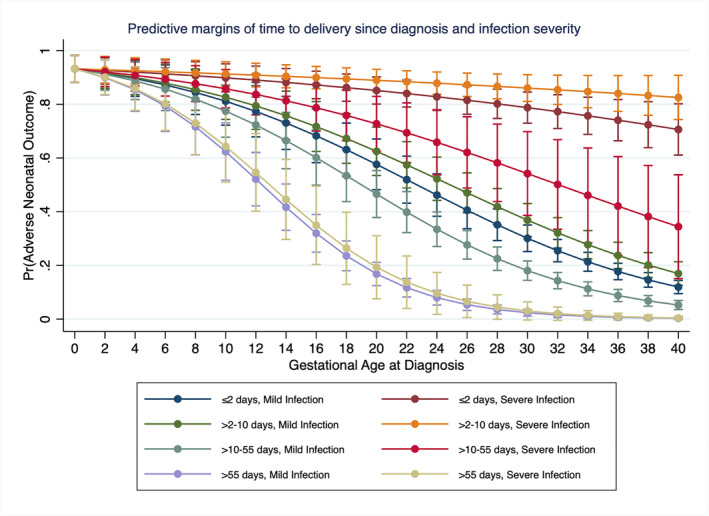
Of 4436 pregnant women, 13.9% (n = 616) had severe infection. Women with severe infection were more likely to be aged ≥30 years (adjusted odds ratio [aOR] aged 30-39 1.48, 95% confidence interval [CI] 1.20-1.83), be overweight or obese (aOR 1.73, 95% CI 1.34-2.25 and aOR 2.52 95% CI 1.97-3.23, respectively), be of mixed ethnicity (aOR 1.93, 95% CI 1.17-3.21) or have gestational diabetes (aOR 1.43, 95% CI 1.09-1.87) compared with those with mild or moderate infection. Women with severe infection were more likely to have a pre-labor cesarean birth (aOR 8.84, 95% CI 6.61-11.83), a very or extreme preterm birth (28-31+ weeks' gestation, aOR 18.97, 95% CI 7.78-14.85; <28 weeks' gestation, aOR 12.35, 95% CI 6.34-24.05) and their babies were more likely to be stillborn (aOR 2.51, 95% CI 1.35-4.66) or admitted to a neonatal unit (aOR 11.61, 95% CI 9.28-14.52). Of 112 women with severe infection who were discharged and gave birth at a later admission, the majority gave birth ≥36 weeks (85.7%), noting that three women in this group (2.7%) had a stillbirth.
Severe COVID-19 in pregnancy increases the risk of adverse outcomes. Information to promote uptake of vaccination should specifically target those at greatest risk of severe outcomes. Decisions about timing of birth should be informed by multidisciplinary team discussion; however, our data suggest that women with severe infection who do not require early delivery have mostly good outcomes but that those with severe infection at term may warrant rapid delivery.
关于 COVID-19 大流行期间妊娠女性的严重 COVID-19 的风险因素和影响,目前尚缺乏人群水平的数据。本研究的目的是确定严重 COVID-19 与轻度和中度 COVID-19 相比,与妊娠和围产儿结局相关的特征,以及探讨分娩时机的影响。
这是一项全国性前瞻性队列研究的二次分析。纳入了 2020 年 3 月 1 日至 2021 年 10 月 31 日期间英国因有症状 SARS-CoV-2 而住院的所有孕妇。使用多变量逻辑回归分析严重母体感染(需要高流量或有创通气、入住重症监护病房或死亡)、妊娠和围产儿结局以及分娩时机的影响。
在 4436 名孕妇中,13.9%(n=616)患有严重感染。严重感染的女性更有可能年龄≥30 岁(调整后的优势比[OR]30-39 岁为 1.48,95%置信区间[CI]1.20-1.83)、超重或肥胖(OR 1.73,95% CI 1.34-2.25 和 OR 2.52,95% CI 1.97-3.23)、混合种族(OR 1.93,95% CI 1.17-3.21)或患有妊娠期糖尿病(OR 1.43,95% CI 1.09-1.87)。与轻度或中度感染相比,严重感染的女性更有可能进行产前剖宫产(OR 8.84,95% CI 6.61-11.83)、非常或极早产(28-31+ 周分娩,OR 18.97,95% CI 7.78-14.85;<28 周分娩,OR 12.35,95% CI 6.34-24.05),其婴儿更有可能死产(OR 2.51,95% CI 1.35-4.66)或入住新生儿病房(OR 11.61,95% CI 9.28-14.52)。在 112 名严重感染出院并在后续住院分娩的女性中,大多数在≥36 周分娩(85.7%),但注意到该组中有 3 名女性(2.7%)死产。
妊娠期间的严重 COVID-19 增加了不良结局的风险。促进疫苗接种的信息应特别针对那些有严重后果风险最高的人群。分娩时机的决策应通过多学科团队讨论来决定;然而,我们的数据表明,不需要早期分娩的严重感染女性大多结局良好,但在足月时发生严重感染的女性可能需要快速分娩。