Giacomelli Andrea, Galli Massimo, Maggi Stefania, Noale Marianna, Trevisan Caterina, Pagani Gabriele, Antonelli-Incalzi Raffaele, Molinaro Sabrina, Bastiani Luca, Cori Liliana, Bianchi Fabrizio, Jesuthasan Nithiya, Prinelli Federica, Adorni Fulvio
III Infectious Diseases Unit, ASST Fatebenefratelli Sacco, Via G.B. Grassi 74, 20157 Milan, Italy.
Dipartimento di Scienze Biomediche e Cliniche Luigi Sacco, Università degli Studi di Milano, Via G.B. Grassi 74, 20157 Milan, Italy.
Vaccines (Basel). 2022 Feb 15;10(2):293. doi: 10.3390/vaccines10020293.
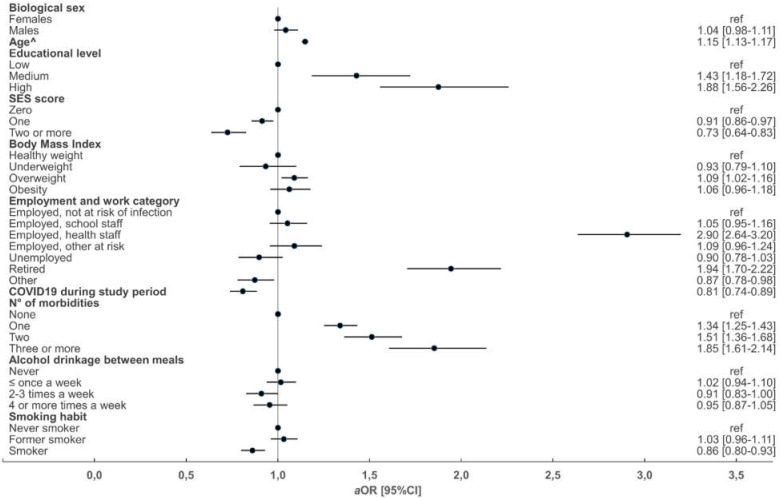
To assess influenza vaccine uptake during the 2020/2021 flu season and compare it with that of the 2019/2020 flu season among respondents to the second phase of the web-based EPICOVID-19 survey, we performed an observational web-based nationwide online survey (January-February 2021) in which respondents to the first survey (April-June 2020) were contacted and asked to complete a second questionnaire. Factors associated with vaccine uptake in the 2020/2021 flu season were assessed by applying a multivariable multinomial logistic regression model. Out of the 198,822 respondents to the first survey, 41,473 (20.9%) agreed to fill out the follow-up questionnaire; of these, 8339 (20.1%) were vaccinated only during the 2020/2021 season, 8828 (21.3%) were vaccinated during both seasons and 22,710 (54.8%) were vaccinated in neither season. Educational level (medium (aOR 1.33 95%CI 1.13-1.56) and high (aOR 1.69 95%CI 1.44-1.97) vs. low) and socio-economic deprivation according to SES scoring (1 point aOR 0.83 (95%CI 0.78-0.89), 2 aOR 0.68 (95%CI 0.60-0.77) points or ≥3 points aOR 0.42 (95%CI 0.28-0.45) vs. 0 points) were found to be associated with flu vaccine uptake. Our study shows that social determinants seemed to affect flu vaccination uptake and identifies specific categories of the population to target during future influenza vaccination campaigns.
为评估2020/2021流感季期间流感疫苗的接种情况,并将其与基于网络的EPICOVID-19调查第二阶段受访者中2019/2020流感季的接种情况进行比较,我们开展了一项基于网络的全国性在线观察性调查(2021年1月至2月),联系了第一次调查(2020年4月至6月)的受访者,并要求他们完成第二份问卷。通过应用多变量多项逻辑回归模型评估与2020/2021流感季疫苗接种相关的因素。在第一次调查的198,822名受访者中,41,473人(20.9%)同意填写后续问卷;其中,8339人(20.1%)仅在2020/2021季节接种了疫苗,8828人(21.3%)在两个季节均接种了疫苗,22,710人(54.8%)在两个季节均未接种疫苗。发现教育水平(中等(调整后比值比1.33,95%置信区间1.13 - 1.56)和高等(调整后比值比1.69,95%置信区间1.44 - 1.97)与低水平相比)以及根据社会经济地位评分的社会经济剥夺情况(1分调整后比值比0.83(95%置信区间0.78 - 0.89),2分调整后比值比0.68(95%置信区间0.60 - 0.77)或≥3分调整后比值比0.42(95%置信区间0.28 - 0.45)与0分相比)与流感疫苗接种相关。我们的研究表明,社会决定因素似乎会影响流感疫苗接种情况,并确定了在未来流感疫苗接种活动中需要针对的特定人群类别。