Yusup Shuayib, Sundberg Sebastian, Fan Beibei, Sulayman Mamtimin, Bu Zhao-Jun
Key Laboratory of Geographical Processes and Ecological Security in Changbai Mountains, Ministry of Education, School of Geographical Sciences, Northeast Normal University, Renmin 5268, Changchun 130024, China.
State Environmental Protection Key Laboratory of Wetland Ecology and Vegetation Restoration, Institute for Peat and Mire Research, Northeast Normal University, Renmin 5268, Changchun 130024, China.
Plants (Basel). 2022 Feb 11;11(4):485. doi: 10.3390/plants11040485.
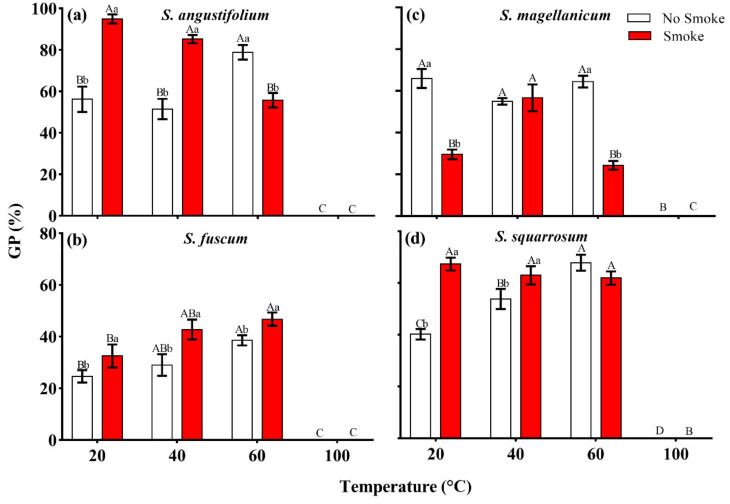
Plants in flammable ecosystems have different response strategies to fire, such as increasing germination after exposure to smoke and break of dormancy through heat shock. Peatlands are ecosystems that are more likely to be disturbed by fire with increasing temperatures, but it is not clear how fire affects spore germination of , the dominant plants in peatlands. Here, we hypothesize that spores respond positively to single and combined treatments of moderate heat and smoke (by increased germinability), while spore germinability decreases in response to high temperature. We exposed the spores of four selected species (, , and ) collected from peatlands in the Changbai Mountains to heat (40, 60 and 100 °C), on its own and combined with smoke-water treatments. Our results showed that a heat of 100 °C inhibited the spore germination or even killed spores of all species, while spore germination of three (, and ) of the four species was promoted by 40 and 60 °C heat compared to the control (20 °C). Hollow species ( and ) showed a stronger positive responsive to heat than hummock species ( and ). spores responded positively to the combined heat and smoke treatment while the other species did not. For the first time, we demonstrate the positive effects of heat on its own and in combination with smoke on spore germination in wetland mosses, which may be important for the establishment and persistence of peatmoss populations after fire.
易燃生态系统中的植物对火灾有不同的应对策略,例如接触烟雾后增加发芽率以及通过热激打破休眠。随着气温升高,泥炭地生态系统更容易受到火灾干扰,但火灾如何影响泥炭地优势植物泥炭藓的孢子萌发尚不清楚。在此,我们假设泥炭藓孢子对适度加热和烟雾的单一及联合处理有积极反应(发芽率提高),而孢子发芽率会因高温而降低。我们将从长白山泥炭地采集的四个选定物种(尖叶泥炭藓、中位泥炭藓、泥炭藓和毛壁泥炭藓)的孢子暴露于加热(40、60和100°C)环境中,单独加热以及与烟水联合处理。我们的结果表明,100°C的高温抑制了所有物种的孢子萌发,甚至杀死了孢子,而与对照(20°C)相比,四个物种中的三个(尖叶泥炭藓、中位泥炭藓和泥炭藓)的孢子在40和60°C加热条件下萌发得到促进。中空物种(尖叶泥炭藓和中位泥炭藓)对加热的积极反应比丘状物种(泥炭藓和毛壁泥炭藓)更强。泥炭藓孢子对加热与烟雾的联合处理有积极反应,而其他物种则没有。我们首次证明了加热本身以及加热与烟雾联合处理对湿地苔藓孢子萌发具有积极影响,这可能对火灾后泥炭藓种群的建立和持续存在具有重要意义。