Flinders Health and Medical Research Institute, College of Medicine and Public Health, Microbiology and Infectious Diseases, Flinders University, Bedford Park, Adelaide, SA 5042, Australia.
Robinson Research Institute, Adelaide Medical School, The University of Adelaide, Adelaide, SA 5000, Australia.
Viruses. 2022 Feb 14;14(2):386. doi: 10.3390/v14020386.
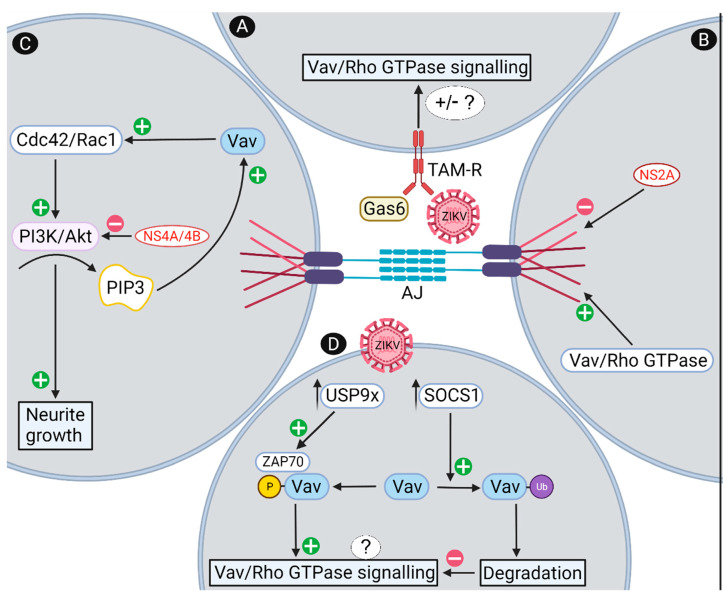
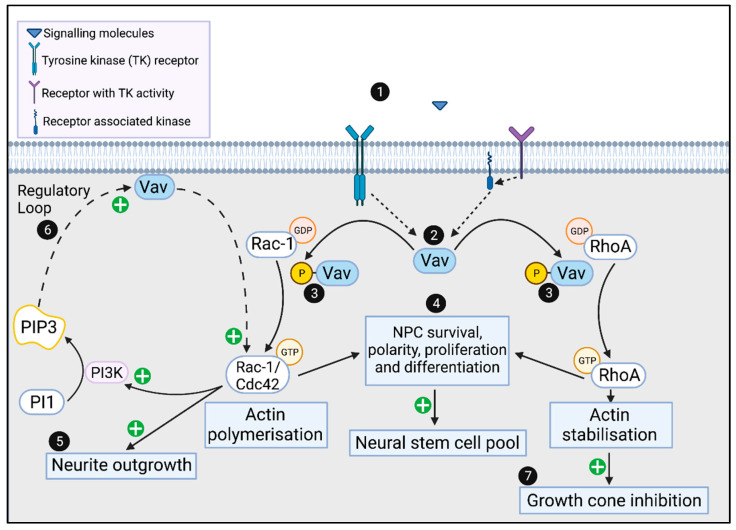
Zika virus (ZIKV) infection during pregnancy can result in a significant impact on the brain and eye of the developing fetus, termed congenital zika syndrome (CZS). At a morphological level, the main serious presentations of CZS are microcephaly and retinal scarring. At a cellular level, many cell types of the brain may be involved, but primarily neuronal progenitor cells (NPC) and developing neurons. Vav proteins have guanine exchange activity in converting GDP to GTP on proteins such as Rac1, Cdc42 and RhoA to stimulate intracellular signaling pathways. These signaling pathways are known to play important roles in maintaining the polarity and self-renewal of NPC pools by coordinating the formation of adherens junctions with cytoskeletal rearrangements. In developing neurons, these same pathways are adopted to control the formation and growth of neurites and mediate axonal guidance and targeting in the brain and retina. This review describes the role of Vavs in these processes and highlights the points of potential ZIKV interaction, such as (i) the binding and entry of ZIKV in cells via TAM receptors, which may activate Vav/Rac/RhoA signaling; (ii) the functional convergence of ZIKV NS2A with Vav in modulating adherens junctions; (iii) ZIKV NS4A/4B protein effects on PI3K/AKT in a regulatory loop via PPI3 to influence Vav/Rac1 signaling in neurite outgrowth; and (iv) the induction of 1 and following ZIKV infection to regulate Vav protein degradation or activation, respectively, and impact Vav/Rac/RhoA signaling in NPC and neurons. Experiments to define these interactions will further our understanding of the molecular basis of CZS and potentially other developmental disorders stemming from in utero infections. Additionally, Vav/Rac/RhoA signaling pathways may present tractable targets for therapeutic intervention or molecular rationale for disease severity in CZS.
寨卡病毒(ZIKV)感染孕妇可能会对胎儿大脑和眼睛造成严重影响,称为先天性寨卡综合征(CZS)。在形态学水平上,CZS 的主要严重表现是小头畸形和视网膜瘢痕。在细胞水平上,大脑的许多细胞类型可能会受到影响,但主要是神经祖细胞(NPC)和发育中的神经元。Vav 蛋白具有将 GDP 转化为 GTP 的鸟嘌呤交换活性,可作用于 Rac1、Cdc42 和 RhoA 等蛋白,从而刺激细胞内信号通路。这些信号通路在通过协调黏着连接的形成与细胞骨架重排来维持 NPC 池的极性和自我更新方面发挥重要作用。在发育中的神经元中,这些相同的途径被用于控制轴突的形成和生长,并介导大脑和视网膜中的轴突导向和靶向。本文综述了 Vavs 在这些过程中的作用,并强调了 ZIKV 潜在相互作用的要点,例如:(i)TAM 受体介导 ZIKV 在细胞中的结合和进入,这可能激活 Vav/Rac/RhoA 信号通路;(ii)ZIKV NS2A 与 Vav 在调节黏着连接中的功能融合;(iii)ZIKV NS4A/4B 蛋白通过 PPI3 影响 PI3K/AKT 以在调节环路中影响 NPC 和神经元中的 Vav/Rac1 信号通路,从而影响神经突起生长;(iv)ZIKV 感染诱导 1 和 分别调节 Vav 蛋白降解或激活,从而影响 NPC 和神经元中的 Vav/Rac/RhoA 信号通路。定义这些相互作用的实验将进一步了解 CZS 的分子基础,并可能为源自宫内感染的其他发育障碍提供分子依据。此外,Vav/Rac/RhoA 信号通路可能是治疗干预或 CZS 疾病严重程度的分子基础的可行靶点。