Plant Physiology, Biochemistry, Molecular Biology Program, Department of Plant and Soil Sciences, University of Kentucky, Lexington, KY 40546, USA.
Int J Mol Sci. 2022 Feb 9;23(4):1933. doi: 10.3390/ijms23041933.
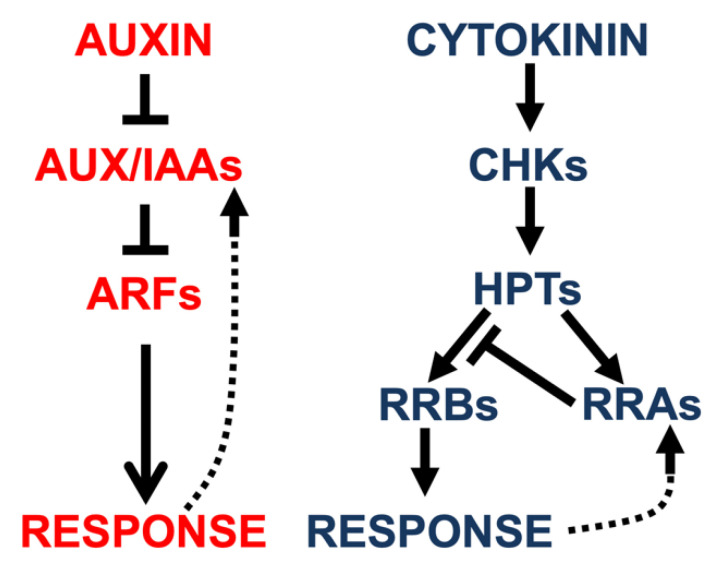
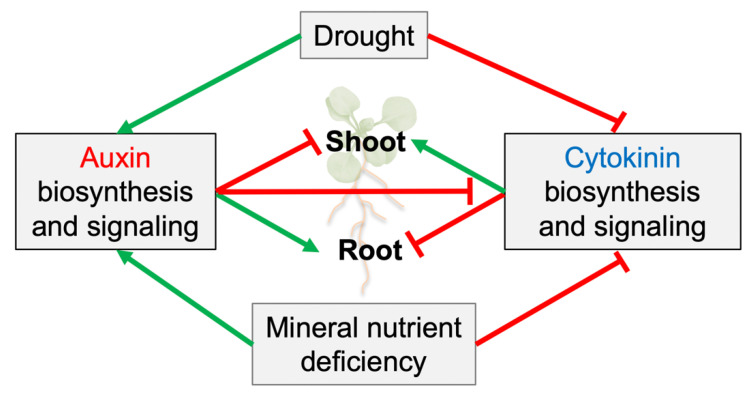
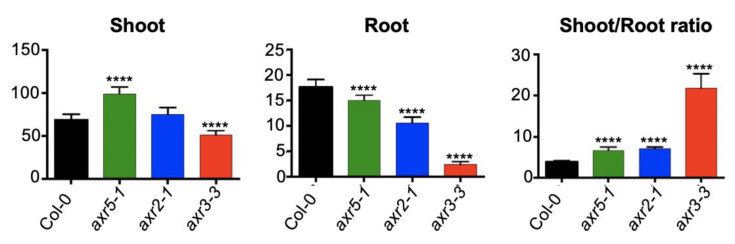
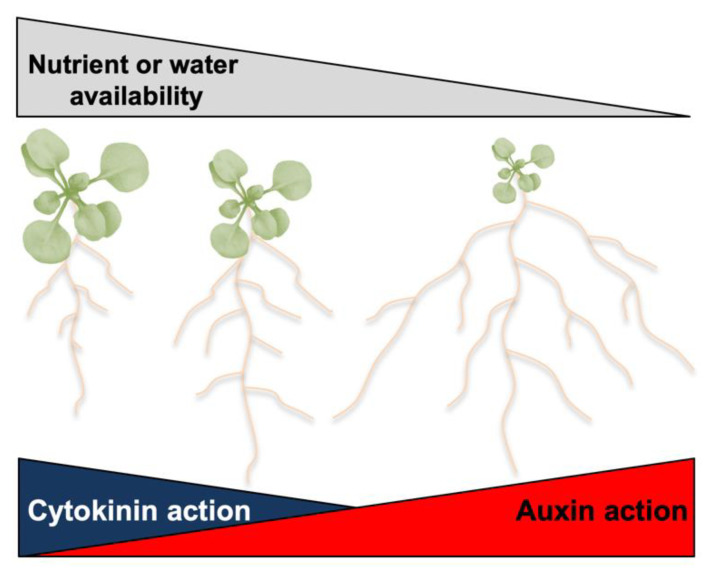
The hormones auxin and cytokinin regulate numerous aspects of plant development and often act as an antagonistic hormone pair. One of the more striking examples of the auxin/cytokinin antagonism involves regulation of the shoot/root growth ratio in which cytokinin promotes shoot and inhibits root growth, whereas auxin does the opposite. Control of the shoot/root growth ratio is essential for the survival of terrestrial plants because it allows growth adaptations to water and mineral nutrient availability in the soil. Because a decrease in shoot growth combined with an increase in root growth leads to survival under drought stress and nutrient limiting conditions, it was not surprising to find that auxin promotes, while cytokinin reduces, drought stress tolerance and nutrient uptake. Recent data show that drought stress and nutrient availability also alter the cytokinin and auxin signaling and biosynthesis pathways and that this stress-induced regulation affects cytokinin and auxin in the opposite manner. These antagonistic effects of cytokinin and auxin suggested that each hormone directly and negatively regulates biosynthesis or signaling of the other. However, a growing body of evidence supports unidirectional regulation, with auxin emerging as the primary regulatory component. This master regulatory role of auxin may not come as a surprise when viewed from an evolutionary perspective.
激素生长素和细胞分裂素调节植物发育的许多方面,通常作为拮抗激素对发挥作用。生长素/细胞分裂素拮抗作用的一个更显著的例子涉及对芽/根生长比例的调节,其中细胞分裂素促进芽的生长并抑制根的生长,而生长素则相反。对芽/根生长比例的控制对于陆生植物的生存至关重要,因为它允许植物根据土壤中水分和矿物质营养的可利用性进行生长适应。由于芽生长的减少和根生长的增加导致在干旱胁迫和营养限制条件下的生存,因此生长素促进、而细胞分裂素减少干旱胁迫耐受性和养分吸收并不令人惊讶。最近的数据表明,干旱胁迫和养分供应也改变了细胞分裂素和生长素的信号转导和生物合成途径,这种胁迫诱导的调节以相反的方式影响细胞分裂素和生长素。细胞分裂素和生长素的这种拮抗作用表明,每种激素直接负向调节另一种激素的生物合成或信号转导。然而,越来越多的证据支持单向调节,生长素作为主要的调节成分出现。从进化的角度来看,生长素作为主要调节成分的这种主调控作用可能并不令人惊讶。