Department of Dietetics and Clinical Nutrition, Medical University of Bialystok, Ul. Mieszka I 4B, 15-054 Bialystok, Poland.
Int J Mol Sci. 2022 Feb 19;23(4):2309. doi: 10.3390/ijms23042309.
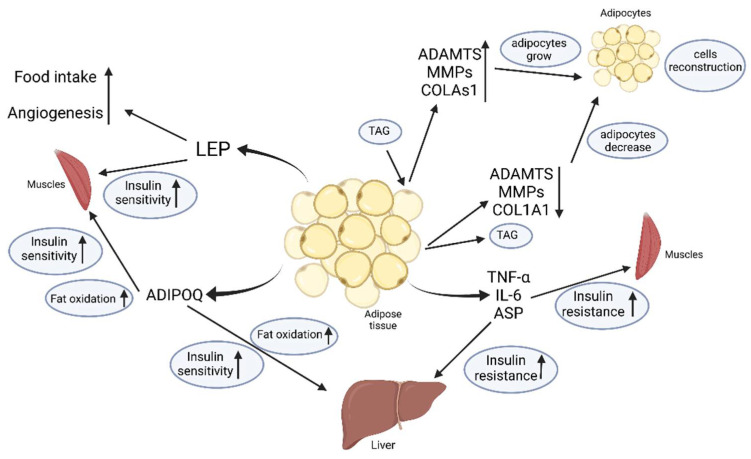
The prevalence of obesity has reached pandemic levels and is becoming a serious health problem in developed and developing countries. Obesity is associated with an increased prevalence of comorbidities that include type II diabetes, cardiovascular diseases and some cancers. The recognition of adipose tissue as an endocrine organ capable of secreting adipokines that influence whole-body energy homeostasis was a breakthrough leading to a better molecular understanding of obesity. Of the adipokines known to be involved in the regulation of energy metabolism, very few are considered central regulators of insulin sensitivity, metabolism and energy homeostasis, and the discovery and characterization of new adipocyte-derived factors are still ongoing. Proteomics techniques, such as liquid chromatography-mass spectrometry or gas chromatography-mass spectrometry, have proven to be useful tools for analyzing the secretory function of adipose tissue (the secretome), providing insights into molecular events that influence body weight. Apart from the identification of novel proteins, the considerable advantage of this approach is the ability to detect post-translational modifications that cannot be predicted in genomic studies. In this review, we summarize recent efforts to identify novel bioactive secretory factors through proteomics.
肥胖的流行已经达到了流行的程度,并且正在成为发达国家和发展中国家的一个严重健康问题。肥胖与合并症的发病率增加有关,包括 2 型糖尿病、心血管疾病和某些癌症。认识到脂肪组织是一种能够分泌影响全身能量平衡的脂肪因子的内分泌器官,这是一个突破,导致对肥胖的更好的分子理解。在已知参与能量代谢调节的脂肪因子中,很少有被认为是胰岛素敏感性、代谢和能量平衡的中枢调节剂,对新的脂肪细胞衍生因子的发现和特性描述仍在进行中。蛋白质组学技术,如液相色谱-质谱或气相色谱-质谱,已被证明是分析脂肪组织分泌功能(分泌组)的有用工具,为影响体重的分子事件提供了见解。除了鉴定新的蛋白质外,这种方法的一个很大的优点是能够检测到基因组研究中无法预测的翻译后修饰。在这篇综述中,我们总结了通过蛋白质组学鉴定新的生物活性分泌因子的最新进展。