Institute of Public Health and Management, Clarke International University, Kampala, Uganda.
The AIDS Support Organization (TASO), Soroti Center of Clinical Excellence, Soroti, Uganda.
BMC Infect Dis. 2022 Feb 25;22(1):191. doi: 10.1186/s12879-022-07178-9.
People with bacteriologically confirmed pulmonary tuberculosis require sputum smear monitoring at 2, 5, and 6 months to establish treatment outcomes. However, there is limited information about sputum smear monitoring in Uganda, similar to other developing countries. We examined factors associated with complete sputum smear monitoring among persons with bacteriologically confirmed pulmonary TB aged ≥ 15 years in central Uganda.
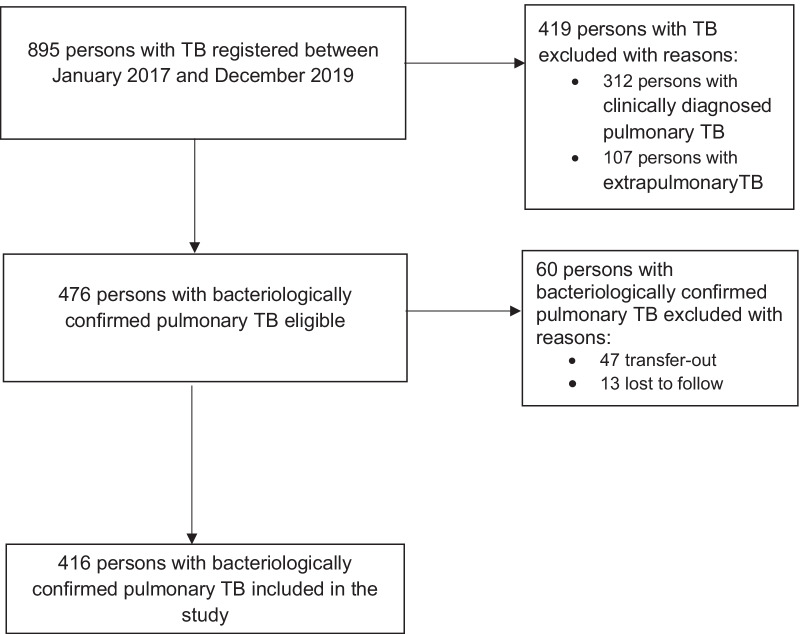
We retrospectively reviewed and abstracted data for persons with bacteriologically confirmed pulmonary TB initiated on treatment between January 2017 and December 2019 across 11 large TB units in Masaka district in central Uganda. Complete sputum smear monitoring was measured as the receipt of three sputum smear microscopy tests at 2, 5, and 6 months of TB treatment. The data were summarized descriptively and the differences in the outcome with independent variables were examined using tests of statistical significance, namely the Chi-square or Fisher's exact test and the student's t-test. The factors independently associated with the outcome were established using the modified Poisson regression analysis with robust standard errors, reported as adjusted risk ratio (aRR) along with the 95% confidence interval (CI).
A total of 416 participants were enrolled, with a mean age of 37.3 ± 12.9 years. Of the participants, 290 (69.7) were males, 269 (64.7) were rural residents, and 128 (30.8%) had complete sputum smear monitoring. Urban residence (aRR, 1.45; 95% CI 1.12-1.90) and treatment under the community-based directly observed therapy short-course strategy (DOTS) (aRR, 1.91; 95% CI 1.25-2.92) were associated with a higher likelihood of complete sputum smear monitoring while TB and human immunodeficiency virus (TB/HIV) comorbidity (aRR 0.45, 95% CI 0.30-0.68) was associated with a lower likelihood of complete sputum smear monitoring.
We found a low magnitude of complete sputum smear monitoring among persons with bacteriologically confirmed pulmonary TB aged ≥ 15 years in central Uganda. Strategies to enhance the performance of sputum smear monitoring should target rural health facilities, strengthen TB/HIV collaboration and the implementation of community-based DOTS.
经细菌学证实患有肺结核的患者需要在第 2、5 和 6 个月进行痰涂片监测,以确定治疗结果。然而,乌干达与其他发展中国家一样,关于痰涂片监测的信息有限。我们调查了乌干达中部年龄≥15 岁经细菌学证实患有肺结核的患者中,与完成痰涂片监测相关的因素。
我们回顾性分析了 2017 年 1 月至 2019 年 12 月期间乌干达中部马萨卡区 11 个大型结核病单位中开始治疗的经细菌学证实患有肺结核的患者的数据,并对其进行了数据提取。完全痰涂片监测定义为在结核病治疗的第 2、5 和 6 个月接受三次痰涂片显微镜检查。使用描述性统计数据总结数据,并使用统计学意义检验(卡方检验或 Fisher 确切检验和学生 t 检验)检验独立变量与结果之间的差异。使用具有稳健标准误差的修正泊松回归分析确定与结果独立相关的因素,并报告调整后的风险比(aRR)及其 95%置信区间(CI)。
共纳入 416 名参与者,平均年龄为 37.3±12.9 岁。参与者中,290 名(69.7%)为男性,269 名(64.7%)为农村居民,128 名(30.8%)完成了完全痰涂片监测。城市居住(aRR,1.45;95%CI,1.12-1.90)和采用社区为基础的直接监督治疗短期疗程策略(DOTS)治疗(aRR,1.91;95%CI,1.25-2.92)与较高的完全痰涂片监测可能性相关,而结核病和人类免疫缺陷病毒(TB/HIV)合并感染(aRR,0.45;95%CI,0.30-0.68)与较低的完全痰涂片监测可能性相关。
我们发现乌干达中部年龄≥15 岁经细菌学证实患有肺结核的患者中,完全痰涂片监测的比例较低。提高痰涂片监测效果的策略应针对农村卫生机构,加强结核病/艾滋病合作以及实施以社区为基础的 DOTS。