Kayigamba Felix R, Bakker Mirjam I, Mugisha Veronicah, Gasana Michel, Schim van der Loeff Maarten F
INTERACT, CPCD, PO Box 2181, Kigali, Rwanda.
BMC Res Notes. 2012 Jul 16;5:357. doi: 10.1186/1756-0500-5-357.
In Rwanda tuberculosis (TB) is one of the major health problems. To contribute to an improved performance of the Rwandan National TB Control Program, we conducted a study with the following objectives: (1) to assess the completion rate of sputum smear examinations at the end of the intensive phase of TB treatment; (2) to assess the sputum conversion rate (SCR); (3) to assess associations between smear completion rate or SCR with key health facility characteristics.
TB registers in 89 health facilities in five provinces were reviewed. Data of new and retreatment smear-positive pulmonary TB (PTB+) cases registered between January and June 2006 were included in the study. Data on key characteristics of the selected health facilities were also collected.
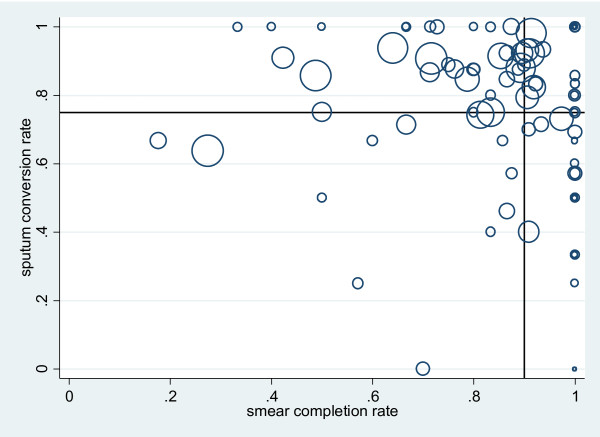
Among 1509 new PTB + cases, 32 (2.1%) had died by 2 months, and 178 (11.8%) had been transferred-out. Among the remaining 1299 patients, a smear examination at month 2 was done in 1039 (smear completion rate 80.0%). Among these 1039, 852 (82.0%) had become smear-negative. The smear completion rate and SCR varied considerably between health facilities. A high number of new PTB cases at a health facility was the only significant predictor of a low completion rate, while the only independent factor associated with low sputum conversion rates was rural (vs. urban) location of the health facility.
In Rwanda, too few patients get a smear examination after 2 months of TB treatment; the SCR among those with smear results was adequate at 82%. A high number of new TB patients at a health facility was a significant predictor of a low completion rate. The national TB control program should design strategies to improve completion rates.
在卢旺达,结核病是主要的健康问题之一。为提高卢旺达国家结核病控制项目的成效,我们开展了一项研究,其目标如下:(1)评估结核病治疗强化期结束时痰涂片检查的完成率;(2)评估痰菌转阴率(SCR);(3)评估涂片完成率或SCR与关键医疗机构特征之间的关联。
对五个省份89家医疗机构的结核病登记情况进行了审查。纳入研究的是2006年1月至6月期间登记的新发病例和复治涂片阳性肺结核(PTB+)病例的数据。还收集了所选医疗机构关键特征的数据。
在1509例新的PTB+病例中,32例(2.1%)在2个月时死亡,178例(11.8%)已转出。在其余1299例患者中,1039例(涂片完成率80.0%)在第2个月进行了涂片检查。在这1039例患者中,852例(82.0%)痰涂片转阴。不同医疗机构之间的涂片完成率和SCR差异很大。医疗机构新PTB病例数量多是完成率低的唯一显著预测因素,而与痰菌转阴率低相关的唯一独立因素是医疗机构位于农村(相对于城市)地区。
在卢旺达,结核病治疗2个月后接受涂片检查的患者太少;有涂片结果的患者中SCR达到82%,还算充足。医疗机构新结核病患者数量多是完成率低的显著预测因素。国家结核病控制项目应制定提高完成率的策略。