Departamento de Educación Física y Deporte, Universidad de Sevilla, 41013, Seville, Spain.
Institute of Aerospace Medicine, German Aerospace Center (DLR), 51147, Cologne, Germany.
Osteoporos Int. 2022 Jul;33(7):1415-1427. doi: 10.1007/s00198-022-06357-3. Epub 2022 Feb 26.
Osteoporosis is a major health issue worldwide. This study analyzes the effects of non-supervised osteoporosis prevention programs on bone mineral density. Non-supervised exercise increases femoral neck and lumbar spine bone mineral density in adult women. Thus, it might be effective for preventing or treating osteoporosis or osteopenia in this population.
Osteoporosis is a major health issue worldwide. Social distancing measures due to COVID-19 have hindered the chances to take part in supervised osteoporosis prevention exercise programs. The purpose of the present study is to systematically review and meta-analyze the effects of non-supervised osteoporosis prevention exercise programs on bone mineral density (BMD) in adult women.
A comprehensive search of electronic databases (n = 7) was conducted including (a) prospective randomized controlled trials (RCTs) comparing at least one exercise group vs. a control group with sedentary lifestyle or sham exercises; (b) baseline and follow-up BMD values, or BMD changes from baseline, at any skeletal site; (c) women over 30 years old; and (d) non-supervised exercise programs only. Subgroup analyses were performed for menopausal status, intervention duration, type of exercise, and osteopenia/osteoporosis status.
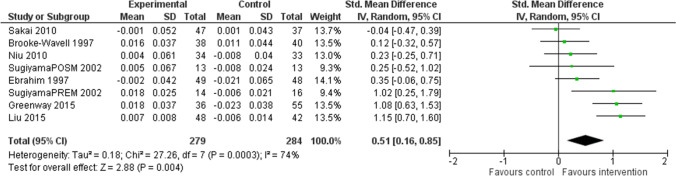
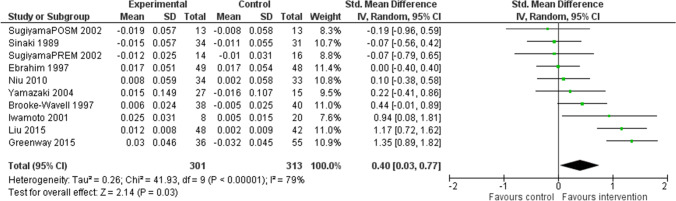
Ten studies were included (n = 668). Random effect analyses showed that unsupervised exercise had beneficial effects on lumbar spine (LS) BMD with standardized mean difference (SMD) = 0.40 (95% confidence interval (CI): 0.03-0.77), and femoral neck (FN) BMD with SMD = 0.51 (95% CI: 0.16-0.85). Unsupervised exercise increased LS (SMD = 0.73 (95% CI: 0.13-1.33)) and FN BMD (SMD = 0.85 (95% CI: 0.33-1.37)) in women with osteopenia/osteoporosis, but not in healthy counterparts.
Non-supervised exercise improves FN and LS BMD in adult women. Beneficial effects of exercise on FN and LS BMD might be more pronounced in those with poor bone health compared with healthy counterparts. More RCTs prescribing non-supervised, osteogenic exercise are required in this population. It is necessary to investigate the efficacy of remote/assistive technologies for delivering and monitoring non-supervised exercise interventions.
骨质疏松症是全球范围内的一个主要健康问题。本研究分析了非监督性骨质疏松预防计划对骨密度的影响。非监督性运动可增加成年女性的股骨颈和腰椎骨密度。因此,它可能对预防或治疗该人群的骨质疏松症或骨量减少有效。
骨质疏松症是全球范围内的一个主要健康问题。由于 COVID-19 的社交距离措施,参加监督性骨质疏松预防运动计划的机会受到了阻碍。本研究的目的是系统地回顾和荟萃分析非监督性骨质疏松预防运动计划对成年女性骨密度(BMD)的影响。
对电子数据库(n=7)进行全面检索,包括(a)比较至少一个运动组与对照组( sedentary lifestyle 或 sham exercises)的前瞻性随机对照试验(RCTs);(b)基线和随访时任何骨骼部位的 BMD 值,或从基线开始的 BMD 变化;(c)30 岁以上的女性;(d)仅非监督性运动计划。对绝经状态、干预持续时间、运动类型和骨质疏松/低骨量状态进行了亚组分析。
纳入了 10 项研究(n=668)。随机效应分析显示,非监督性运动对腰椎(LS)BMD 有有益的影响,标准化均数差(SMD)=0.40(95%置信区间(CI):0.03-0.77),对股骨颈(FN)BMD 的影响为 SMD=0.51(95% CI:0.16-0.85)。非监督性运动增加了骨质疏松/低骨量女性的 LS(SMD=0.73(95% CI:0.13-1.33))和 FN BMD(SMD=0.85(95% CI:0.33-1.37)),但对健康对照组没有影响。
非监督性运动可提高成年女性的 FN 和 LS BMD。与健康对照组相比,运动对 FN 和 LS BMD 的有益影响在骨健康较差的人群中可能更为明显。该人群需要更多的 RCT 来规定非监督性、成骨运动。有必要研究远程/辅助技术在提供和监测非监督性运动干预方面的效果。