Department of Public Health and Primary Care, Leiden University Medical Center, ZA Leiden, the Netherlands.
Department of Internal Medicine, section Gerontology and Geriatrics, Leiden University Medical Center, ZA Leiden, the Netherlands.
J Clin Endocrinol Metab. 2022 May 17;107(6):e2339-e2347. doi: 10.1210/clinem/dgac106.
Subclinical thyroid dysfunction and anemia are common disorders, and both have increasing prevalence with advancing age.
The aim of this study was to assess whether levothyroxine treatment leads to a rise in hemoglobin levels in older persons with subclinical hypothyroidism.
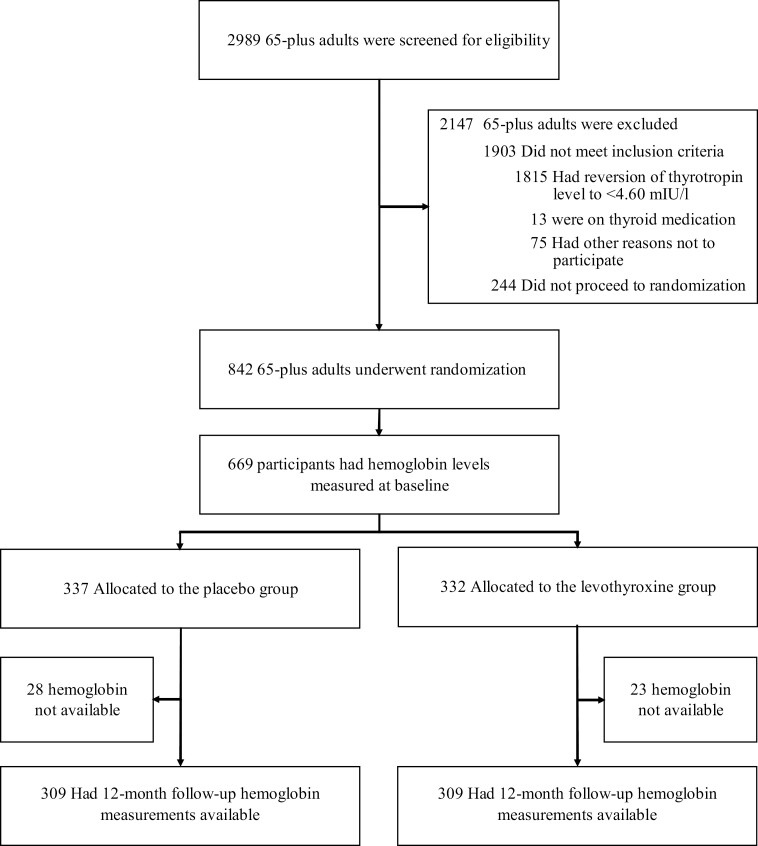
This preplanned combined analysis of 2 randomized controlled trials included community-dwelling persons aged 65 years and older with subclinical hypothyroidism who were randomly assigned to levothyroxine or placebo treatment. The levothyroxine dose was periodically titrated aiming at thyroid stimulating hormone (TSH) level within the reference range, with mock titrations in the placebo group. The main outcome measure was the change in hemoglobin level after 12 months.
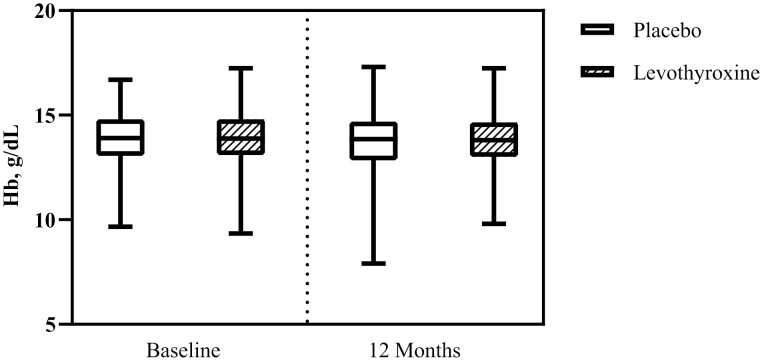
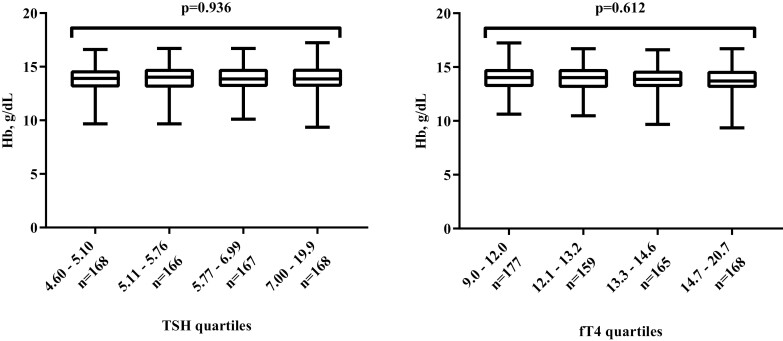
Analyses included 669 participants (placebo n = 337, levothyroxine n = 332) with a median age of 75 years (range, 65-97) and mean baseline hemoglobin of 13.8 ± 1.3 g/dL. Although levothyroxine treatment resulted in a reduction in TSH from baseline after 12 months of follow-up compared with placebo, the change in hemoglobin level was not different between the levothyroxine and the placebo groups (-0.03 g/dL [95% CI, -0.16 to 0.11]). Similar results were found in stratified analyses including sex, age, or TSH levels. No difference in change of hemoglobin levels after 12 months was identified in 69 participants with anemia at baseline (-0.33 g/dL [95% CI, -0.87 to 0.21]).
In persons aged 65 years and older with subclinical hypothyroidism, treatment with levothyroxine does not lead to a rise in hemoglobin levels, regardless of the presence of anemia.
亚临床甲状腺功能减退和贫血是常见疾病,且随着年龄的增长,其发病率逐渐升高。
本研究旨在评估左甲状腺素治疗是否会导致亚临床甲状腺功能减退的老年人血红蛋白水平升高。
这是对 2 项随机对照试验的预先计划的联合分析,包括年龄在 65 岁及以上的、患有亚临床甲状腺功能减退的、居住在社区的患者,他们被随机分配到左甲状腺素或安慰剂治疗组。左甲状腺素剂量定期滴定,目标是使促甲状腺激素(TSH)水平处于参考范围内,安慰剂组则进行模拟滴定。主要观察指标是治疗 12 个月后血红蛋白水平的变化。
分析纳入了 669 名参与者(安慰剂组 n=337,左甲状腺素组 n=332),中位年龄为 75 岁(范围:65-97 岁),平均基线血红蛋白为 13.8±1.3 g/dL。虽然与安慰剂组相比,左甲状腺素治疗 12 个月后 TSH 从基线水平下降,但左甲状腺素组和安慰剂组之间血红蛋白水平的变化无差异(-0.03 g/dL[95%CI,-0.16 至 0.11])。包括性别、年龄或 TSH 水平在内的分层分析也得到了相似的结果。在基线时有贫血的 69 名参与者中,12 个月后血红蛋白水平的变化也无差异(-0.33 g/dL[95%CI,-0.87 至 0.21])。
在年龄在 65 岁及以上的亚临床甲状腺功能减退患者中,无论是否存在贫血,左甲状腺素治疗并不能导致血红蛋白水平升高。