van der Spoel Evie, van Vliet Nicolien A, Poortvliet Rosalinde K E, Du Puy Robert S, den Elzen Wendy P J, Quinn Terence J, Stott David J, Sattar Naveed, Kearney Patricia M, Blum Manuel R, Alwan Heba, Rodondi Nicolas, Collet Tinh-Hai, Westendorp Rudi G J, Ballieux Bart E, Jukema J Wouter, Dekkers Olaf M, Gussekloo Jacobijn, Mooijaart Simon P, van Heemst Diana
Department of Internal Medicine, Section of Gerontology and Geriatrics, Leiden University Medical Center, 2333 ZA Leiden, The Netherlands.
Department of Public Health and Primary Care, Leiden University Medical Center, 2333 ZA Leiden, The Netherlands.
J Clin Endocrinol Metab. 2024 Feb 20;109(3):e1167-e1174. doi: 10.1210/clinem/dgad623.
With age, the prevalence of subclinical hypothyroidism rises. However, incidence and determinants of spontaneous normalization remain largely unknown.
To investigate incidence and determinants of spontaneous normalization of TSH levels in older adults with subclinical hypothyroidism.
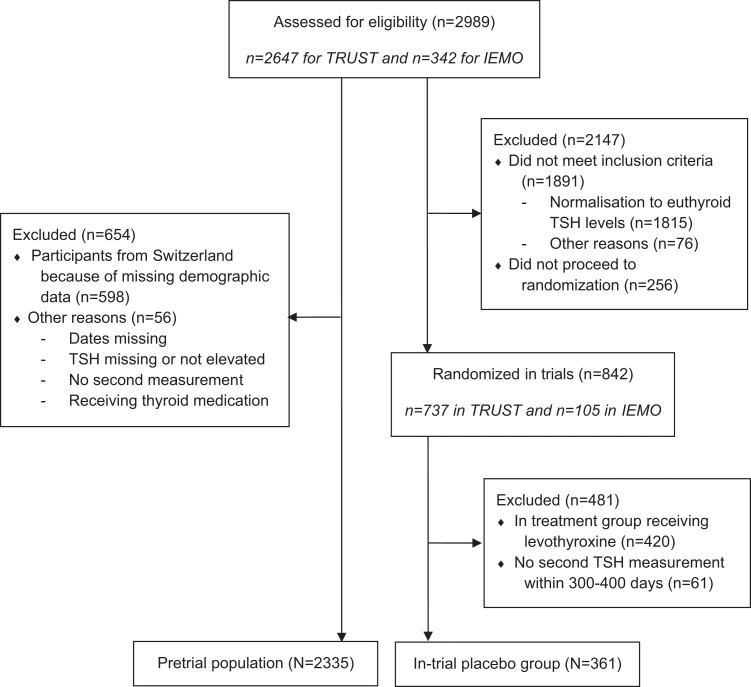
Pooled data were used from the (1) pretrial population and (2) in-trial placebo group from 2 randomized, double-blind, placebo-controlled trials (Thyroid Hormone Replacement for Untreated Older Adults With Subclinical Hypothyroidism Trial and Institute for Evidence-Based Medicine in Old Age thyroid 80-plus thyroid trial).
Community-dwelling 65+ adults with subclinical hypothyroidism from the Netherlands, Switzerland, Ireland, and the United Kingdom.
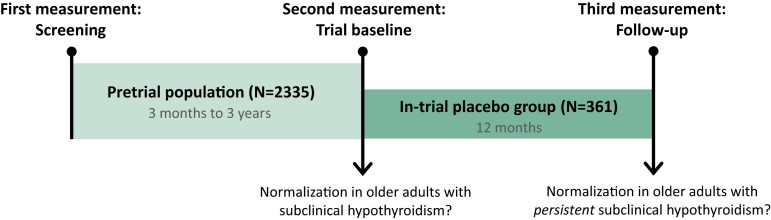
The pretrial population (N = 2335) consisted of older adults with biochemical subclinical hypothyroidism, defined as ≥1 elevated TSH measurement (≥4.60 mIU/L) and a free T4 within the laboratory-specific reference range. Individuals with persistent subclinical hypothyroidism, defined as ≥2 elevated TSH measurements ≥3 months apart, were randomized to levothyroxine/placebo, of which the in-trial placebo group (N = 361) was included.
Incidence of spontaneous normalization of TSH levels and associations between participant characteristics and normalization.
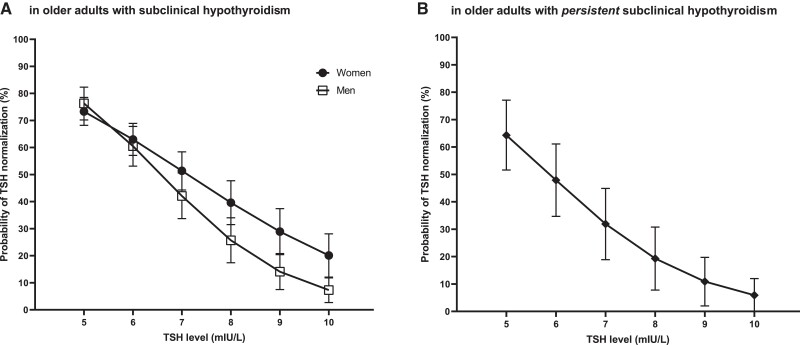
In the pretrial phase, TSH levels normalized in 60.8% of participants in a median follow-up of 1 year. In the in-trial phase, levels normalized in 39.9% of participants after 1 year of follow-up. Younger age, female sex, lower initial TSH level, higher initial free T4 level, absence of thyroid peroxidase antibodies, and a follow-up measurement in summer were independent determinants for normalization.
Because TSH levels spontaneously normalized in a large proportion of older adults with subclinical hypothyroidism (also after confirmation by repeat measurement), a third measurement may be recommended before considering treatment.
ClinicalTrials.gov, NCT01660126 and Netherlands Trial Register, NTR3851.
随着年龄增长,亚临床甲状腺功能减退症的患病率上升。然而,其自发恢复正常的发生率及决定因素仍 largely 未知。
调查亚临床甲状腺功能减退症老年患者促甲状腺激素(TSH)水平自发恢复正常的发生率及决定因素。
使用来自两项随机、双盲、安慰剂对照试验(未治疗的亚临床甲状腺功能减退症老年患者甲状腺激素替代试验和老年循证医学研究所 80 岁及以上甲状腺试验)的(1)预试验人群和(2)试验中的安慰剂组的汇总数据。
来自荷兰、瑞士、爱尔兰和英国的社区居住的 65 岁及以上亚临床甲状腺功能减退症成年人。
预试验人群(N = 2335)由生化亚临床甲状腺功能减退症老年患者组成,定义为促甲状腺激素测量值升高≥1 次(≥4.60 mIU/L)且游离甲状腺素在实验室特定参考范围内。持续性亚临床甲状腺功能减退症患者,定义为促甲状腺激素测量值升高≥2 次且间隔≥3 个月,被随机分配至左甲状腺素/安慰剂组,其中试验中的安慰剂组(N = 361)被纳入。
TSH 水平自发恢复正常的发生率以及参与者特征与恢复正常之间的关联。
在预试验阶段,中位随访 1 年时,60.8%的参与者 TSH 水平恢复正常。在试验阶段,随访 1 年后,39.9%的参与者水平恢复正常。年龄较小、女性、初始 TSH 水平较低、初始游离甲状腺素水平较高、无甲状腺过氧化物酶抗体以及在夏季进行随访测量是恢复正常的独立决定因素。
由于很大一部分亚临床甲状腺功能减退症老年患者的 TSH 水平会自发恢复正常(重复测量确认后也是如此),在考虑治疗之前可能建议进行第三次测量。
ClinicalTrials.gov,NCT01660126 和荷兰试验注册,NTR3851。