School of Health and Related Research, University of Sheffield, Sheffield, UK.
University of Strathclyde, Glasgow, UK.
Int J Health Policy Manag. 2022 Dec 19;11(12):2780-2792. doi: 10.34172/ijhpm.2022.6550. Epub 2022 Feb 23.
A 'Health in All Policies' (HiAP) approach has been widely advocated as a way to involve multiple government sectors in addressing health inequalities, but implementation attempts have not always produced the expected results. Explaining how HiAP-style collaborations have been governed may offer insights into how to improve population health and reduce health inequalities.
Theoretically focused systematic review. Synthesis of evidence from evaluative studies into a causal logic model.
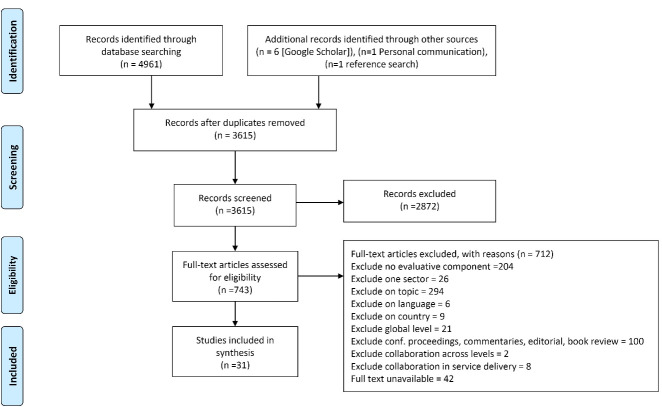
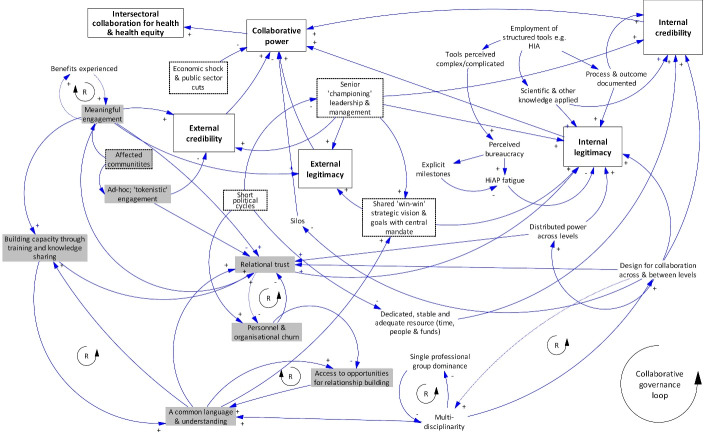
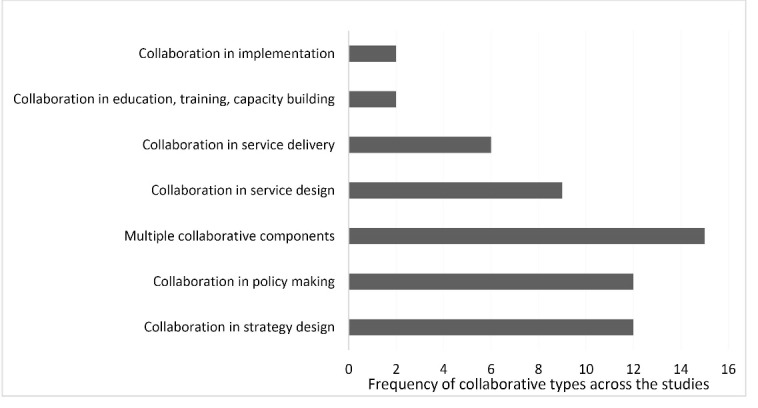
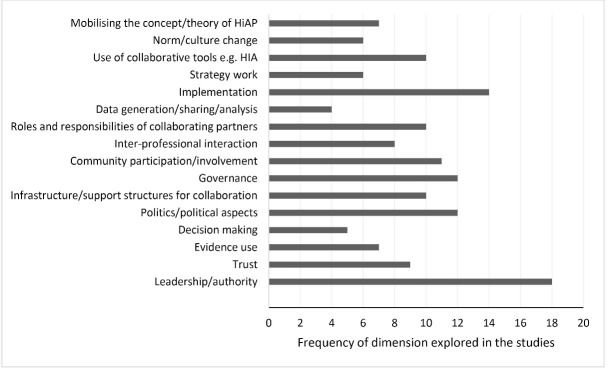
Thirty-one publications based on 40 case studies from nine high-income countries were included. Intersectoral collaborations for population health and equity were multi-component and multi-dimensional with collaborative activity spanning policy, strategy, service design and service delivery. Governance of intersectoral collaboration included structural and relational components. Both internal and external legitimacy and credibility delivered collaborative power, which in turn enabled intersectoral collaboration. Internal legitimacy was driven by multiple structural elements and processes. Many of these were instrumental in developing (often-fragile) relational trust. Internal credibility was supported by multi-level collaborations that were adequately resourced and shared power. External legitimacy and credibility was created through meaningful community engagement, leadership that championed collaborations and the identification of 'win-win' strategies. External factors such as economic shocks and short political cycles reduced collaborative power.
This novel review, using systems thinking and causal loop representations, offers insights into how collaborations can generate internal and external legitimacy and credibility. This offers promise for future collaborative activity for population health and equity; it presents a clearer picture of what structural and relational components and dynamics collaborative partners can focus on when planning and implementing HiAP initiatives. The limits of the literature base, however, does not make it possible to identify if or how this might deliver improved population health or health equity.
“全健康政策”(Health in All Policies,HiAP)方法已被广泛倡导为一种让多个政府部门参与解决健康不平等问题的途径,但实施尝试并不总能产生预期的结果。解释 HiAP 风格的合作是如何管理的,可以深入了解如何改善人口健康和减少健康不平等。
理论重点系统综述。将来自九个高收入国家的 40 项案例研究的评估研究证据综合为一个因果逻辑模型。
共纳入 31 篇基于九个高收入国家 40 项案例研究的出版物。针对人口健康和公平的跨部门合作具有多组成分和多维性,合作活动涵盖政策、战略、服务设计和服务提供。跨部门合作的治理包括结构和关系组成部分。内部和外部合法性和可信度赋予了合作权力,从而使跨部门合作成为可能。内部合法性由多个结构要素和流程驱动。其中许多要素在发展(通常是脆弱的)关系信任方面发挥了作用。内部可信度得到了多层次合作的支持,这些合作得到了充分的资源支持并共享权力。外部合法性和可信度是通过有意义的社区参与、支持合作的领导力以及确定“双赢”战略来创造的。经济冲击和短期政治周期等外部因素削弱了合作权力。
本综述采用系统思维和因果循环表示法,深入了解合作如何产生内部和外部合法性和可信度。这为未来针对人口健康和公平的合作活动提供了希望;它更清晰地描绘了合作伙伴在规划和实施 HiAP 计划时可以关注的结构和关系组成部分和动态。然而,文献基础的局限性使得无法确定这是否或如何能够改善人口健康或健康公平。