W.L. Gore and Associates, Inc., Flagstaff, AZ, USA.
W.L. Gore and Associates, Inc., Flagstaff, AZ, USA.
Thromb Res. 2022 Apr;212:51-57. doi: 10.1016/j.thromres.2022.02.016. Epub 2022 Feb 23.
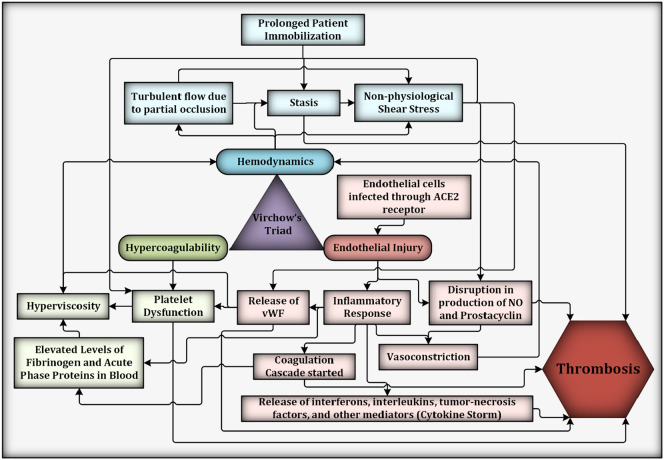
Severe coronavirus disease 2019 (COVID-19) is characterized by an increased risk of thromboembolic events, a leading cause for adverse outcomes in patients afflicted by the more serious manifestation of the disease. These thromboembolic complications expressed as sepsis-induced coagulopathy, disseminated intravascular coagulation, venous and arterial thromboembolism, pulmonary embolism, microthrombosis, and thrombotic microangiopathy have been observed to affect different organs such as the lungs, heart, kidneys, and brain. Endothelial injury and dysfunction have been identified as the critical pathway towards thrombogenesis, and contributions of other mechanisms such as hypercoagulability, cytokine storm, neutrophils have been studied. However, the contribution of hemodynamic pathways towards thrombosis in severe COVID-19 cases has not been investigated. From the classical theory of Virchow's triad to the contemporary studies on the effect of shear enhanced platelet activation, it is well established that hemodynamics plays a role in the initiation and growth of thrombosis. This article reviews recent studies on COVID-19 related thrombotic events and offers hypotheses on how hemodynamics may be responsible for some of the adverse outcomes observed in severe COVID-19 cases. While thrombogenesis through endothelial injury and the effects of hypercoagulability on thrombosis are briefly addressed, the crux of the discussion is focused on hemodynamic factors such as stasis, turbulent flow, and non-physiological shear stress and their effects on thrombosis. In addition, hemodynamics-dependent venous, arterial, and microvascular thrombosis in COVID-19 cases is discussed. We also propose further investigation of diagnostic and therapeutic options that address the hemodynamics aspects of COVID-19 thrombus formation to assess their potential in patient care.
严重的 2019 年冠状病毒病(COVID-19)的特征是血栓栓塞事件的风险增加,这是患有更严重疾病表现的患者不良结局的主要原因。这些血栓栓塞并发症表现为脓毒症诱导的凝血障碍、弥散性血管内凝血、静脉和动脉血栓栓塞、肺栓塞、微血栓和血栓性微血管病,已观察到它们会影响肺部、心脏、肾脏和大脑等不同器官。内皮损伤和功能障碍已被确定为血栓形成的关键途径,并且已经研究了其他机制(如高凝状态、细胞因子风暴、中性粒细胞)的贡献。然而,严重 COVID-19 病例中血流动力学途径对血栓形成的贡献尚未得到研究。从 Virchow 三联征的经典理论到关于剪切增强血小板激活作用的当代研究,血流动力学在血栓形成的启动和生长中起作用已得到充分证实。本文综述了最近关于 COVID-19 相关血栓形成事件的研究,并提出了关于血流动力学如何导致严重 COVID-19 病例中一些不良结局的假说。虽然简要讨论了通过内皮损伤的血栓形成和高凝状态对血栓形成的影响,但讨论的核心是关注血流动力学因素,如停滞、湍流和非生理剪切应力及其对血栓形成的影响。此外,还讨论了 COVID-19 病例中依赖血流动力学的静脉、动脉和微血管血栓形成。我们还建议进一步研究针对 COVID-19 血栓形成的血流动力学方面的诊断和治疗选择,以评估它们在患者护理中的潜在价值。