Global and Women's Health, School of Public Health and Preventive Medicine, Monash University Faculty of Medicine Nursing and Health Sciences, Melbourne, VIC, Australia.
The Ian Potter Library, The Alfred Hospital, Melbourne, Victoria, Australia.
BMC Public Health. 2022 Feb 27;22(1):403. doi: 10.1186/s12889-022-12576-4.
Globally, the number of forcibly displaced women is growing. Refugee and displaced women have poorer health outcomes compared to migrant and host country populations. Conflict, persecution, violence or natural disasters and under-resourced health systems in their country of origin contribute to displacement experiences of refugee and displaced women. Poor health outcomes are further exacerbated by the migration journey and challenging resettlement in host countries. Preventive sexual and reproductive health (SRH) needs of refugee and displaced women are poorly understood. The aim was to synthesise the evidence about access to preventive SRH care of refugee and displaced women.
A systematic review of qualitative, quantitative and mixed methods studies of women aged 18 to 64 years and health care providers' (HCPs') perspectives on barriers to and enablers of SRH care was undertaken. The search strategy was registered with PROSPERO in advance of the search (ID CRD42020173039). The MEDLINE, PsycINFO, Embase, CINAHL, and Global health databases were searched for peer-reviewed publications published any date up to 30th April 2020. Three authors performed full text screening independently. Publications were reviewed and assessed for quality. Study findings were thematically extracted and reported in a narrative synthesis. Reporting of the review followed the Preferred Reporting Items for Systematic Reviews and Meta-Analyses recommendations.
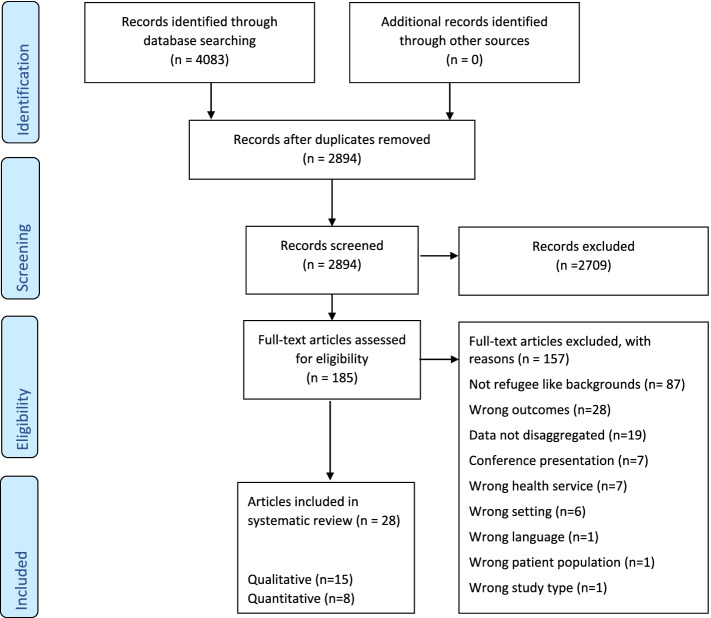
The search yielded 4083 results, of which 28 papers reporting 28 studies met inclusion criteria. Most related to contraception and cervical or breast cancer screening. Three main themes and ten subthemes relating to SRH care access were identified: interpersonal and patient encounter factors (including knowledge, awareness, perceived need for and use of preventive SRH care; language and communication barriers), health system factors (including HCPs discrimination and lack of quality health resources; financial barriers and unmet need; HCP characteristics; health system navigation) and sociocultural factors and the refugee experience (including family influence; religious and cultural factors).
Implications for clinical practice and policy include giving women the option of seeing women HCPs, increasing the scope of practice for HCPs, ensuring adequate time is available during consultations to listen and develop refugee and displaced women's trust and confidence, strengthening education for refugee and displaced women unfamiliar with preventive care and refining HCPs' and interpreters' cultural competency. More research is needed on HCPs' views regarding care for refugee and displaced women.
在全球范围内,被迫流离失所的妇女人数不断增加。与移民和东道国人口相比,难民和流离失所妇女的健康状况更差。冲突、迫害、暴力或原籍国资源不足的卫生系统导致了难民和流离失所妇女的流离失所经历。移民过程和在东道国的艰难安置进一步加剧了不良健康结果。难民和流离失所妇女的预防性性健康和生殖健康(SRH)需求了解甚少。目的是综合有关难民和流离失所妇女获得预防性 SRH 护理的证据。
对年龄在 18 至 64 岁之间的妇女和卫生保健提供者(HCPs)的观点进行了系统评价,这些观点涉及 SRH 护理的障碍和促进因素。在进行搜索之前,搜索策略已在 PROSPERO 中进行了预先注册(ID CRD42020173039)。检索了同行评审出版物,这些出版物在任何日期发表,截止日期为 2020 年 4 月 30 日,使用了 MEDLINE、PsycINFO、Embase、CINAHL 和全球健康数据库。三位作者独立进行了全文筛选。对出版物进行了审查和质量评估。研究结果以主题提取,并以叙述性综合的形式报告。该综述的报告遵循系统评价和荟萃分析的首选报告项目建议。
搜索结果为 4083 项,其中 28 篇论文报道的 28 项研究符合纳入标准。大多数研究涉及避孕和宫颈癌或乳腺癌筛查。确定了与获得 SRH 护理有关的三个主要主题和十个子主题:人际和患者遭遇因素(包括知识,意识,对预防性 SRH 护理的需求和使用;语言和沟通障碍),卫生系统因素(包括 HCP 歧视和缺乏优质卫生资源;经济障碍和未满足的需求;HCP 特征;卫生系统导航)和社会文化因素和难民经历(包括家庭影响;宗教和文化因素)。
对临床实践和政策的影响包括让妇女选择看女卫生保健提供者,扩大卫生保健提供者的实践范围,确保在咨询期间有足够的时间倾听并建立难民和流离失所妇女的信任和信心,加强对不熟悉预防性护理的难民和流离失所妇女的教育,并完善卫生保健提供者和口译员的文化能力。需要对卫生保健提供者对难民和流离失所妇女护理的看法进行更多研究。