Wang Ying, Pan Fengfeng, Xie Fang, He Rongqiao, Guo Qihao
Department of Gerontology, Shanghai Jiao Tong University Affiliated Sixth People's Hospital, Shanghai, China.
PET Center, Huashan Hospital, Fudan University, Shanghai, China.
Front Aging Neurosci. 2022 Feb 10;14:820385. doi: 10.3389/fnagi.2022.820385. eCollection 2022.
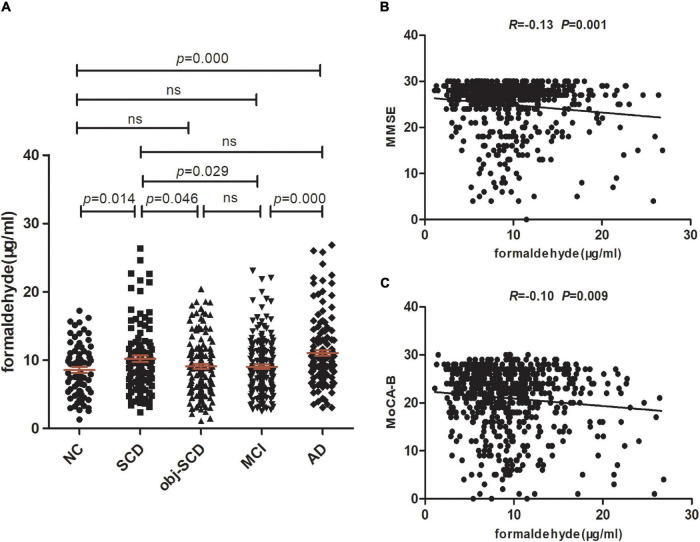
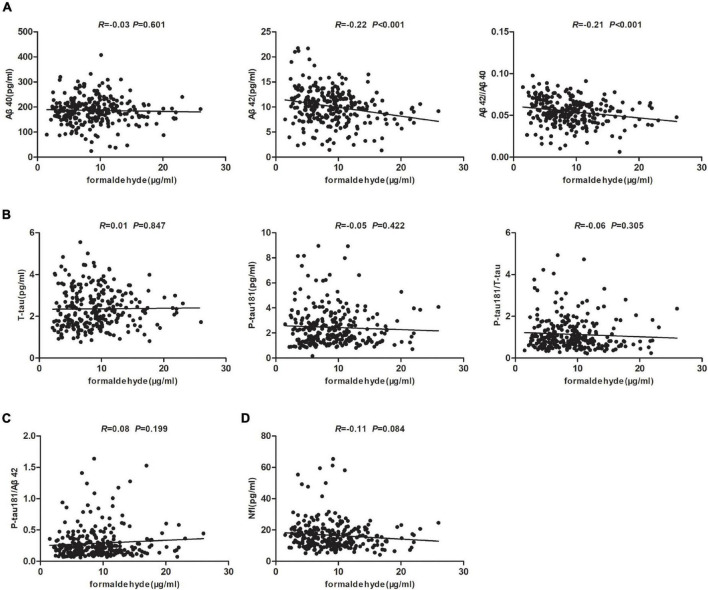
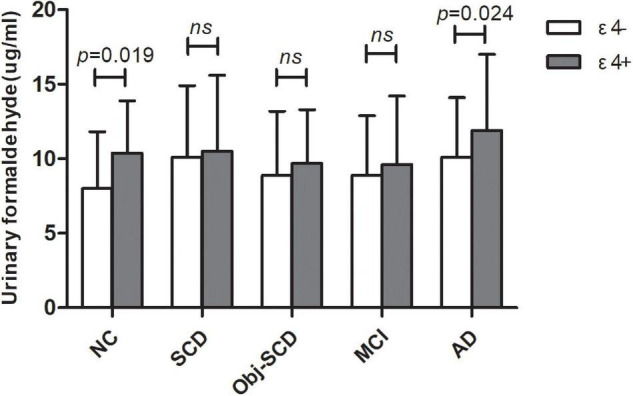
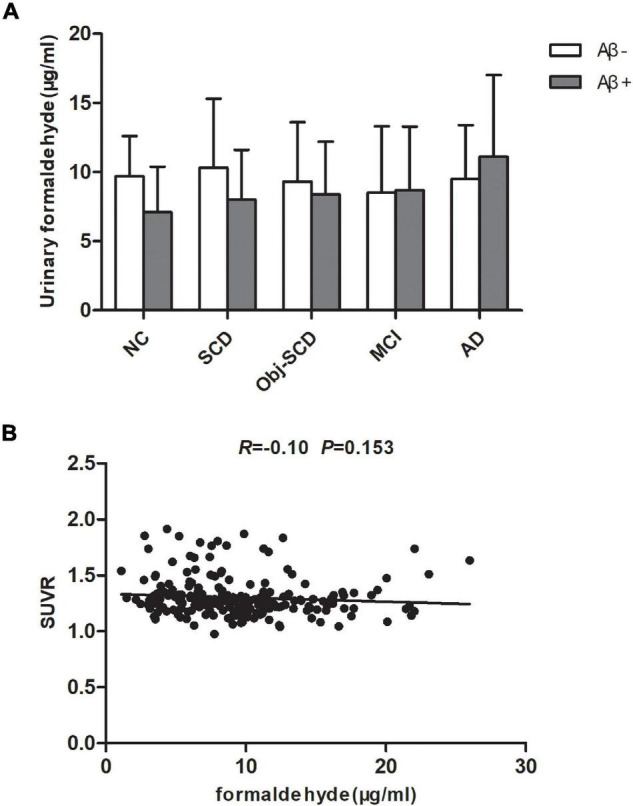
Urine-based formaldehyde has been reported to be a potential biomarker for Alzheimer's disease (AD). However, there is a lack of research about the correlation between urine formaldehyde and cognitive abilities in the clinical spectrum of AD, especially the preclinical period. The relationship of urine formaldehyde with APOE genotype, brain Aβ status and plasma pathological markers in AD are also not clear. This study intends to explore the correlation between urine formaldehyde and cognitive abilities throughout the AD continuum, to evaluate the role of APOE genotype and Aβ accumulation on urine formaldehyde, and further to clarify the relationship between urine formaldehyde level and AD plasma pathological markers. We recruited 72 cognitively normal controls (NC), 110 subjective cognitive decline (SCD), 140 objectively defined subtle cognitive decline (Obj-SCD), 171 mild cognitive impairment (MCI) and 136 AD dementia participants. Next, we collected the data of clinical materials, neuropsychological examination, APOE genotyping, urine formaldehyde concentration, 18F-florbetapir PET imaging and plasma biomarkers. Compared with NC, Obj-SCD and MCI groups, the level of urine formaldehyde was found to be significantly upregulated in SCD group. In addition, the level of urine formaldehyde was significantly higher in AD group compared to both NC and MCI groups. Further subgroup analysis showed that, the level of urine formaldehyde was higher in APOE ε4+ subgroup compared to APOE ε4- subgroup in both NC and AD groups. There was no difference in urine formaldehyde level between the brain Aβ+ subgroup and Aβ- subgroup in each group. In addition, regression analysis showed urine formaldehyde level was correlated with gender, plasma Aβ42 and p-Tau181/T-tau. The dynamic change of urine formaldehyde in the AD continuum could be used as a potential biomarker, and combined with comprehensive cognitive evaluation could become a useful method to distinguish SCD from NC and Obj-SCD, and to distinguish MCI from AD.
据报道,尿液中的甲醛可能是阿尔茨海默病(AD)的一种生物标志物。然而,在AD临床谱系中,尤其是临床前期,关于尿液甲醛与认知能力之间的相关性研究较少。尿液甲醛与AD患者的载脂蛋白E(APOE)基因型、脑β淀粉样蛋白(Aβ)状态及血浆病理标志物之间的关系也尚不明确。本研究旨在探讨AD连续病程中尿液甲醛与认知能力之间的相关性,评估APOE基因型和Aβ积累对尿液甲醛的影响,并进一步阐明尿液甲醛水平与AD血浆病理标志物之间的关系。我们招募了72名认知正常对照者(NC)、110名主观认知下降(SCD)者、140名客观定义的轻度认知下降(Obj-SCD)者、171名轻度认知障碍(MCI)者和136名AD痴呆患者。接下来,我们收集了临床资料、神经心理学检查、APOE基因分型、尿液甲醛浓度、18F-氟代贝他吡PET成像及血浆生物标志物的数据。与NC组、Obj-SCD组和MCI组相比,SCD组尿液甲醛水平显著上调。此外,AD组尿液甲醛水平显著高于NC组和MCI组。进一步亚组分析显示,在NC组和AD组中,APOE ε4+亚组的尿液甲醛水平均高于APOE ε4-亚组。每组中脑Aβ+亚组和Aβ-亚组的尿液甲醛水平无差异。此外,回归分析显示尿液甲醛水平与性别、血浆Aβ42及磷酸化tau蛋白181/总tau蛋白相关。AD连续病程中尿液甲醛的动态变化可作为一种潜在的生物标志物,结合综合认知评估可能成为区分SCD与NC及Obj-SCD、区分MCI与AD的有用方法。