Department of Chemistry, College of Natural Sciences, Hanyang University, Seoul, South Korea.
Department of Internal Medicine, Hanyang University Hospital, Seoul, South Korea.
Front Immunol. 2022 Feb 9;13:814030. doi: 10.3389/fimmu.2022.814030. eCollection 2022.
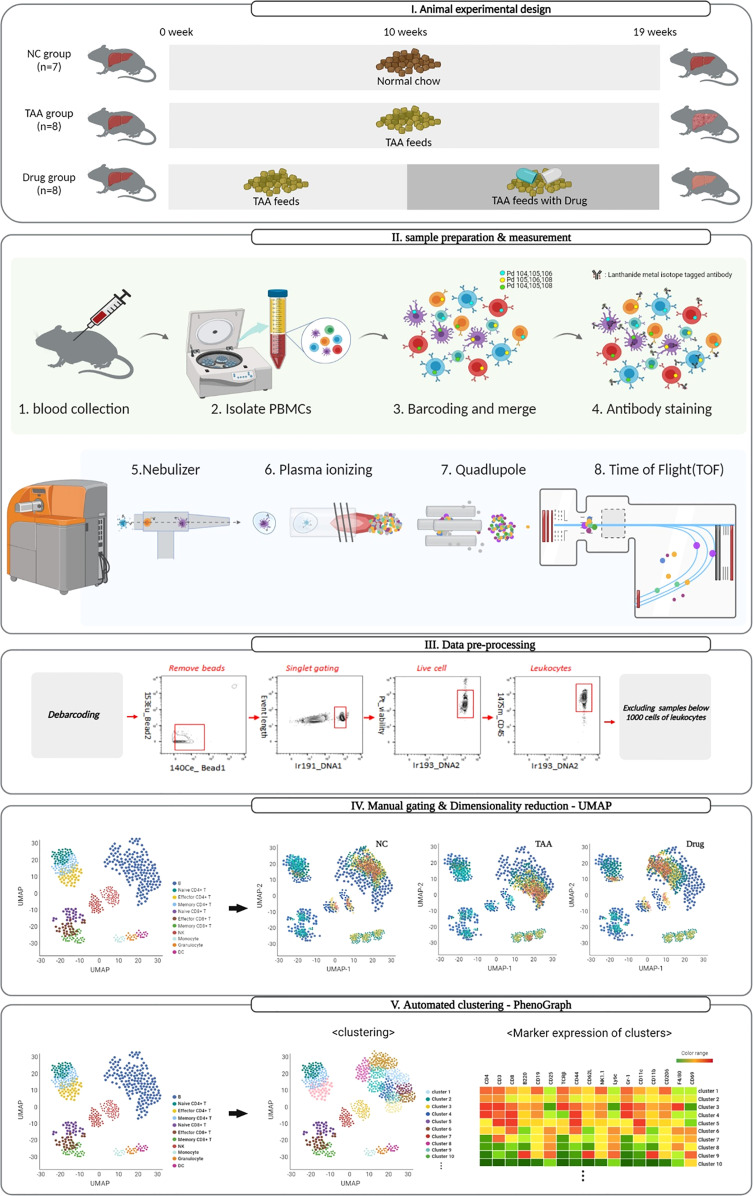
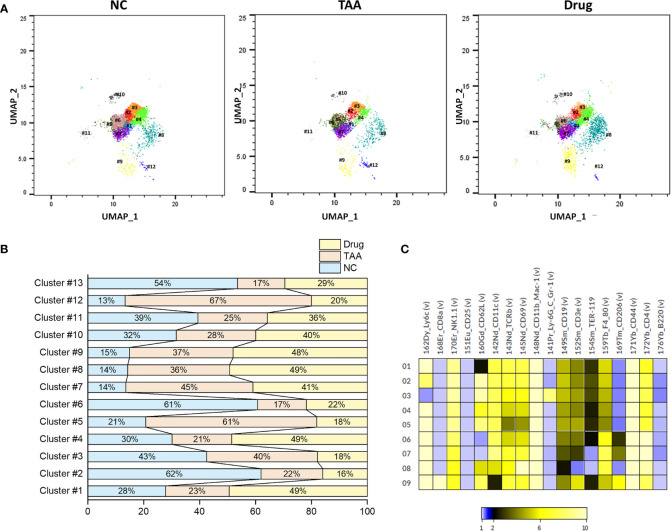
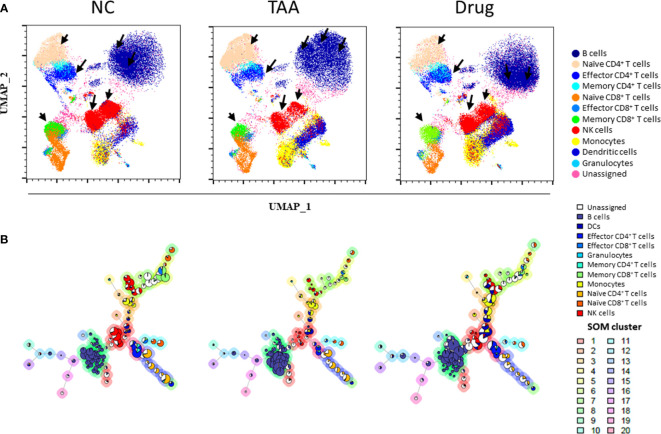
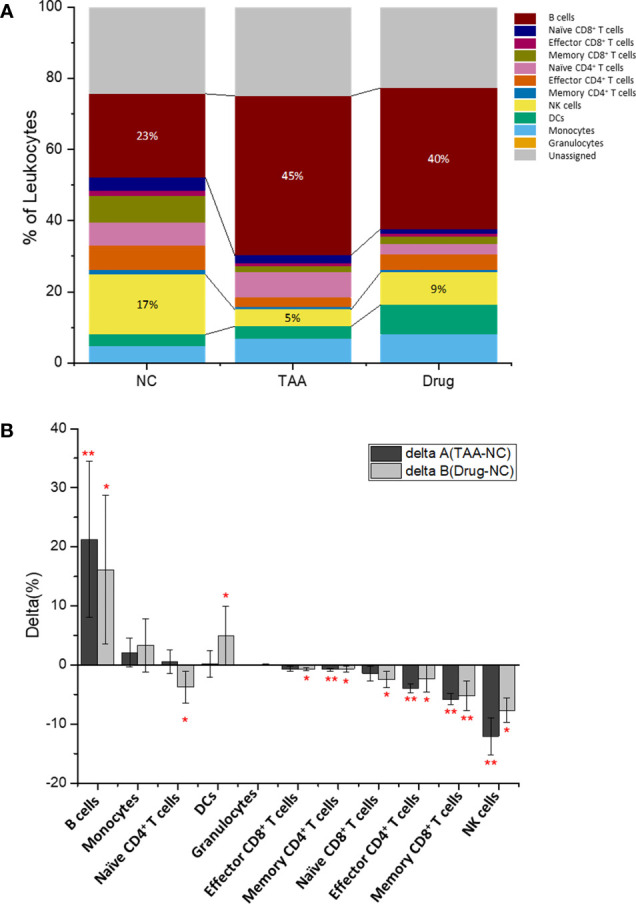
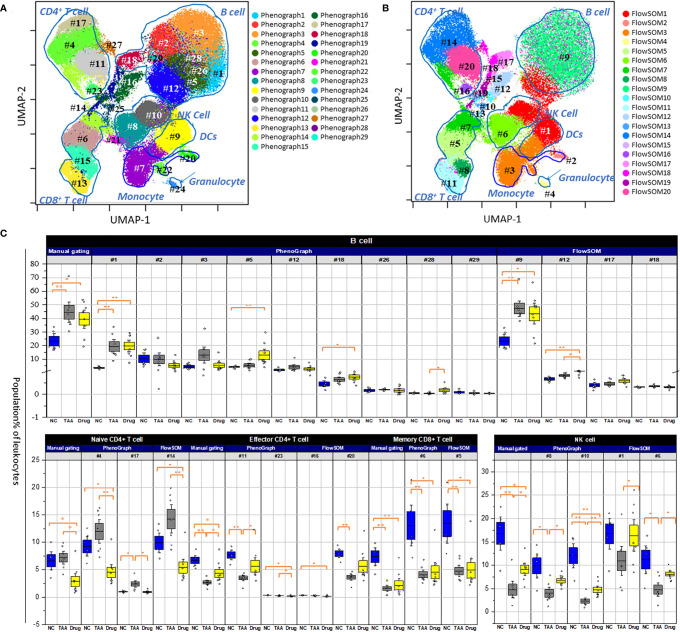
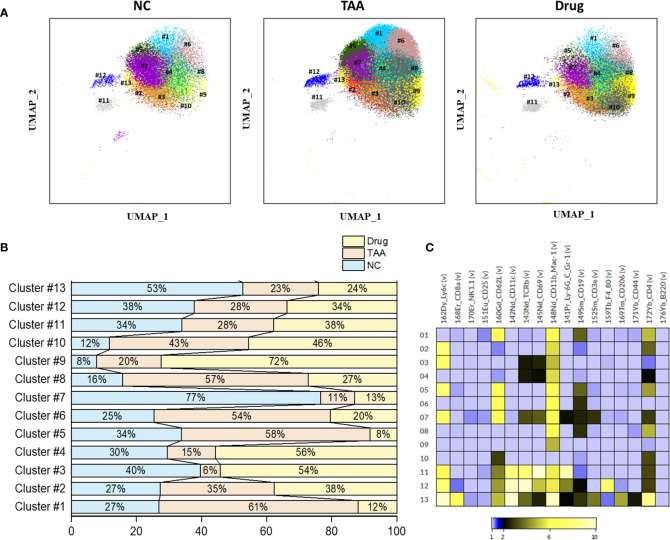
The number of patients with liver diseases has increased significantly with the progress of global industrialization. Hepatic fibrosis, one of the most common liver diseases diagnosed in many developed countries, occurs in response to chronic liver injury and is primarily driven by the development of inflammation. Earlier immunological studies have been focused on the importance of the innate immune response in the pathophysiology of steatohepatitis and fibrosis, but recently, it has also been reported that adaptive immunity, particularly B cells, plays an essential role in hepatic inflammation and fibrosis. However, despite recent data showing the importance of adaptive immunity, relatively little is known about the role of B cells in the pathogenesis of steatohepatitis fibrosis. In this study, a single-cell-based, high-dimensional mass cytometric investigation of the peripheral blood mononuclear cells collected from mice belonging to three groups [normal chow (NC), thioacetamide (TAA), and 11beta-HSD inhibitor drug] was conducted to further understand the pathogenesis of liver fibrosis through reliable noninvasive biomarkers. Firstly, major immune cell types and their population changes were qualitatively analyzed using UMAP dimensionality reduction and two-dimensional visualization technique combined with a conventional manual gating strategy. The population of B cells displayed a twofold increase in the TAA group compared to that in the NC group, which was recovered slightly after treatment with the 11beta-HSD inhibitor drug. In contrast, the populations of NK cells, effector CD4 T cells, and memory CD8 T cells were significantly reduced in the TAA group compared with those in the NC group. Further identification and quantification of the major immune cell types and their subsets were conducted based on automated clustering approaches [PhenoGraph (PG) and FlowSOM]. The B-cell subset corresponding to PhenoGraph cluster PG#2 (CD62LCD44Ly6c B cells) and PG#3 (CD62LCD44Ly6c B cell) appears to play a major role in both the development of hepatic fibrosis and recovery treatment, whereas PG#1 (CD62LCD44Ly6c B cell) seems to play a dominant role in the development of hepatic fibrosis. These findings provide insights into the roles of cellular subsets of B cells during the progression of, and recovery from, hepatic fibrosis.
随着全球工业化的进步,肝脏疾病患者的数量显著增加。肝纤维化是许多发达国家诊断出的最常见的肝脏疾病之一,它是对慢性肝损伤的反应,主要由炎症的发展驱动。早期的免疫学研究集中在固有免疫反应在脂肪性肝炎和纤维化的病理生理学中的重要性,但最近也有报道称,适应性免疫,特别是 B 细胞,在肝炎症和纤维化中发挥着重要作用。然而,尽管最近的数据表明了适应性免疫的重要性,但人们对 B 细胞在脂肪性肝炎纤维化发病机制中的作用知之甚少。在这项研究中,通过单细胞、高维质量细胞计数分析,对来自三组小鼠(正常饮食组(NC)、硫代乙酰胺组(TAA)和 11β-HSD 抑制剂药物组)的外周血单核细胞进行了研究,以通过可靠的非侵入性生物标志物进一步了解肝纤维化的发病机制。首先,使用 UMAP 降维和二维可视化技术结合传统的手动门控策略,对主要免疫细胞类型及其群体变化进行了定性分析。与 NC 组相比,TAA 组的 B 细胞群体增加了两倍,用 11β-HSD 抑制剂药物治疗后略有恢复。相比之下,TAA 组的 NK 细胞、效应性 CD4 T 细胞和记忆性 CD8 T 细胞群体明显低于 NC 组。然后,基于自动化聚类方法(PhenoGraph(PG)和 FlowSOM)对主要免疫细胞类型及其亚群进行了进一步的鉴定和量化。与 PhenoGraph 聚类 PG#2(CD62LCD44Ly6c B 细胞)和 PG#3(CD62LCD44Ly6c B 细胞)对应的 B 细胞亚群似乎在肝纤维化的发展和恢复治疗中都起着主要作用,而 PG#1(CD62LCD44Ly6c B 细胞)似乎在肝纤维化的发展中起着主要作用。这些发现为 B 细胞细胞亚群在肝纤维化的进展和恢复过程中的作用提供了新的认识。