Molla Mulugeta, Kebede Fassikaw, Kebede Tsehay, Haile Assefa
Pharmacology and Toxicology Unit, Department of Pharmacy, College of Health Sciences, Debre Tabor University, Debre Tabor, Ethiopia.
Department of Epidemiology and Biostatistics, School of Public Health, College of Health Science, Woldia University, Woldia, Ethiopia.
Int J Pediatr. 2022 Feb 17;2022:1046220. doi: 10.1155/2022/1046220. eCollection 2022.
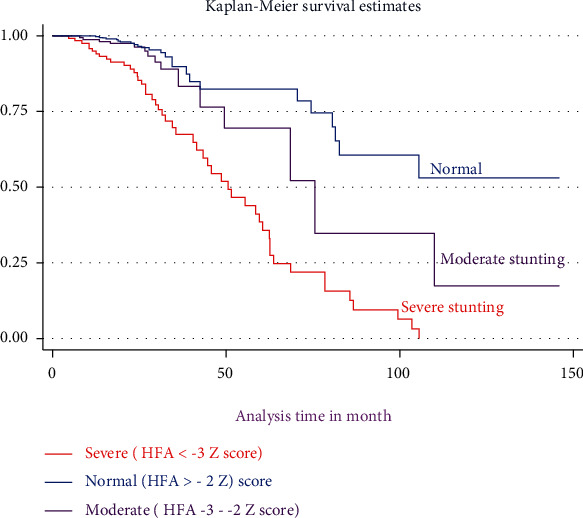
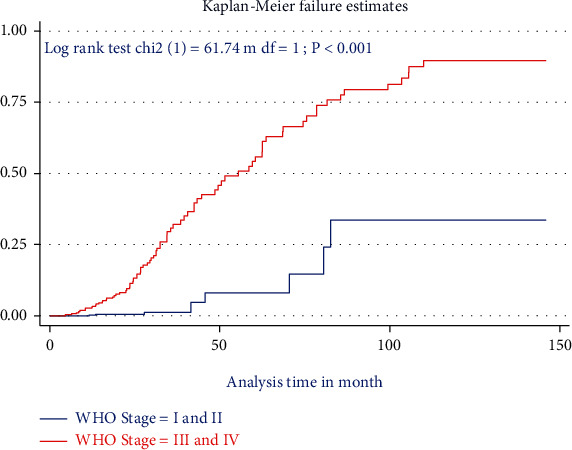
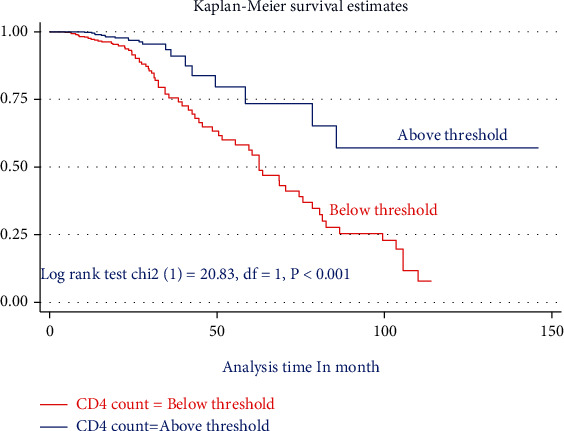
Malnutrition and human immunodeficiency virus/acquired immunodeficiency syndrome have complex and multidirectional relationships. Ethiopia is one of the countries hardest hit by the HIV epidemic as well as malnutrition. This study was aimed at assessing the effects of undernutrition on the survival status of HIV-positive children who received HIV/AIDS care in Northwest Ethiopia. . A facility-based retrospective follow-up was conducted from January 1, 2009, to December 31, 2020. The data was entered into EpiData version 4.2.0. Then, the entered data was exported to STATA 14 software for further analysis, and the Kaplan-Meier survival curve was used to estimate survival time after the initiation of ART. The Bivariable and multivariable Cox regression analyses were conducted to identify predictors of mortality associated with undernutrition. . The mean (±SD) age of participant children was found 118.4 (±38.24) months. The overall mortality rate in this study was determined as 5.4 per 100 child-years (95% CI: 3.6, 5.8). Children with CD4 cell counts below the threshold [AHR = 1.6; 95% CI (1.19, 7.85)], advanced WHO clinical stages (III and IV) HIV [AHR = 4.5; 95% CI (2.80, 8.40)], and being severe stunting at the beginning [AHR = 2.9; 95% CI (1.80, 6.40)] were significantly associated with mortality of HIV-positive children. . The findings of the current study indicated that HIV-positive children on ART had a high rate of mortality. Baseline undernutrition has the mortality of children who had CD4 counts below a threshold, advanced WHO HIV clinical staging (III and IV), and being severe stunting (HAZ ≤ -3 Z score) which were found to be independent predictors for mortality of undernourished HIV.
营养不良与人类免疫缺陷病毒/获得性免疫缺陷综合征存在复杂的多向关系。埃塞俄比亚是受艾滋病毒流行和营养不良影响最严重的国家之一。本研究旨在评估营养不良对在埃塞俄比亚西北部接受艾滋病毒/艾滋病护理的艾滋病毒阳性儿童生存状况的影响。从2009年1月1日至2020年12月31日进行了一项基于机构的回顾性随访。数据录入EpiData 4.2.0版本。然后,将录入的数据导出到STATA 14软件进行进一步分析,并使用Kaplan-Meier生存曲线估计开始抗逆转录病毒治疗后的生存时间。进行双变量和多变量Cox回归分析以确定与营养不良相关的死亡预测因素。研究发现参与儿童的平均(±标准差)年龄为118.4(±38.24)个月。本研究的总体死亡率确定为每100儿童年5.4例(95%置信区间:3.6,5.8)。CD4细胞计数低于阈值的儿童[AHR = 1.6;95%置信区间(1.19,7.85)]、世界卫生组织艾滋病毒临床晚期阶段(III和IV期)[AHR = 4.5;95%置信区间(2.80,8.40)]以及开始时严重发育迟缓[AHR = 2.9;95%置信区间(1.80,6.40)]与艾滋病毒阳性儿童的死亡率显著相关。本研究结果表明,接受抗逆转录病毒治疗的艾滋病毒阳性儿童死亡率很高。基线营养不良使CD4计数低于阈值、世界卫生组织艾滋病毒临床晚期阶段(III和IV期)以及严重发育迟缓(身高别年龄Z评分≤ -3)的儿童死亡,这些被发现是营养不良艾滋病毒感染者死亡的独立预测因素。