Faculty of Public Health; Department of Health Policy and Management, Jimma University, Jimma, Ethiopia.
PLoS One. 2020 Mar 12;15(3):e0229883. doi: 10.1371/journal.pone.0229883. eCollection 2020.
Malnutrition especially undernutrition is the main problem that is seen over people living with HIV/AIDS and can occur at any age. Multiple factors contributed to undernutrition of HIV/AIDS patients and it need immediate identification and prompt action. The objective of this study was to assess the nutritional status of patients and identify factors associated with undernutrition among HIV/AIDS patients on follow-up care in Jimma medical center, Southwest Ethiopia.
A cross-sectional study design was conducted from March-April 2016. Data were collected retrospectively from clinical records of HIV/AIDS patients enrolled for follow up care in ART clinic from June 2010 to January 2016. Bivariate and multivariate logistic regression analysis were performed to identify independent predictor of undernutrition.
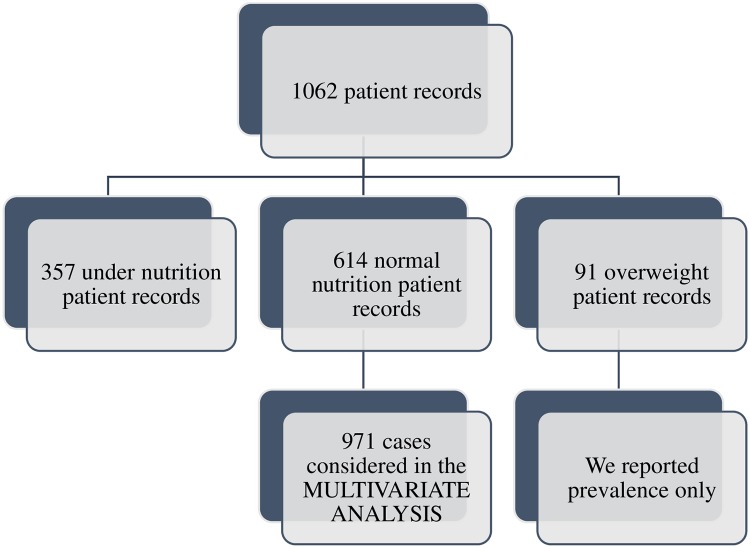
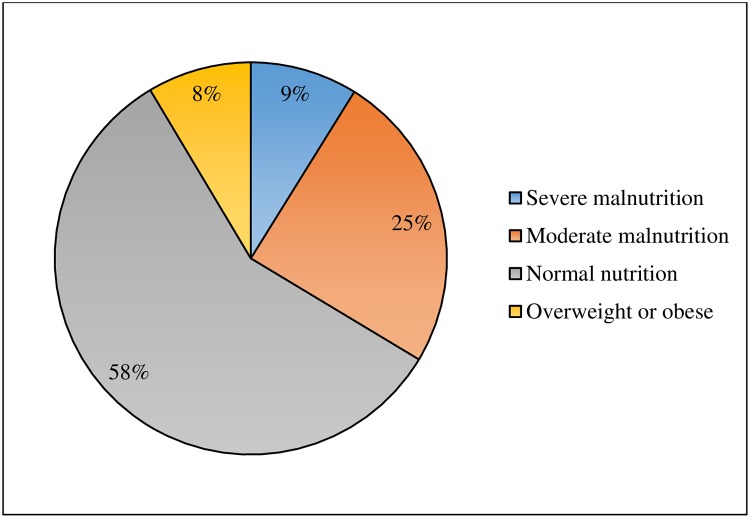
Data of 1062 patients were included in the study. The prevalence of undernutrition (BMI<18.5 kg/m2) and overweight or obesity were 34% and 9%, respectively. Out of undernourished patients, severely malnourished patients (BMI<16 kg/m2) accounted of 9%. Undernutrition was more likely among widowed patients (AOR = 1.7, 95% CI, 1.03-2.79), patients with no access to water supply (AOR = 1.69, 95% CI, 1.16-2.47) and patients in the WHO clinical stage of three (AOR = 2.0, 95% CI, 1.33-2.97) and four (AOR = 3.0, 95% CI, 1.74-5.07). Moreover, the odds of undernutrition was more likely among patients with CD4 cell count of <200 cells/mm3 (AOR = 2.0, 95% CI, 1.38-2.47) and patients with a functional status of bedridden (AOR = 3.6, 95% CI, 1.55-8.35) and ambulatory (AOR = 2.4, 95% CI, 1.66-3.51), respectively.
Both undernutrition and overweight or obesity were prevalent among HIV/AIDS patients in Jimma Medical Center, Ethiopia. Undernutrition was significantly associated with clinical outcome of patients. Hence, nutritional assessment, care and support should be strengthened. Critical identification of malnourished patients and prompt interventions should be undertaken.
营养不良,尤其是营养不足,是艾滋病病毒感染者和艾滋病患者面临的主要问题,可发生于任何年龄段。多种因素导致艾滋病病毒感染者/艾滋病患者发生营养不足,需要及时识别并迅速采取行动。本研究旨在评估吉姆马医疗中心艾滋病病毒感染者/艾滋病患者的营养状况,并确定与营养不足相关的因素。
这是一项 2016 年 3 月至 4 月进行的横断面研究。研究数据来自 2010 年 6 月至 2016 年 1 月期间在抗逆转录病毒治疗门诊接受随访的艾滋病病毒感染者的临床记录。采用单变量和多变量逻辑回归分析来确定营养不足的独立预测因素。
本研究共纳入 1062 例患者。营养不良(BMI<18.5kg/m2)和超重或肥胖的患病率分别为 34%和 9%。在营养不良患者中,严重营养不良(BMI<16kg/m2)患者占 9%。丧偶患者(AOR=1.7,95%CI,1.03-2.79)、无法获得供水的患者(AOR=1.69,95%CI,1.16-2.47)和世界卫生组织临床分期为 3 期(AOR=2.0,95%CI,1.33-2.97)和 4 期(AOR=3.0,95%CI,1.74-5.07)的患者更有可能出现营养不足。此外,CD4 细胞计数<200 个/mm3(AOR=2.0,95%CI,1.38-2.47)和卧床(AOR=3.6,95%CI,1.55-8.35)或行动不便(AOR=2.4,95%CI,1.66-3.51)的患者营养不足的可能性更大。
在埃塞俄比亚吉姆马医疗中心,艾滋病病毒感染者/艾滋病患者中存在营养不良和超重/肥胖两种情况。营养不足与患者的临床结局显著相关。因此,应加强营养评估、护理和支持。应仔细识别营养不良患者并及时进行干预。