Bie Fenglong, Tian He, Sun Nan, Zang Ruochuan, Zhang Moyan, Song Peng, Liu Lei, Peng Yue, Bai Guangyu, Zhou Bolun, Gao Shugeng
Department of Thoracic Surgery, National Cancer Center/National Clinical Research Center for Cancer/Cancer Hospital, Chinese Academy of Medical Sciences and Peking Union Medical College, Beijing, China.
State Key Laboratory of Molecular Oncology, National Cancer Center/National Clinical Research Center for Cancer/Cancer Hospital, Chinese Academy of Medical Sciences and Peking Union Medical College, Beijing, China.
Front Oncol. 2022 Feb 9;12:769124. doi: 10.3389/fonc.2022.769124. eCollection 2022.
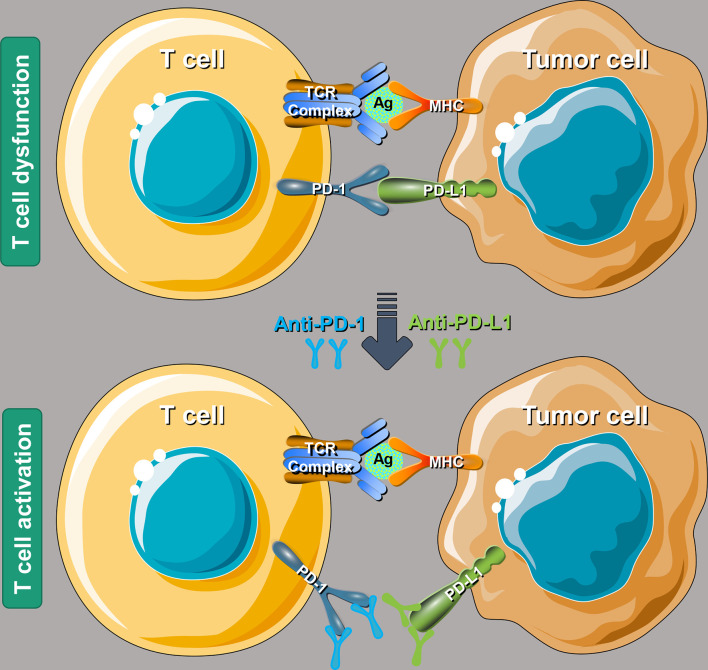
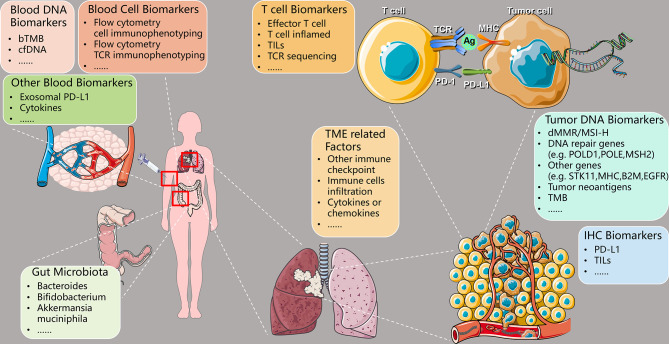
Programmed cell death-1 (PD-1)/programmed death-ligand 1 (PD-L1) is an important pair of immune checkpoints (IC), which play an essential role in the immune escaping process of tumors. Anti-PD-1/PD-L1 immunotherapy can block the suppression effect of the immune system produced by tumor cells through the PD-1/PD-L1 axis and restore the pernicious effect of the immune system on tumor cells. The specific mechanism of anti-PD-1/PD-L1 immunotherapy is closely related to PI3K (phosphatidylinositol 3-kinase)/AKT (AKT serine/threonine kinase 1), JNK (c-Jun N-terminal kinase), NF-kB (nuclear factor-kappa B subunit 1), and other complex signaling pathways. Patients receiving anti-PD-1/PD-L1 immunotherapy are prone to drug resistance. The mechanisms of drug resistance mainly include weakening recognition of tumor antigens by immune cells, inhibiting activation of immune cells, and promoting the production of suppressive immune cells and molecules. Anti-PD-1/PD-L1 immunotherapy plays a vital role in non-small cell lung cancer (NSCLC). It is essential to find better efficacy prediction-related biomarkers and screen patients suitable for immunotherapy. At present, common biomarkers related to predicting immune efficacy mainly include PD-L1 expression level in tumors, tumor mutation burden (TMB), microsatellite instability (MSI)/mismatch repair (MMR), mutations of driver gene, etc. However, the screening efficacy of each indicator is not ideal, and the combined application of multiple indicators is currently used. This article comprehensively reviews anti-PD-1/PD-L1 immunotherapy-related mechanisms, drug resistance-related mechanisms, and therapeutic efficacy-related predictive biomarkers.
程序性细胞死亡蛋白1(PD-1)/程序性死亡配体1(PD-L1)是重要的一对免疫检查点,在肿瘤免疫逃逸过程中发挥着关键作用。抗PD-1/PD-L1免疫疗法可通过PD-1/PD-L1轴阻断肿瘤细胞对免疫系统产生的抑制作用,并恢复免疫系统对肿瘤细胞的杀伤作用。抗PD-1/PD-L1免疫疗法的具体机制与磷脂酰肌醇3激酶(PI3K)/AKT(AKT丝氨酸/苏氨酸激酶1)、JNK(c-Jun氨基末端激酶)、NF-κB(核因子κB亚基1)等复杂信号通路密切相关。接受抗PD-1/PD-L1免疫疗法的患者容易产生耐药性。耐药机制主要包括免疫细胞对肿瘤抗原的识别减弱、免疫细胞激活受到抑制以及促进抑制性免疫细胞和分子的产生。抗PD-1/PD-L1免疫疗法在非小细胞肺癌(NSCLC)中起着至关重要的作用。寻找更好的疗效预测相关生物标志物并筛选适合免疫疗法的患者至关重要。目前,与预测免疫疗效相关的常见生物标志物主要包括肿瘤中PD-L1表达水平、肿瘤突变负荷(TMB)、微卫星不稳定性(MSI)/错配修复(MMR)、驱动基因突变等。然而,各指标的筛选效果均不理想,目前多采用多个指标联合应用。本文全面综述了抗PD-1/PD-L1免疫疗法相关机制、耐药相关机制以及治疗疗效相关的预测生物标志物。