School of Government, Institute of Urban Governance, Shenzhen University, Shenzhen, China.
School of Public Administration and Emergency Management, Jinan University, Guangzhou, China.
Front Public Health. 2022 Feb 10;10:820444. doi: 10.3389/fpubh.2022.820444. eCollection 2022.
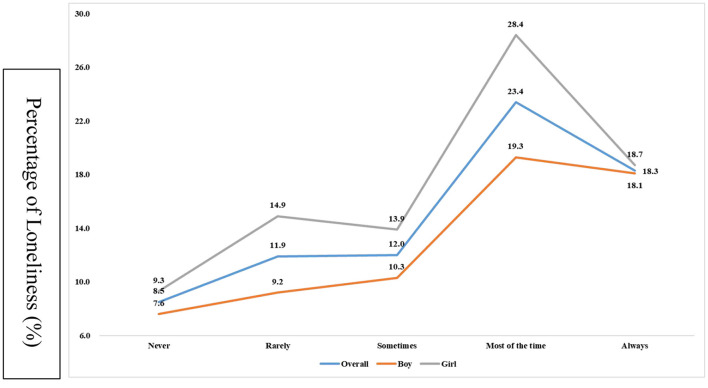
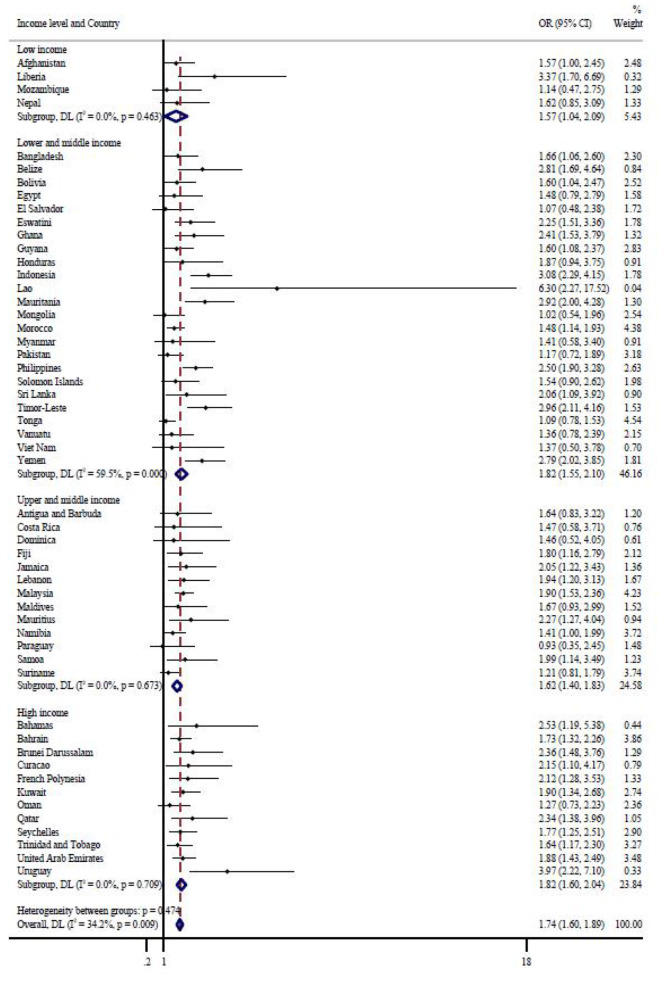
As a proxy measure of socioeconomic status, food insecurity is understudied in mental health-related research. This study aimed to explore the association between food insecurity and loneliness in adolescents. Using cross-sectional data from the Global Student Health Survey (GSHS), 164,993 adolescent participants were included in this study. Food insecurity, loneliness, and other covariates were assessed by self-reported questionnaire. Multivariable logistics regression considering complex survey was used to explore the association between food insecurity and loneliness. The prevalence of loneliness was 10.8% in adolescents. With higher levels of food insecurity, the prevalence of loneliness in general increased, but "most of the time" was the most frequently reported item in terms of food insecurity. Adolescents who reported severe food insecurity had significantly greater odds for loneliness: (1) being most of the time [odd ratio (OR) = 2.54, 95% CI = 2.13-3.02]; (2) always hungry (OR = 1.97, 95% CI = 1.55-2.51). Of all the 53 countries, adolescents from 39 countries reported significantly higher prevalence of loneliness when exposed to food insecurity. The pooled OR was 1.74 (1.60-1.89) with a negligible heterogeneity (higher I-squared was 34.2%). Adolescents with food insecurity were more likely to be exposed to be lonely. Eliminating socioeconomic disparities in adolescents might be a good approach to promote mental health in adolescents. Future studies are encouraged to utilize longitudinal studies to confirm or negate our study findings.
作为社会经济地位的替代指标,粮食不安全在心理健康相关研究中研究不足。本研究旨在探讨粮食不安全与青少年孤独感之间的关系。本研究使用全球学生健康调查(GSHS)的横断面数据,共纳入 164993 名青少年参与者。通过自我报告问卷评估粮食不安全、孤独感和其他协变量。采用考虑复杂调查的多变量逻辑回归探讨粮食不安全与孤独感之间的关系。青少年孤独感的患病率为 10.8%。随着粮食不安全程度的升高,一般孤独感的患病率也随之升高,但在粮食不安全方面,“大多数时候”是报告频率最高的项目。报告严重粮食不安全的青少年发生孤独感的可能性显著增加:(1)大多数时候[比值比(OR)=2.54,95%可信区间(CI)=2.13-3.02];(2)总是感到饥饿(OR=1.97,95%CI=1.55-2.51)。在所有 53 个国家中,有 39 个国家的青少年在面临粮食不安全时报告的孤独感发生率显著更高。汇总 OR 为 1.74(1.60-1.89),异质性较小(较高的 I 平方值为 34.2%)。有粮食不安全的青少年更有可能感到孤独。消除青少年中的社会经济差距可能是促进青少年心理健康的一个很好的方法。鼓励未来的研究利用纵向研究来证实或否定我们的研究结果。