Department of Vascular Surgery, Union Hospital, Tongji Medical College, Huazhong University of Science and Technology, Wuhan, China.
Clinic Center of Human Gene Research, Union Hospital, Tongji Medical College, Huazhong University of Science and Technology, Wuhan, China.
Front Public Health. 2022 Feb 11;10:833967. doi: 10.3389/fpubh.2022.833967. eCollection 2022.
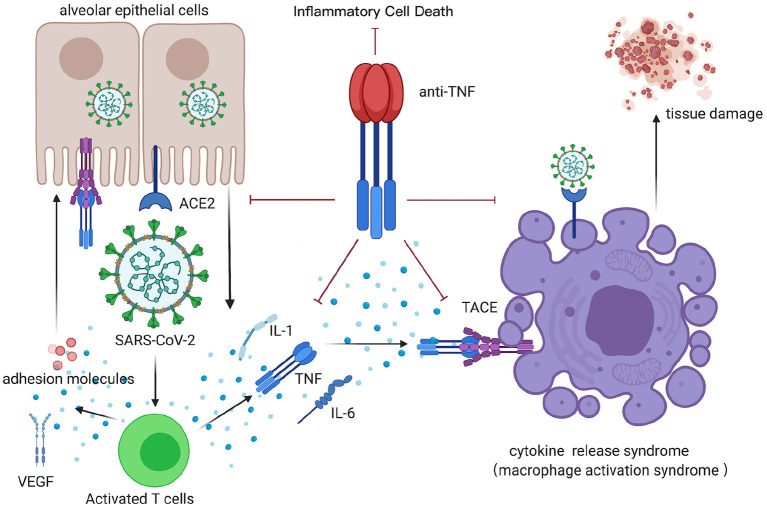
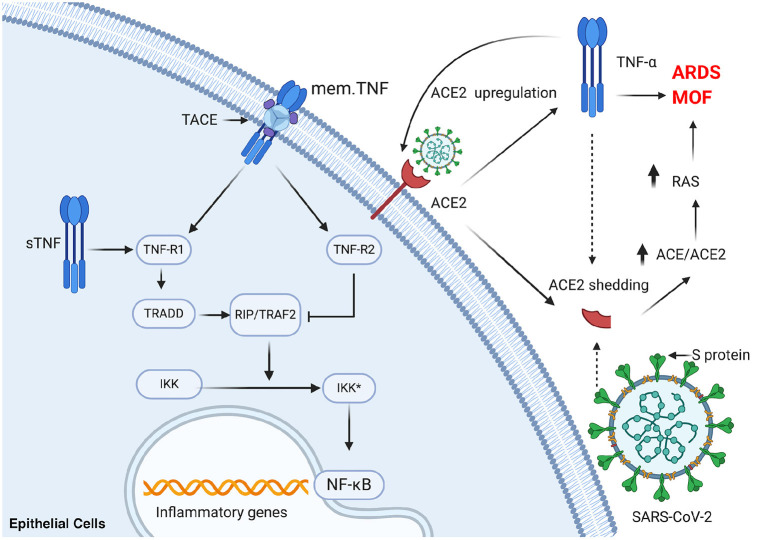
Recent advances in the pathophysiologic understanding of coronavirus disease 2019 (COVID-19) suggests that cytokine release syndrome (CRS) has an association with the severity of disease, which is characterized by increased tumor necrosis factor α (TNF-α), interleukin (IL)-6, IL-2, IL-7, and IL-10. Hence, managing CRS has been recommended for rescuing severe COVID-19 patients. TNF-α, one of the pro-inflammatory cytokines commonly upregulated in acute lung injury, triggers CRS and facilitates SARS-CoV-2 interaction with angiotensin-converting enzyme 2 (ACE2). TNF-α inhibitors, therefore, may serve as an effective therapeutic strategy for attenuating disease progression in severe SARS-CoV-2 infection. Below, we review the possibilities and challenges of targeting the TNF-α pathway in COVID-19 treatment.
新型冠状病毒病 2019(COVID-19)的病理生理学理解的最新进展表明,细胞因子释放综合征(CRS)与疾病的严重程度有关,其特征是肿瘤坏死因子 α(TNF-α)、白细胞介素(IL)-6、IL-2、IL-7 和 IL-10 增加。因此,建议管理 CRS 以抢救重症 COVID-19 患者。TNF-α 是急性肺损伤中常见的上调的促炎细胞因子之一,可引发 CRS,并促进 SARS-CoV-2 与血管紧张素转换酶 2(ACE2)的相互作用。因此,TNF-α 抑制剂可能是减轻严重 SARS-CoV-2 感染疾病进展的有效治疗策略。在下面,我们回顾了在 COVID-19 治疗中靶向 TNF-α 途径的可能性和挑战。