Schlichtner Stephanie, Yasinska Inna M, Ruggiero Sabrina, Berger Steffen M, Aliu Nijas, Prunk Mateja, Kos Janko, Meyer N Helge, Gibbs Bernhard F, Fasler-Kan Elizaveta, Sumbayev Vadim V
Medway School of Pharmacy, Universities of Kent and Greenwich, Chatham Maritime, United Kingdom.
Department of Pediatric Surgery, Children's Hospital, Inselspital Bern, University of Bern, Bern, Switzerland.
Front Med (Lausanne). 2022 Feb 10;9:790995. doi: 10.3389/fmed.2022.790995. eCollection 2022.
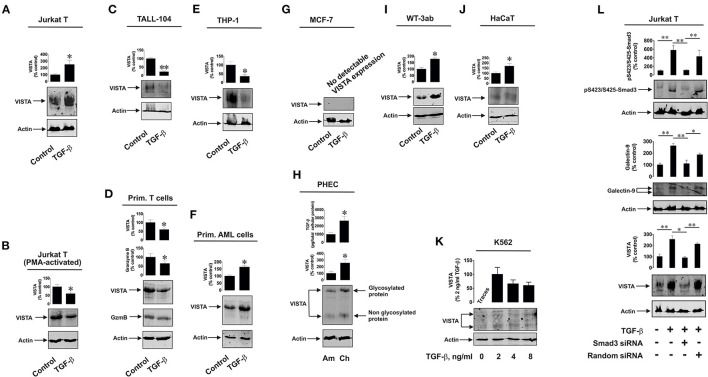
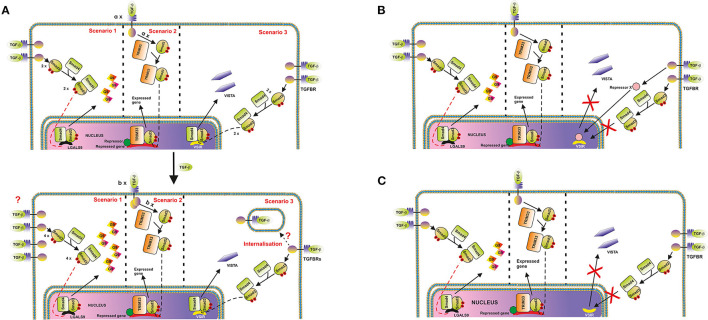
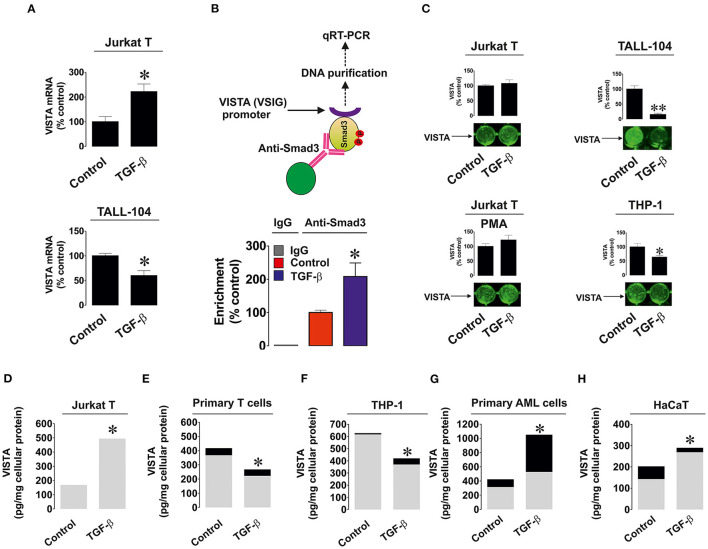
Immune checkpoint proteins play crucial roles in human embryonic development but are also used by cancer cells to escape immune surveillance. These proteins and biochemical pathways associated with them form a complex machinery capable of blocking the ability of cytotoxic immune lymphoid cells to attack cancer cells and, ultimately, to fully suppress anti-tumor immunity. One of the more recently discovered immune checkpoint proteins is V-domain Ig-containing suppressor of T cell activation (VISTA), which plays a crucial role in anti-cancer immune evasion pathways. The biochemical mechanisms underlying regulation of VISTA expression remain unknown. Here, we report for the first time that VISTA expression is controlled by the transforming growth factor beta type 1 (TGF-β)-Smad3 signaling pathway. However, in T lymphocytes, we found that VISTA expression was differentially regulated by TGF-β depending on their immune profile. Taken together, our results demonstrate the differential biochemical control of VISTA expression in human T cells and various types of rapidly proliferating cells, including cancer cells, fetal cells and keratinocytes.
免疫检查点蛋白在人类胚胎发育中发挥关键作用,但癌细胞也利用它们逃避免疫监视。这些蛋白及其相关的生化途径构成了一个复杂的机制,能够阻断细胞毒性免疫淋巴细胞攻击癌细胞的能力,并最终完全抑制抗肿瘤免疫。最近发现的免疫检查点蛋白之一是含V结构域免疫球蛋白的T细胞激活抑制因子(VISTA),它在抗癌免疫逃逸途径中起关键作用。VISTA表达调控的生化机制尚不清楚。在此,我们首次报道VISTA表达受转化生长因子β1(TGF-β)-Smad3信号通路控制。然而,在T淋巴细胞中,我们发现VISTA表达受TGF-β的差异调节,这取决于它们的免疫特征。综上所述,我们的结果证明了人类T细胞以及包括癌细胞、胎儿细胞和角质形成细胞在内的各种快速增殖细胞中VISTA表达的差异生化调控。