CRESS, Obstetrical Perinatal and Pediatric Epidemiology Research Team, EPOPé, INSERM, INRA, Université de Paris, Paris, France.
Department of Obstetrics and Gynecology, Antoine Béclère Hospital, AP-HP, University Paris Saclay, Clamart, France.
Acta Obstet Gynecol Scand. 2022 Apr;101(4):405-416. doi: 10.1111/aogs.14335. Epub 2022 Feb 27.
Customized intrauterine growth charts are widely used for growth monitoring and research. They are based on three assumptions: (1) estimated fetal weight (EFW) has a normal distribution with a constant coefficient of variation at all gestational ages; (2) Hadlock's growth curve accurately describes the relation between EFW and gestational ages; (3) associations between EFW and the fetal and maternal characteristics included in the customization model (fetal sex, pre-pregnancy weight, height, parity) are proportional throughout pregnancy. The aim of this study was to test whether these underlying assumptions are verified.
Data came from (1) the French Longitudinal Study of Children (ELFE) cohort, which recruited births after 32 weeks' gestation in 349 maternity hospitals in France in 2011, and (2) the National Perinatal Survey, which included births from all French maternity hospitals in 2016. The study population included, respectively, 6 920 and 8 969 singleton non-malformed term live births with data on customization characteristics and EFW. We computed the coefficient of variation by gestational age and then modeled the association of gestational age, maternal and fetal characteristics with EFW at the second and third trimester ultrasound and with birthweight using linear regression. To assess the proportionality of the impact of maternal and fetal characteristics, we computed the percent change in weight associated with these characteristics at these three time points.
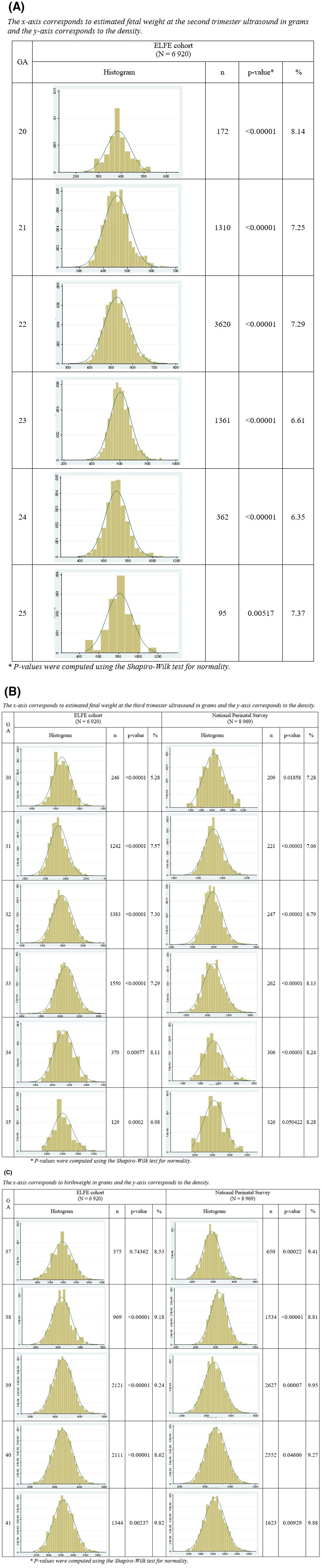
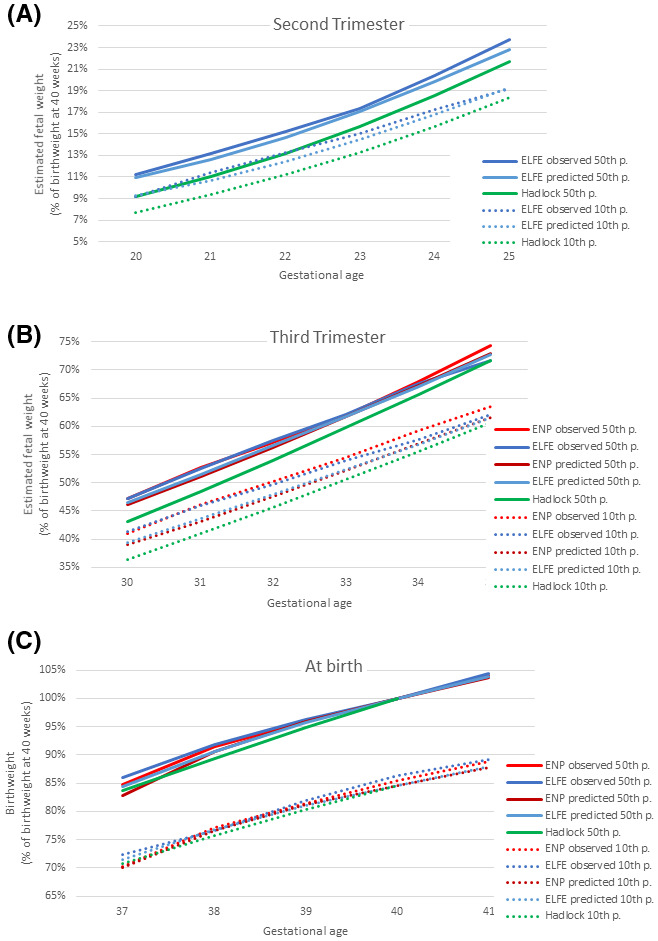
The coefficient of variation was close to 12% at each gestational age, but EFW was not normally distributed, leading to small but systematic underestimation of fetuses under the 10th percentile. Weights representing the 50th and 10th percentiles based on Hadlock's growth trajectory were lower than observed or predicted weights. Most characteristics more strongly impacted weight at birth than during pregnancy. In the French Longitudinal study of Children (ELFE) cohort, boys were 1.8% (95% confidence interval [CI] 1.3-2.4) heavier than girls in the third trimester, whereas this percentage was 4.6% (95% CI 4.0-5.2) at birth. In the National Perinatal Survey, these percentages were 2.3% (95% CI 1.8-2.8) and 4.3% (95% CI 3.8-4.8).
These results from two independent sources revealed discrepancies between routine clinical EFW data used for growth monitoring and the customized growth model's assumptions.
定制的宫内生长图表被广泛用于生长监测和研究。它们基于三个假设:(1)估计胎儿体重(EFW)在所有胎龄具有正态分布和恒定的变异系数;(2)Hadlock 的生长曲线准确描述了 EFW 与胎龄之间的关系;(3)EFW 与定制模型中包含的胎儿和母体特征(胎儿性别、孕前体重、身高、产次)之间的关联在整个孕期呈比例关系。本研究旨在检验这些基本假设是否成立。
数据来自(1)法国儿童纵向研究(ELFE)队列,该队列于 2011 年在法国 349 家产科医院招募了 32 周以上分娩的婴儿;(2)全国围产期调查,该调查包括 2016 年所有法国产科医院的分娩。研究人群分别包括 6920 例和 8969 例无畸形足月活产的单胎,有定制特征和 EFW 数据。我们按胎龄计算变异系数,然后使用线性回归模型分析胎龄、母体和胎儿特征与第二次和第三次超声 EFW 以及与出生体重的关系。为了评估母体和胎儿特征的影响比例,我们计算了这些特征在三个时间点与体重相关的百分比变化。
在每个胎龄,变异系数接近 12%,但 EFW 呈非正态分布,导致第 10 百分位数以下的胎儿被低估。基于 Hadlock 生长轨迹的代表第 50 和第 10 百分位数的体重低于观察到的或预测到的体重。大多数特征对出生体重的影响大于对孕期体重的影响。在法国儿童纵向研究(ELFE)队列中,男孩在孕晚期比女孩重 1.8%(95%置信区间 [CI] 1.3-2.4),而这一比例在出生时为 4.6%(95% CI 4.0-5.2)。在全国围产期调查中,这两个比例分别为 2.3%(95% CI 1.8-2.8)和 4.3%(95% CI 3.8-4.8)。
这两个独立来源的结果显示,常规临床 EFW 数据用于生长监测与定制生长模型的假设之间存在差异。